Tag Archives: thankfulness

Our days are not filled with things we like.

Today, I just want to share excerpts from Fr. Stephen Freeman’s article, Thanksgiving as Mystical Communion:

“In one form or another, we divide the world into light and dark. It might take the form, ‘I like this. I do not like that.’ What we find easy are the things we see as good and the things we like. If a day is filled with such things, we are likely to be happy…. Of course, our days are not filled with good things that we like.”

“The modern myth is bound up with the ‘better world,’ the notion that through proper management and applications of science and technology (and all of the so-called ‘sciences’), we can make the world a better place – meaning that we will be able to eliminate the negative and maximize our pleasure. Pleasure is equated with the good, while suffering is seen as inherently bad. Modernity seeks to turn the world into a candy store (without diabetes).”

“My continuing critique of modernity has nothing to do with technology, medicine, science, etc. None of those things are ‘modern’ in and of themselves. Modernity is a set of ideas, not a time in history. One of its most subtle bits of propaganda is to pass itself off as a historical period, and, even, as the inevitable outcome of everything that has gone before…. Modernity is propaganda parading as history.

“It is also ungrateful.”

“No doubt, Christians will continue in doing good. However, in spite of every modern mythology, the world will not be a ‘better’ place. Evil things will continue to happen (many of them done in the name of a better world). Modernity, however, cannot bear suffering, which is truly tragic in that suffering is an inevitable part of every life. The modern world’s absence of a meaningful narrative with regard to suffering – other than to eradicate it – perpetuates and cultivates a heart that is frequently unable to be grateful.”

“In every thing give thanks:
for this is the will of God
in Christ Jesus concerning you.”
-I Thessalonians 5:18

“Giving Thanks” by Horace Pippin

To think about the nature of lies.

“A lie seeks to make true something that has no true existence. It is an ‘alternate,’ make-believe universe to the one in which we live. Our desire for alternatives (and our fear of reality) are among the many motivations behind lies. It is revealing, however, to think about the nature of lies (which also reveals the nature of the truth). It is, at the very least, a matter of existence.”

“That which is true, is that which truly exists. As such, it is always its own strongest argument. If it truly exists, it will continue whether I believe in it or not. The truth does not require ideology. This carries the corollary of a lack of anxiety. If the truth abides, whether I believe it or not, then I am not bound to ‘make it so’ through the efforts of a culture war. It is, rather, for me to live it, to give thanks for it, and enjoy its fruit in the world.”

-Father Stephen Freeman, in this article: “‘Make It So!’ vs. ‘Let It Be!'”

A bean. A life.

It’s been a long time since my first posting of the poem below. I thought of it this morning when I was sorting my Painted Lady beans. October is the month to clean up all the leftovers of summer plants and visitors. It probably won’t surprise you to know that little boys left dishes in the playhouse sink!

Last week four helpers came for a long session of work, and the youngest of them washed up those dishes; now I can put them where the winter wind won’t drop leaves and dust and rain on them, when it blows through the paneless windows.

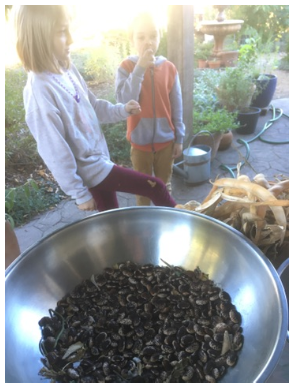
They also finished up tasks relating to those runner beans, removing the last of the vines from the trellis, and shelling the beans into a big bowl.

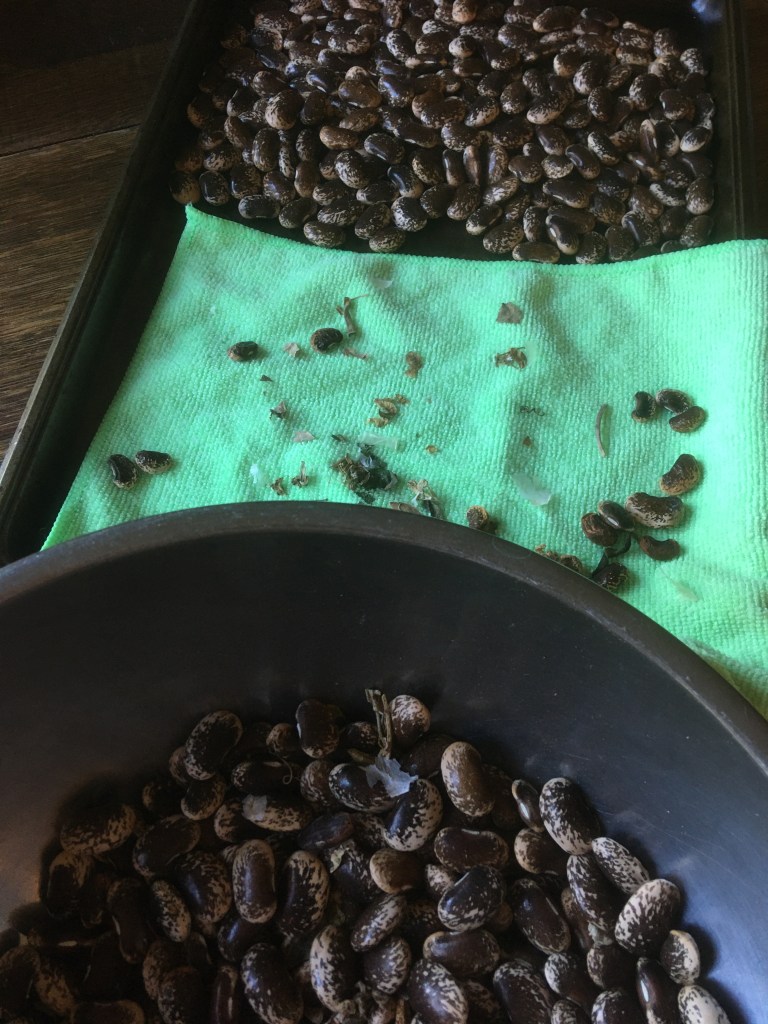
Then it was my turn, to take out the biggest pieces of stem and pod so that the beans could simply be washed when I’m ready to cook them. But no sifter or screen that I could find had the right size holes.

When I was dusting this morning I hit upon the idea of using a microfiber cloth to spread the beans on, thinking it might reach out and grab all of that litter. It worked beautifully. I spread a layer of dirty beans on the cloth, and then moved the beans off, leaving all the detritus behind. The shriveled or undeveloped beans were left with the inedibles.


A WOMAN CLEANING LENTILS

A lentil, a lentil, a lentil, a stone.
A green one, a black one, a green one, a black. A stone.
A lentil, a lentil, a stone, a lentil, a lentil, a word.
Suddenly a word. A lentil.
A lentil, a word, a word next to another word. A sentence.
A word, a word, a word, a nonsense speech.
Then an old song.
Then an old dream.
A life, another life, a hard life. A lentil. A life.
An easy life. A hard life, Why easy? Why hard?
Lives next to each other. A life. A word. A lentil.
A green one, a black one, a green one, a black one, pain.
A green song, a green lentil, a black one, a stone.
A lentil, a stone, a stone, a lentil.

— Zahrad

There is a book we’ve had for years in our parish bookstore, Our Thoughts Determine Our Lives. I might even have it in my house by now, but I haven’t read much of it. One might think its message is similar to “The Power of Positive Thinking,” but it’s not. It’s more like what the Apostle Paul said:

“We demolish arguments and every pretension that sets itself up against the knowledge of God, and we take captive every thought to make it obedient to Christ” (2 Corinthians 10:5).

That book is a collection of teachings from Elder Thaddeus of Vitovnica, such as:

“Our life depends on the kind of thoughts we nurture. If our thoughts are peaceful, calm, meek, and kind, then that is what our life is like. If our attention is turned to the circumstances in which we live, we are drawn into a whirlpool of thoughts and can have neither peace nor tranquility.”

“We need repentance. You see, repentance is not only going to a priest and confessing. We must free ourselves from the obsession of thoughts.”

“Freedom belongs to God. When a person is free from the tyranny of thoughts, that is freedom. When he lives in peace, that is freedom. He is always in prayer, he is always expecting help from the Lord—he listens to his conscience and does his best. We must pray with our whole being, work with our whole being, do everything with our whole being. We must also not be at war with anyone and never take any offense to heart.”

Quietly thinking, letting words come to one’s mind, sorting them out — it sounds like a wholesome and meditative activity. But how many pieces worthy only of the garbage might we find in the bowl of a lifetime — or merely a certain calendar year — stones and shriveled things, and who knows what words and whole tirades and laments that might pop into one’s mind?

When they do, it’s better to grab them, to be like a microfiber cloth. Keep only the beautiful, smooth and thankful legumes on which your soul can feast and grow strong. Every lentil can be like a knot on a prayer rope, bringing the sorter closer to her Lord, Who is her Life.

Healing in all directions.

“There is never a pain as deep as that inflicted by someone who is supposed to love you. Such injuries echo through the years and the generations. The face that stares back at us in the mirror is easily a fractal of someone whose actions power our own insanity. We can hate a parent, only to be haunted by their constant presence in us.”

The first part of Father Stephen Freeman’s post for today, “Every Generation,” is about that dark side of our human connectedness. But the reality of it works positively, also, as we all know, if not from our own families, then from others who might seem to have received a better legacy.

The older I get, the more time I spend considering all of the people who have gone before who have contributed to my physical and/or spiritual well-being. The Orthodox Church trains us in this perspective by bringing us very close to the saints throughout time whose names we do know, and closer to this earthly home, we often remember in our thankful prayers the “founders of this holy temple.”

No doubt the prayers of my Sunday School teachers and other adults protected me as I grew up; the teachers and friends, my parents and grandparents and great-grandparents, aunts and uncles gave me so much, in particular behaviors and actions that must remain in large degree a mystery to us who can only see the outward.

In many cases I’m sure that their gift to their descendants was to struggle… and fail; but having struggled, their defeat was not as much of a failure as it would have been. God only knows how they tried, how hard it was just to keep going day after day. If their minds were ignorant of the significance of their lives to the whole of humanity, they were nevertheless contributing:

“If we inherit a burden within our life, so our salvation, our struggles with that burden, involve not only ourselves but those who have gone before as well as those who come after. We struggle as the ‘Whole Adam’ (in the phrase of St. Silouan).

“There is an Athonite saying: ‘A monk heals his family for seven generations.’ When I first heard this, my thought was, ‘In which direction?’ The answer, I think, is every direction. We are always healing the family tree as we embrace the path of salvation, monk or layman. Our lives are just that connected.”

What does all that have to do with Christ’s mother? In her prophecy Mary said, “All generations shall call me blessed.” There is a lot packed into that statement. As Father Stephen writes:

“In her person we see all generations gathered together. Her ‘be it unto me according to your word’ resounds in the heart of every believer, uniting them to her heart whose flesh unites us to God.”

Read the whole article. I didn’t quote quite all of it! When I started to write this post it was still the Feast of the Dormition of Mary, which is a fitting day to think about these things. Now we have passed liturgically to the next day, but that’s okay, because every day is good to remember family and be thankful.