Tag Archives: thankfulness

Healing in all directions.

“There is never a pain as deep as that inflicted by someone who is supposed to love you. Such injuries echo through the years and the generations. The face that stares back at us in the mirror is easily a fractal of someone whose actions power our own insanity. We can hate a parent, only to be haunted by their constant presence in us.”

The first part of Father Stephen Freeman’s post for today, “Every Generation,” is about that dark side of our human connectedness. But the reality of it works positively, also, as we all know, if not from our own families, then from others who might seem to have received a better legacy.

The older I get, the more time I spend considering all of the people who have gone before who have contributed to my physical and/or spiritual well-being. The Orthodox Church trains us in this perspective by bringing us very close to the saints throughout time whose names we do know, and closer to this earthly home, we often remember in our thankful prayers the “founders of this holy temple.”

No doubt the prayers of my Sunday School teachers and other adults protected me as I grew up; the teachers and friends, my parents and grandparents and great-grandparents, aunts and uncles gave me so much, in particular behaviors and actions that must remain in large degree a mystery to us who can only see the outward.

In many cases I’m sure that their gift to their descendants was to struggle… and fail; but having struggled, their defeat was not as much of a failure as it would have been. God only knows how they tried, how hard it was just to keep going day after day. If their minds were ignorant of the significance of their lives to the whole of humanity, they were nevertheless contributing:

“If we inherit a burden within our life, so our salvation, our struggles with that burden, involve not only ourselves but those who have gone before as well as those who come after. We struggle as the ‘Whole Adam’ (in the phrase of St. Silouan).

“There is an Athonite saying: ‘A monk heals his family for seven generations.’ When I first heard this, my thought was, ‘In which direction?’ The answer, I think, is every direction. We are always healing the family tree as we embrace the path of salvation, monk or layman. Our lives are just that connected.”

What does all that have to do with Christ’s mother? In her prophecy Mary said, “All generations shall call me blessed.” There is a lot packed into that statement. As Father Stephen writes:

“In her person we see all generations gathered together. Her ‘be it unto me according to your word’ resounds in the heart of every believer, uniting them to her heart whose flesh unites us to God.”

Read the whole article. I didn’t quote quite all of it! When I started to write this post it was still the Feast of the Dormition of Mary, which is a fitting day to think about these things. Now we have passed liturgically to the next day, but that’s okay, because every day is good to remember family and be thankful.

Praising with drum and cello.

PSALM

Give thanks for all things
On the plucked lute, and likewise
The harp of ten strings.

Have the lifted horn
Greatly blare, and pronounce it
Good to have been born.

Lend the breath of life
To the stops of the sweet flute
Or capering fife,

And tell the deep drum
To make, at the right juncture,
Pandemonium.

Then, in grave relief,
Praise too our sorrows on the
Cello of shared grief.

-Richard Wilbur

It’s a mistake to rush through this cake.

My friend Timothy told me yesterday that the only people he knows who can truly multi-task are mothers of young children. It’s true, when you are a mother, you often are solving their problems, teaching them, or nurturing their souls more generally even while sweeping the floor or cooking, etc.
But if like me you are often alone and can fully focus on one thing at a time, that is best. One of my favorite quotes on this subject has long been from St. Seraphim of Sarov: “Whatever you do, do it gently and unhurriedly, because virtue is not a pear to be eaten in one bite.” And this morning I read on Lisa’s blog this good word from Fr. Jacques Philippe:

“To live today well we also should remember that God only asks for one thing at a time, never two. It doesn’t matter whether the job we have in hand is sweeping the kitchen floor or giving a speech to forty thousand people. We must put our hearts into it, simply and calmly, and not try to solve more than one problem at a time. Even when what we’re doing is genuinely trifling, it’s a mistake to rush through it as though we felt we were wasting our time. If something, no matter how ordinary, needs to be done and is part of our lives, it’s worth doing for its own sake, and worth putting our hearts into.”

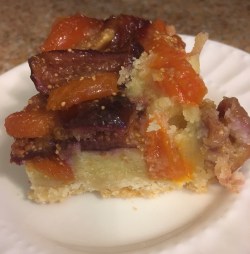
When I read that, I had just finished eating a piece of the most delectable cake — while reading at the computer. Everyone knows that is a bad thing for an overeater to do! But the other unfortunate thing is, I missed the full experience of this cake, which I don’t exactly want to put my heart into, but which I do want to receive “gently and unhurriedly,” in a way that promotes the greatest thankfulness and encourages virtue.

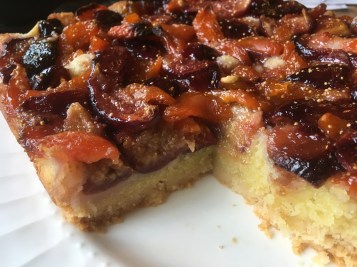
I’d been wanting to try this cake to make use of my fig harvest; I think of it as an autumn cake because it is now that the figs really come in. The recipe is from Martha Stewart, but I combined the figs with dried apricots instead of fresh plums, because I had just bought the wonderfully rich Blenheim apricots from Trader Joe’s, and did not have plums on hand. The apricots were both more flavorful and colorful than plums would have been. Also I cut down on the sugar.

I don’t think I’ve ever had a more buttery cake, but the flavor of butter was even lovelier — is that possible? — by being in combination with the almonds and fruit. As it turns out, the fruit and nuts and eggs are all products of California farms or gardens, and perhaps the butter as well? So mine is a California Cake, but yours might be otherwise.

You start with a cookie-like crust that gets pre-baked, an eggy almond-flour paste spread on top, then the fruit over all, before it goes in the oven again for a long time. I added a little water to the fruit to make up for the apricots being dried. I definitely had to give the whole process my full attention.

AUTUMN FIG CAKE

Trying to warm the butter a bit.

2 sticks unsalted butter, cool room temperature, cut into pieces, plus more for pan
1 pound fresh figs, halved or quartered
6 oz dried apricots, preferably Blenheim variety, sliced
1/4 cup water
1 1/4 cups unbleached all-purpose flour, divided
Almost 1 cup sugar, divided
1 teaspoon salt, divided
1/4 teaspoon baking powder
1 cup finely ground almond flour
2 large eggs, room temperature
1/4 teaspoon pure almond extract

Preheat oven to 350 degrees. Butter a 9-inch square cake pan; line with 2 wide pieces of parchment, leaving a 2-inch overhang on all sides. Butter parchment. Toss fruit with 1/3 cup sugar, and 1/4 teaspoon salt. If you are using dried fruit add the 1/4 cup water; set aside and stir occasionally.

In a food processor, pulse 1 cup all-purpose flour, 1/4 cup sugar, and 1/4 teaspoon salt to combine. Add half of butter and pulse until fine crumbs form. Transfer to prepared cake pan and use floured fingers to press dough evenly into bottom of pan. (If too soft to easily press in, refrigerate 10 minutes.)

Bake until crust is light golden in color, about 20 minutes; transfer to a wire rack and let cool 15 minutes.

In food processor, pulse remaining half of butter, 1/2 cup sugar, and 1/2 teaspoon salt with baking powder until combined. Add almond flour, remaining 1/4 cup all-purpose flour, eggs, and almond extract; process until smooth.

Spread batter evenly over crust. Gently stir fruit to reincorporate sugar mixture and arrange on top of batter (cut-side up). Bake until fruit is bubbling and filling is firm, about 1 hour and 5 minutes (Mine took 10 minutes longer). Let cool in pan 15 minutes, then use parchment overhang to lift cake out of pan and transfer to a wire rack. Let cool 1 hour and serve. Cake can be stored in an airtight container up to 2 days.

Wouldn’t the base of this cake be good with just about any fruit topping? I think it would.

Whatever you make of it, when you do partake,
I hope you can do it with attentive thanksgiving. 🙂

A discipline in pleasure.

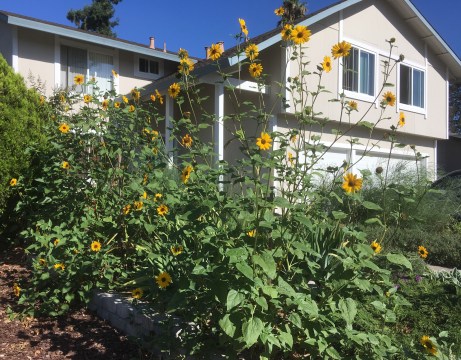
I’m in a good mood, because I cleared the driveway of weeds this morning, and brought sunflowers into the house. My foot feels all better, which had been slightly gimpy merely from wearing sandals instead of boots while gardening last week.
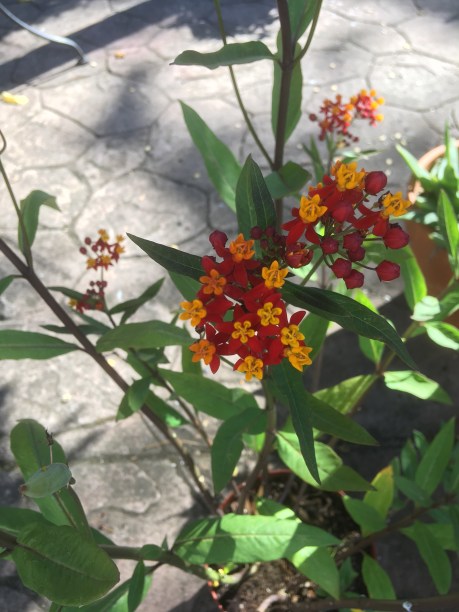
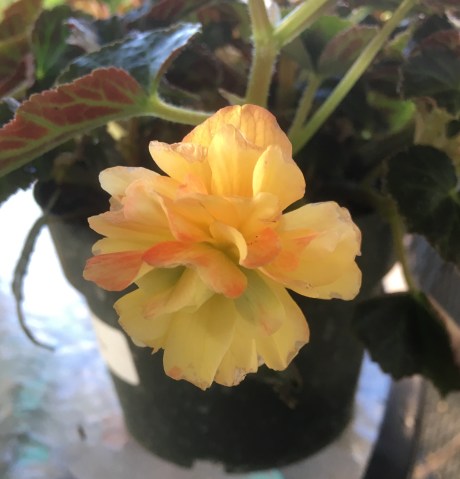
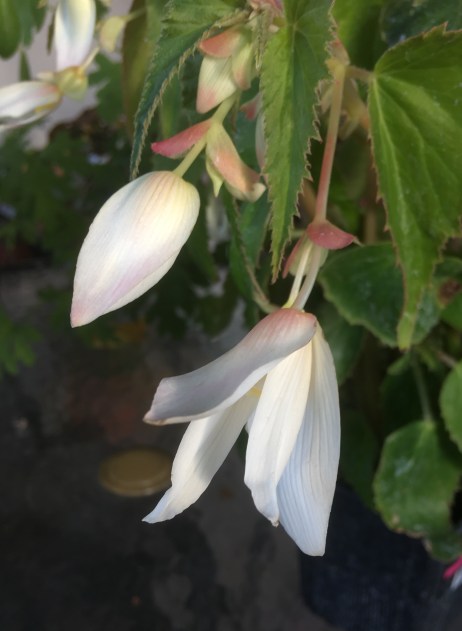
The Monarch caterpillars are thriving on giant leaves of the showy milkweed that I bring to them in their mesh cage almost every day. If they had hatched out on the spindly narrowleaf variety where Mama Monarch had laid the eggs, they’d have run out of food fast. I bought a new tropical milkweed plant when I went shopping for begonias last Sunday, but they don’t seem to care for its leaves. (At the bottom of the page is a milkweed I encountered in the mountains some years ago.)

I’ve been too busy to write good sentences about All The Things. I am trying hard to learn to say NO to myself sometimes: “Remember, Dearest Self, you can’t do ALL the things ALL of the time!” Finally after four months, in the middle of which we think the city lost my application, we got the building permit for my remodeling project that I’ve been preparing for over the last year. It’s taking hours and hours to choose paint and cabinets and faucets and mirrors, and more time to watch caterpillars munch, so naturally there have been fewer hours with which to read, write, and cook.

I don’t know how to apply the principle that wise GKC is telling us about in this quote that I thought was simply lovely when I put it in a draft a while back. The word austerity doesn’t seem to fit with the way I behave, though pleasure and gratitude are the world I live in. I’d like to know what you all think about his twist on these qualities of our existence.


Purification and austerity are even more necessary for the appreciation of life and laughter than for anything else. To let no bird fly past unnoticed, to spell patiently the stones and weeds, to have in the mind a storehouse of sunsets, requires a discipline in pleasure, and an education in gratitude.

-G.K. Chesterton — Twelve Types (1903)