Tag Archives: The Cross

Here it thickens to the limit.

“…what transformed the cross and eternally transforms the cross into victory if not the love of Christ, the same divine love that, as the very essence and glory of the kingdom of God, Christ manifested and granted at the last supper? And where, if not at the last supper, do we find the consummation of the full, complete self-sacrifice of this love, which in ‘this world’ made the cross — betrayal, crucifixion, suffering and death — unavoidable?

“The gospels and the church services, particularly the wonderfully profound services of passion week, witness precisely to this link between the last supper and the cross, to their connection as the manifestation and victory of the kingdom of God. In these services, the last supper is always referred to that night that surrounds it on all sides and in which particularly shines the light of the festival of love that Christ accomplished with his disciples in the ‘large upper room, furnished,’ as if prepared in advance from all ages.

“This was the night of sin, night as the very essence of ‘this world.’ And here it thickens to the limit, it prepares to devour the last light shining in it. Already the ‘princes of the people are assembled together against the Lord and his Christ.’ Already the thirty silver pieces  — the price of betrayal — are paid. Already the crowd, incited by their leaders, armed with swords and spears, are heading out on the road leading to the garden of Gethsemane.
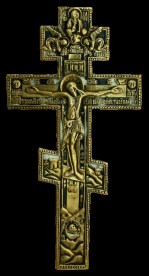
“But — and this is infinitely important for the Church’s understanding of the cross — the last supper itself took place under the shadow of this darkness. Christ knew ‘the hand of him who betrays me is with me on the table’ (Luke 22:21). And it was precisely from the last supper, from its light, that Judas, after taking the morsel (John 13:27) went out into that dreadful night, and soon after him, Christ.

“And if in the services of Holy Thursday, the day of the express commemoration of the last supper, joy is all the time interlaced with sadness, if the Church again and again recalls not only the light but also the darkness overshadowing it, it is because, in the double exits of Judas and Christ from that light into that darkness, she sees and knows the beginning of the cross as the mystery of sin and the mystery of victory over it.”

-Father Alexander Schmemann, The Eucharist

A beautiful Pride, and the Cross.

One day during this week of the Cross, which comes now in the middle of Lent, I drove to the coast. It was cloudy but not as cold as inland. Here the north wind has been blowing, and a different night Susan even built a fire that I was so glad to sit in front of when I came home late. I will write about the beach on my Sea Log eventually, but here I wanted to post pictures of the Pride of Madeira echium that are so abundant out that way in this season.

In the past I’ve mentioned how my late husband and I, celebrating our wedding anniversary in March, often used to spend a night or two at the coast, and it was on those trips that I first encountered this plant. We were always delighted to see it again and again up and down the California seashore, for more than forty years.


It does grow a ways inland, even in my neighborhood, but it seems to prefer the coast. And the botanical cousin that I have in my back yard, called Tower of Jewels, I do not love as much, even if it is more rare. I’ve never seen so many and varied colors and forms as I did this week along one stretch of Highway 1.

I also wanted to share something of the wonderful homily, “In the Days of His Flesh,” which I heard on a podcast. Fr. Patrick Reardon gave this homily on the Sunday of the Cross. But I am too sleepy, so I’ll just leave you with the link, and this little quote from elsewhere:

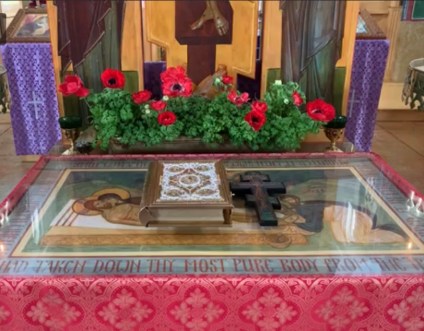
“The cross stands in the midst of the church in the middle of the lenten season not merely to remind men of Christ’s redemption and to keep before them the goal of their efforts, but also to be venerated as that reality by which man must live to be saved.

“‘He who does not take up his cross and follow me is not worthy of me’ (Mt.10:38). For in the Cross of Christ Crucified lies both ‘the power of God and the wisdom of God’ for those being saved (1 Cor.1:24).”

Mosaic is in the apse of the Church of San Clemente in Rome. Prompted by a comment from Jeannette, I have added a larger image showing more of the setting, here at the bottom.

The weakness of God.

From the readings for Holy Friday:

For the message of the cross is foolishness to those who are perishing, but to us who are being saved it is the power of God. For it is written:

“I will destroy the wisdom of the wise,
And bring to nothing the understanding of the prudent.”

Where is the wise? Where is the scribe? Where is the disputer of this age? Has not God made foolish the wisdom of this world? For since, in the wisdom of God, the world through wisdom did not know God, it pleased God through the foolishness of the message preached to save those who believe. For Jews request a sign, and Greeks seek after wisdom; but we preach Christ crucified, to the Jews a stumbling block and to the Greeks foolishness, but to those who are called, both Jews and Greeks, Christ the power of God and the wisdom of God. Because the foolishness of God is wiser than men, and the weakness of God is stronger than men.

For you see your calling, brethren, that not many wise according to the flesh, not many mighty, not many noble, are called. But God has chosen the foolish things of the world to put to shame the wise, and God has chosen the weak things of the world to put to shame the things which are mighty; and the base things of the world and the things which are despised God has chosen, and the things which are not, to bring to nothing the things that are, that no flesh should glory in His presence. But of Him you are in Christ Jesus, who became for us wisdom from God—and righteousness and sanctification and redemption— that, as it is written, “He who glories, let him glory in the Lord.”

-From I Corinthians 1

(Screen shots from Great Vespers, streamed)

Beauty meets death.

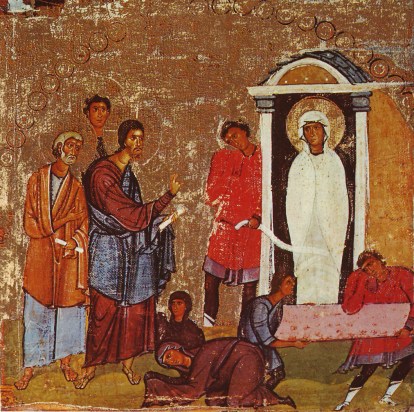
LAZARUS SATURDAY

“’It stinketh,’ say the Jews trying to prevent Jesus from approaching the corpse, and this awful warning applies to the whole world, to all life. God is Life and the Giver of Life. He called man into the Divine reality of Life and behold ‘it stinketh’…The world was created to reflect and proclaim the glory of God and ‘it stinketh.’

“At the grave of Lazarus God encounters Death, the reality of anti-life, of destruction and despair. He meets His Enemy, who has taken away from Him His World and become its prince. And we who follow Jesus, as He approaches the grave, enter with Him into that hour of His, which He announced so often as the climax and the fulfillment of his whole work. The Cross, its necessity and universal meaning are announced in the shortest verse of the Gospel: ‘and Jesus wept’ …We understand now that it is because He wept, i.e., loved His friend Lazarus, that Jesus had the power of calling him back to life.

“The power of Resurrection is not a Divine ‘power in itself,’ but power of love, or rather love as power. God is Love and Love is Life, Love creates Life…It is Love that weeps at the grave and it is Love that restores life. This is the meaning of the Divine tears of Jesus. In them love is at work again—recreating, redeeming, restoring the darkened life of man: ‘Lazarus, come forth!…’ And this is why Lazarus Saturday is the beginning of both: the Cross, as the Supreme sacrifice of love, the Resurrection, as the ultimate triumph of love.”

-Fr. Alexander Schmemann

It is the end of Lent in the Orthodox Church. We enter Holy Week with Lazarus Saturday, and though we do fast until Pascha, it’s not technically Lent anymore for us. We now stop thinking about whether we succeeded or failed at Lent, because we need to focus on what God has done and be fully present for these last days of the remembering of the death and resurrection of the Lord.

Matins of Lazarus Saturday is a time to remember the whole story of how Lazarus had been dead four days when Jesus came into town and his friends said, “If only you had been here, he wouldn’t have died.” And Jesus wept. Then He showed his power over death, and raised Lazarus. And then followed the events that sent Him to His own death, which He also overcame for our sakes. His powerful beauty is still filling this world.

“Despite the effects of the Fall and despite our deep sinfulness, the world continues to be God’s creation. It has not ceased to be ‘altogether beautiful.’ Despite human alienation and suffering, the Divine Beauty is still present in our midst and still remains ever active, incessantly performing its work of healing and transfiguration. Even now beauty is saving the world, and it will always continue to do so. But it is the beauty of a God who is totally involved in the pain of the world that He has made, of a God who died on the Cross and on the third day rose victorious from the dead.”

–Metropolitan Kallistos

christ passion


(Old material from the archives, but Life ever new.)