“The day was so delightful that I wished one could live slowly as one can play music slowly…. It was warm as high summer, and bars of sunshine lay honey-coloured across the floor, the air above them shimmering with motes; and bees droned about a purple branch of viburnum in a vase on the mantelpiece. We four girls were bathed in a sense of leisure we had never enjoyed before and were never to enjoy again, for we were going to leave school at the end of term, and we had passed all the examinations which were to give us the run of the adult world. We were as happy as escaped prisoners, for we had all hated being children.”
-Rebecca West, from the first page of This Real Night
When in the novel The Fountain Overflows Rose Aubrey accompanies her father to the House of Commons to persuade a particular MP to help his current cause, we find out just how wily a politician he is. We also get a glimpse of the glory of the architecture:
“…I looked down for the first time on Westminster Hall. We had entered a Victorian building and had come on Shakespeare. The stone chamber was splendid like blank verse, the golden angels who held up the roof matched the poetry of earth with heavenly hymns, great embodiments of the passions had gone out a minute before, trailing their gold and crimson cloaks on the staircase that leads up the wall and into the end of the play.”
… and of the drabness of the age, mused upon while waiting in the Central Lobby:
“It was like sitting in the midst of a tureen full of gravy soup. I was growing up at the end of an age which, partly by necessity and partly by choice, was very brown. In the towns chimneys poured out smoke from open fires and kitchen ranges, and light itself was permanently stained; and town-dwellers, who then so largely set the way of thinking, romanticized the obscurity to which they grew accustomed. Such sights as a narrow shaft of light struggling over a broad dark passage aroused none of the impatience we would feel today, but rather a sense that here was something as acceptable as a succession of major chords or a properly scanned line of verse.
“The House of Commons was a supreme effort of brownness. I can remember looking at one such needle-broad shaft of sunlight that afternoon, struggling through an interior brown in itself, what with brown wood, brown paint, and brown upholstery, and made more brown because the struggling rays of defeated natural light were supplemented by the molasses of shaded gaslight.”
The Central Lobby no longer lit by gas.
Originally I had planned for the photo just above to end my post, but then I saw Susan Branch’s recent exploration with lovely illustrations of BROWN. I am drawn to Rebecca West’s descriptions as an intimate peek into another time and place, but not having lived through that dimness to see the brightening of it, Susan’s take on Brown is closer to my own!
The day after I wrote about feeling my mortality, I was prompted to think more on the subject, first by Father Stephen Freeman, in an article about hospitals vs. hospice, and the importance of visiting the sick. When he was chaplain on a hospice team:
“It was the first time I ever saw a doctor listening carefully to nurses and chaplains. There was nothing ‘active’ that could be done other than providing comfort and support. The team stood in awe before the reality of dying, inevitably sharing the knowledge that what a patient was facing would be our own lot in time.”
For several years I’ve had more of that awareness myself, that every moment I go on living it is only because of God’s will and sustaining power. This understanding was only heightened when I was weak and sick, and not distracted by all the “active” things of my typical days, and could be in awe of the fact of existence.
This morning, I have a further reminder of death, and the scripture that tells us, “Precious in the eyes of the Lord is the death of His saints.” A woman about my age fell asleep in death this week and I will be helping to prepare her body for burial in just a couple of hours. We will pray and anoint her with oil and commend her to Christ, before she is moved to the church for her funeral. It is always a holy thing to join with a sister at this stage in her “journey to the kingdom.”
In the short movie linked below, the musings of a 97-year-old philosopher as he calmly and “philosophically” considers his own death show a sensibility much more deeply human and nuanced than what he wrote in his book on the subject when he was younger. Though he feels that he lost half of himself when his wife of 70 years died, at the same time he doesn’t want to die; he has just started noticing the beauty of trees the way he never did before. The intellectual history of his own mind tells him that “there is no point” to life, so it doesn’t make sense to him, he calls it foolish, that he should mind saying good-bye. But he does mind.
Maybe it was the death of his wife that shook up his life so that now he calls death “the one thing central to my existence.” And he doesn’t have it figured out. Though now he likely knows more than he did then, because he has actually crossed that river; the movie was made by his grandson in his memory. There is a short article with a little more information at The Atlantic.
“The monastic tradition of the Church has the notion that we should always keep death before our eyes. In a culture where sickness and death are hidden from view, such a notion can seem morbid and wrongly formulated. St. Paul said of himself, ‘I die daily’ (1Cor. 15:31).
“More completely, he said, ‘I am crucified with Christ, nevertheless I live. Yet not I, but Christ lives in me. And the life that I now live, I live by the faith of the Son of God, who loved me and gave Himself for me’ (Gal. 2:20).
“These are not morbid notions, but remembrances of the truth. If you lived on the edge of a cliff, only disaster could come from forgetting that fact. We remember the truth of our existence (including its end) so that our life might be shaped by the conscious remembrance of the name of God. When we pray, ‘Lord, Jesus Christ, have mercy on me,’ we proclaim the futility and emptiness of our self-existence, while more profoundly proclaiming the goodness and kindness of God in Christ who, in us, tramples down death by death.
“There is a monastic saying in Orthodoxy: ‘If you die before you die, then you won’t have to die when you die.'”
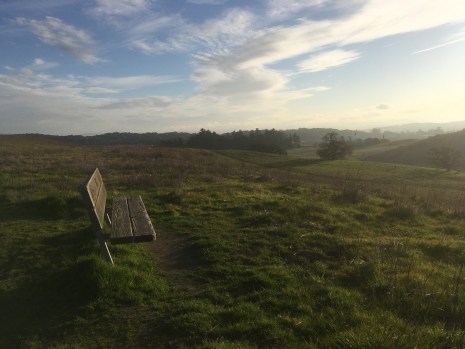
In spite of being only 95% recovered from my illness (a wild guess at a statistic), I started something new today. Pippin and the Professor gave me a Christmas present of a year’s membership in the local regional parks agency. It includes other benefits besides free parking, but my unwillingness to waste that part made me want to use it soon and often. I’d thought that I’d need to drum up a walking companion in order to get myself moving in that direction, but today when the afternoon suddenly opened up, I decided to go on my own to the most familiar of the parks. I’ve written about this one before, most memorably just after my husband’s death almost five years ago.
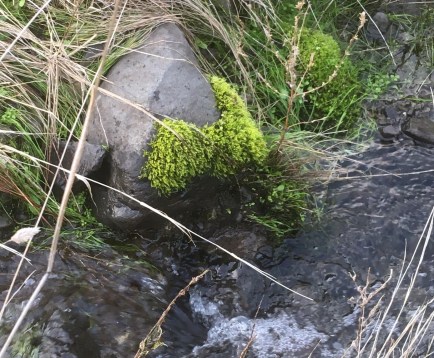
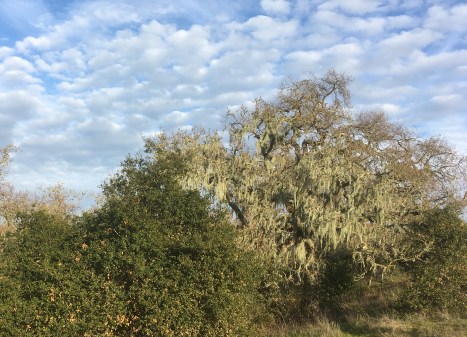
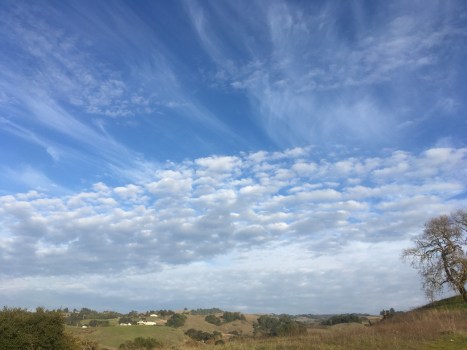
It’s winter, and I knew there would be a lot of grayness on this mostly gray day; I was (surprisingly) surprised at how much there was to see that wasn’t drab. Some of the regional parks I will visit have no parking fee at all, but this one is $7! So it was a good one to start with, to make me feel the monetary value of my gift — which is surely the least part.
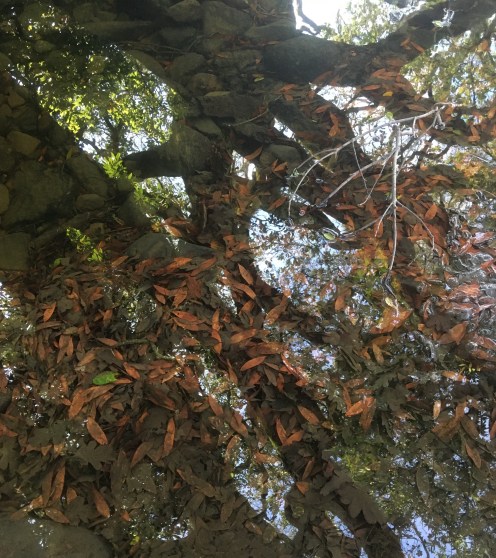
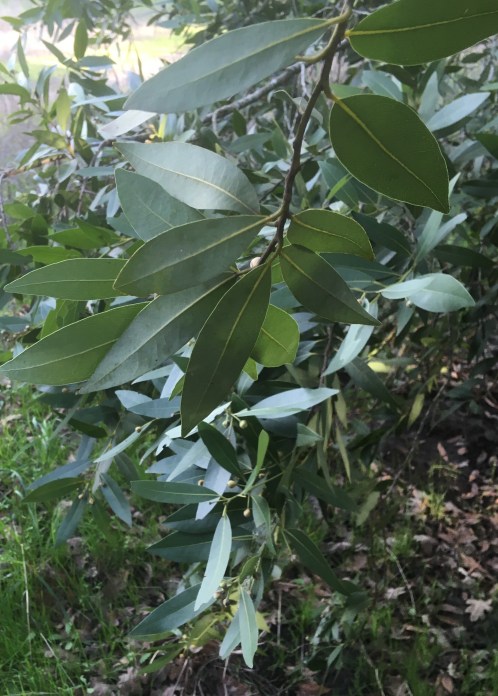
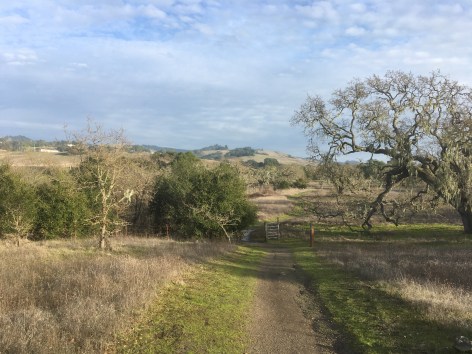
It’s not a huge park, but it is crisscrossed with several trails and I never have a map. In the past it seems we often end up back at the parking lot before we are feeling done, so I was trying to make the widest loop I could around the perimeter of the space. I think I did okay. Where a huge bay tree hangs over the creek, I took this picture in which I already can’t tell where the lines lie between the sky and the tree and the reflections.
In the last several months “everything,” most lately the attack of who knows what viruses, has conspired to make me feel my mortality. Not that I thought I was near death, but in just one year’s time I seemed to have become several years older, weaker and flabbier. I know youth is relative to a point, but I thought my youth might have died. It felt very good to be walking briskly in the fresh air and to be right there under the sky when the sun came out from time to time. It was shining nearly horizontally in my face or my camera lens when it did. Frogs croaked, and towhees hopped about in the bushes.
Have I mentioned that I also put my back “out” just before my battle with the viruses? I couldn’t even do anything about that for weeks, but last Friday I did see a chiropractor and am now on my way to getting back my less flabby self. The weather is of the sort that makes me want to curl up indoors with a book and a blanket, but I have had my warning, and I am going to fight against my tendency to the sedentary lifestyle.
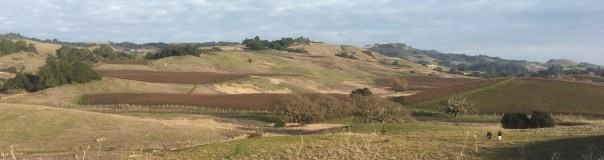
Not far from the descent to the parking lot, I was on a ridge from which I could see across the road below to the vineyards on the slopes beyond. And on my drive home — only ten minutes! — I noticed workers pruning the vines.
January is usually somewhat depressing for me, but this year I have been distracted from the bleak weather by other things that one might think more depressing. It didn’t work that way; I was continually reminded of God’s presence and had so many occasions of joy and contentment, it was obvious that they were pure gift. And this Christmas present from my children — it is a gentle prod to do the things they know I will love. I wonder if I can squeeze in one more park before the end of January?
 “The day was so delightful that I wished one could live slowly as one can play music slowly…. It was warm as high summer, and bars of sunshine lay honey-coloured across the floor, the air above them shimmering with motes; and bees droned about a purple branch of viburnum in a vase on the mantelpiece. We four girls were bathed in a sense of leisure we had never enjoyed before and were never to enjoy again, for we were going to leave school at the end of term, and we had passed all the examinations which were to give us the run of the adult world. We were as happy as escaped prisoners, for we had all hated being children.”
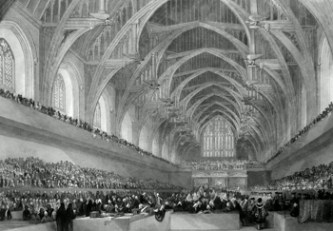 When in the novel The Fountain Overflows Rose Aubrey accompanies her father to the House of Commons to persuade a particular MP to help his current cause, we find out just how wily a politician he is. We also get a glimpse of the glory of the architecture:
 “It was like sitting in the midst of a tureen full of gravy soup. I was growing up at the end of an age which, partly by necessity and partly by choice, was very brown. In the towns chimneys poured out smoke from open fires and kitchen ranges, and light itself was permanently stained; and town-dwellers, who then so largely set the way of thinking, romanticized the obscurity to which they grew accustomed. Such sights as a narrow shaft of light struggling over a broad dark passage aroused none of the impatience we would feel today, but rather a sense that here was something as acceptable as a succession of major chords or a properly scanned line of verse.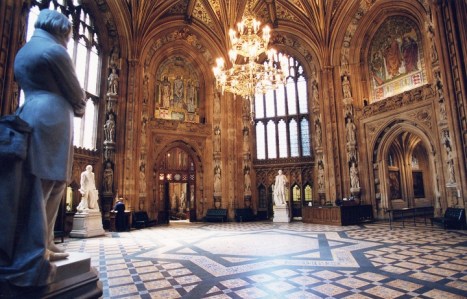








 Gladsome Lights