Monthly Archives: August 2020

Healing in all directions.

“There is never a pain as deep as that inflicted by someone who is supposed to love you. Such injuries echo through the years and the generations. The face that stares back at us in the mirror is easily a fractal of someone whose actions power our own insanity. We can hate a parent, only to be haunted by their constant presence in us.”

The first part of Father Stephen Freeman’s post for today, “Every Generation,” is about that dark side of our human connectedness. But the reality of it works positively, also, as we all know, if not from our own families, then from others who might seem to have received a better legacy.

The older I get, the more time I spend considering all of the people who have gone before who have contributed to my physical and/or spiritual well-being. The Orthodox Church trains us in this perspective by bringing us very close to the saints throughout time whose names we do know, and closer to this earthly home, we often remember in our thankful prayers the “founders of this holy temple.”

No doubt the prayers of my Sunday School teachers and other adults protected me as I grew up; the teachers and friends, my parents and grandparents and great-grandparents, aunts and uncles gave me so much, in particular behaviors and actions that must remain in large degree a mystery to us who can only see the outward.

In many cases I’m sure that their gift to their descendants was to struggle… and fail; but having struggled, their defeat was not as much of a failure as it would have been. God only knows how they tried, how hard it was just to keep going day after day. If their minds were ignorant of the significance of their lives to the whole of humanity, they were nevertheless contributing:

“If we inherit a burden within our life, so our salvation, our struggles with that burden, involve not only ourselves but those who have gone before as well as those who come after. We struggle as the ‘Whole Adam’ (in the phrase of St. Silouan).

“There is an Athonite saying: ‘A monk heals his family for seven generations.’ When I first heard this, my thought was, ‘In which direction?’ The answer, I think, is every direction. We are always healing the family tree as we embrace the path of salvation, monk or layman. Our lives are just that connected.”

What does all that have to do with Christ’s mother? In her prophecy Mary said, “All generations shall call me blessed.” There is a lot packed into that statement. As Father Stephen writes:

“In her person we see all generations gathered together. Her ‘be it unto me according to your word’ resounds in the heart of every believer, uniting them to her heart whose flesh unites us to God.”

Read the whole article. I didn’t quote quite all of it! When I started to write this post it was still the Feast of the Dormition of Mary, which is a fitting day to think about these things. Now we have passed liturgically to the next day, but that’s okay, because every day is good to remember family and be thankful.

Walking in foggy time.

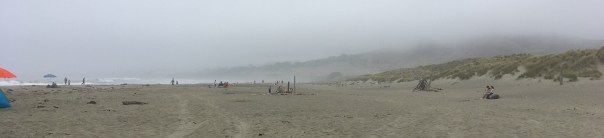
I did it – I went back to the beach all on my own, only about three weeks after that last trip. Because I didn’t arrive until the afternoon, and I could only afford to spend a couple of hours at the most, I thought that time pressure would make the minutes fly.

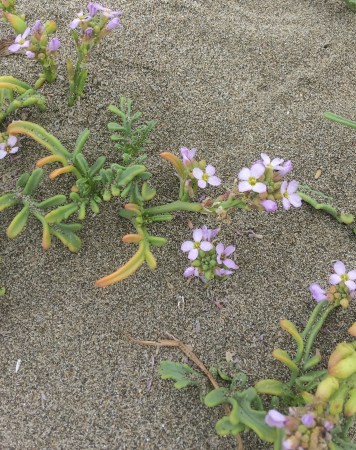
Sea Rocket

But somehow, the opposite happened. Time swelled to be as big as the ocean; it was as vague and undefined as the fog. I walked and walked, lost in it, and when I checked my phone, I couldn’t believe how little of my allotment I had used. So I walked some more….

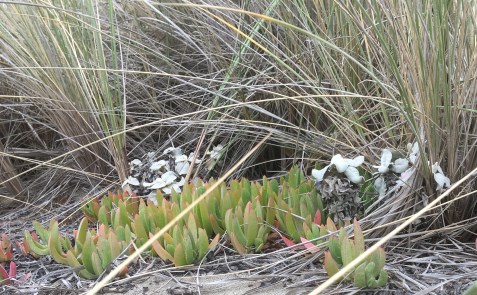
Believe it or not, I have the plant above, with the whitish leaves, in my garden. I bought it a the native plant nursery years ago, and knew it was a beach plant, but I’d never seen it before in its natural habitat. I recognized it immediately. I won’t worry about my plant anymore. It looks more spindly than these but otherwise … yeah. And I don’t know its name.

The sun never came out, but the air was pleasant. I wore a thin linen shirt, and carried my Teva sandals so that my feet could get the full sand experience. A girl spun cartwheels in the fringes of the incoming waves. Fathers with their children dug holes to catch the water. Bodies huddled like seals in driftwood teepees.

Coyote Brush
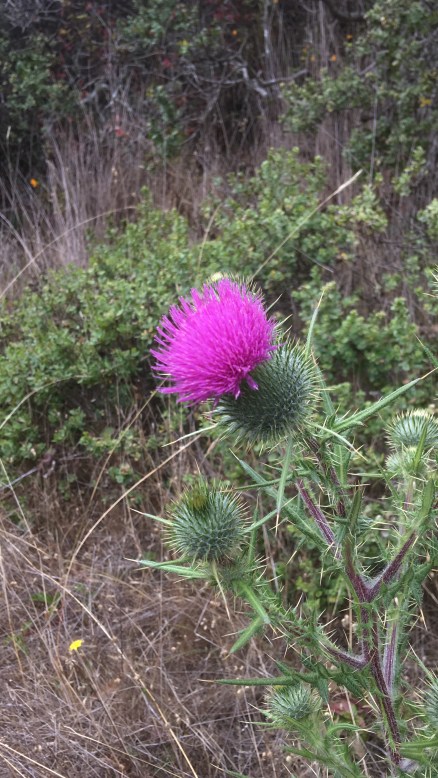
Bull Thistle

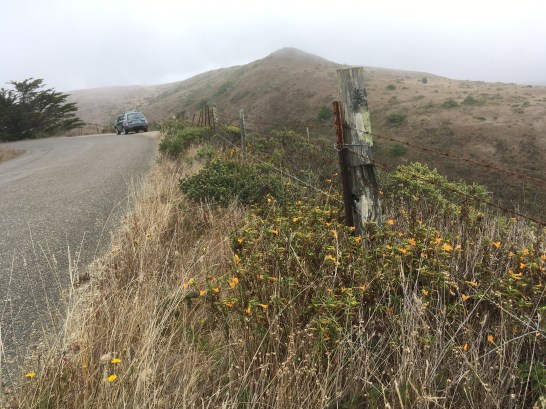
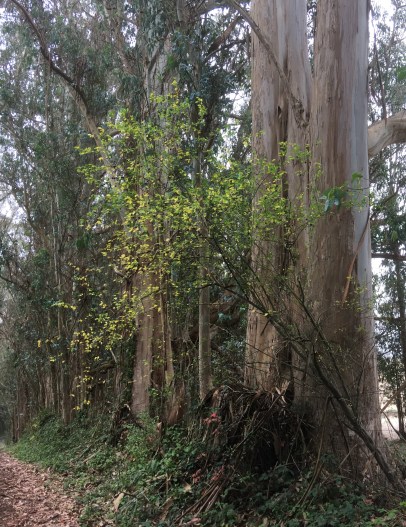
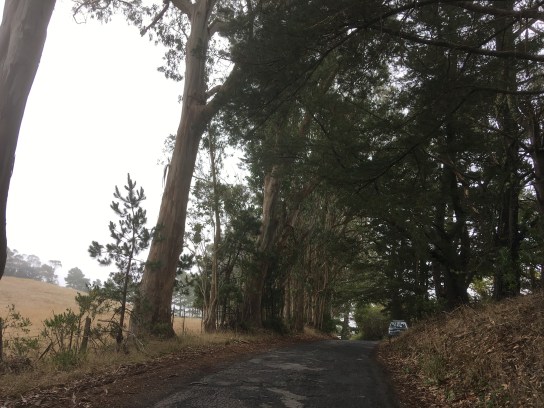
On my favorite shortcut road home I stopped many times to take pictures, and wished I could take scents. The masses of eucalyptus trunks and leaves exuded their distinctive aroma, which mixed with that of the cypress trees and the drying grass. Probably the coyote brush contributed to the heady perfume that was part of the afternoon’s fog on that particular hill.

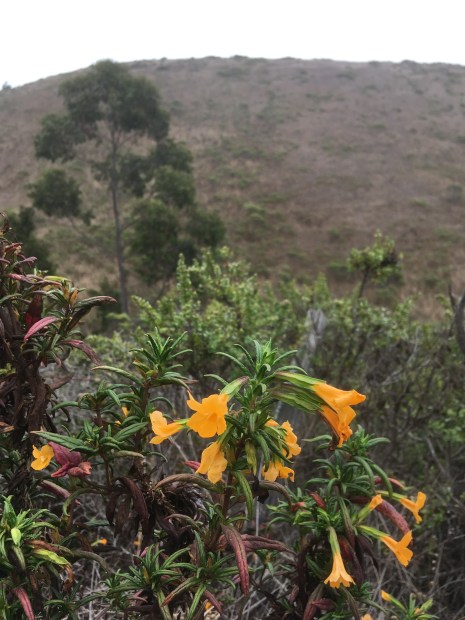
Orange Bush Monkeyflower
Coyote Brush surrounded by Poison Oak surrounded by Coyote Brush

My app said that the little tree below was in the rose family. It had fruit looking like cherries, but didn’t resemble a cherry plum tree. I guessed it was a volunteer/escapee from an old farm nearby.

From the top of the hill I could look back and see just a bit of the bay and the hill above, through the fog and mist — and the barbed wire.

A wind came up and whished the slender eucalyptus leaves into a loud whisper, and they were still telling their secrets when I had to drive away. So I must go back soon for the rest of the story, right?

The elder’s pain and love.

I don’t know who all will be in my class when my parish’s church school program begins again next month. But I think I know what I’ll be teaching, and it includes gleanings from this book that I haven’t read yet, With Pain and Love for Contemporary Man. The arrangement of our classes and students and how and where they will meet is one more realm of decisions that has been affected by the coronavirus situation, and that is why I didn’t know until this week to get busy and start reading; I had expected to be using a different curriculum.
This big book was first published in Greek in 1996, as the first of several volumes of the monk’s teachings. Over the course of 28 years his spiritual counsels were carefully recorded in notes and on tape, by the sisterhood of St. John the Theologian monastery in Souroti, for whom he was a guide and helper. In the preface they tell about his response at the beginning of their project:

“When Elder Paisios realised what we were doing, he was rather irritated: ‘Why are you taking notes?’ he asked. ‘Are you saving them for an emergency? You should put my words into practice; put them to work! Who knows what you are saying in these notes! Let me see them.’ When we showed him a sample, particularly the notes of one Sister, his expression changed. He seemed comforted and reassured, and exclaimed with satisfaction, ‘My goodness! She is like a tape recorder! She wrote it exactly as I said it!'”

St. Paisios of Mount Athos: InjusticeThis man, who in 2015 the Orthodox Church formally recognized as a saint, was in 1924 born Arsenios Eznepidis, in Cappadocia in Asia Minor. This was just after the Greco-Turkish war, and just before those governments mutually agreed upon a population exchange that forced more than a million people to become refugees; his family was among them, and they moved to Greece. You can read all about his life here: St. Paisios, and in other articles and books. I just wanted to tell you a little bit in introduction, because I’m planning to share at least a few quotes from the saint as I go. For now I will leave you with this that I found elsewhere:

“What I see around me would drive me insane
if I did not know that no matter what happens,
God will have the last word.”

— Elder Paisios of the Holy Mountain
1924-1974


What they saw on Mount Tabor.

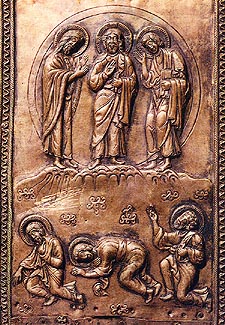
transfiguration georgian used GL 2020“Through the fall our nature was stripped of divine illumination and resplendence. But the Logos of God had pity upon our disfigurement, and in His compassion He took our nature upon Himself. On Tabor He manifested it to His elect disciples clothed once again most brilliantly. He showed what we once were and what we shall become through Him in the age to come if we choose to live our present life, as far as possible, in accordance with His ways.”

-St. Gregory Palamas

Today we celebrate the Feast of the Transfiguration. If you would like a full discussion of the event and its meaning, you will find it, also from St. Gregory, here:“The Holy Transfiguration of our Lord God and Savior Jesus Christ.”

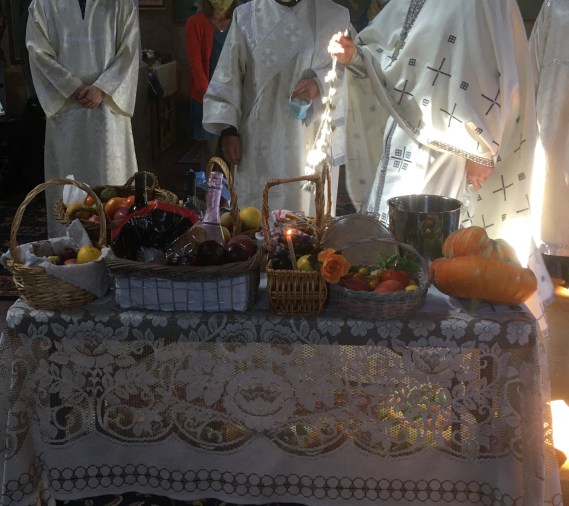
Transfiguration 20 IMG_7178 (2)