Monthly Archives: February 2024

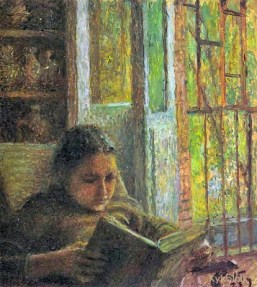
Women reading and laughing.

As soon as I got inspired by the 5×5 reading plan that I mentioned in my last post, I collected most of the books from around my two-storey house that were in stacks and not on shelves, and spread them on the dining table. I started to arrange the appropriate ones according to topics, and the two categories of “Women” and “Church History/Saints” were quite overloaded.

As I perused this scene, I recalled that in the last few years, many books I’ve read have been by audio — and few of those on the table were of the sort that are easy for me to attend to, by the “ear gate.” I wondered, “When will I sit and read all these books, most of which are too big to read in bed at night?” Quickly my mood also went into the Overloaded/Overwhelmed category and I climbed the stairs to bed.

Soon I decided the 5×5 plan is not for me. Clearly it wasn’t designed for me, but for young homeschooling mothers who need to read more books and look less at screens, who need to develop the habit of lifelong learning. I picked out several — not 25 — that I want to try extra hard to read in print this year.

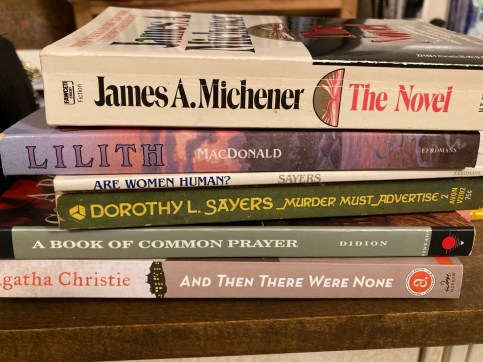
Hmm… I almost forgot these I want to read after that first bunch. Altogether I see that they add up to about half of 25:

My two long-time friends Cori and Di came to visit for a couple of days last week, and because I planned for us to eat at the smaller table near the kitchen, I left my book mess as it was. They each brought dozens of titles for show-and-tell, give-or-lend. The warmth of the wood stove drew us to the nearby love seats, where we talked about all the volumes they brought out of their bags, a broad variety of genres and titles that would make the Scholé Sisters proud.

Many of Di’s offerings had Cori in mind, because she and her husband had lost their extensive library when their house burned down, in one of the many northern California fires of recent years. The only books I kept from this trading session were small paperbacks that I can easily read lying in bed, while my mind is turning off just before conking out for the night.
Our gathering was a festival, and a marathon
of talking and thinking, laughing and even weeping.
Now, it’s time for the reading to begin.
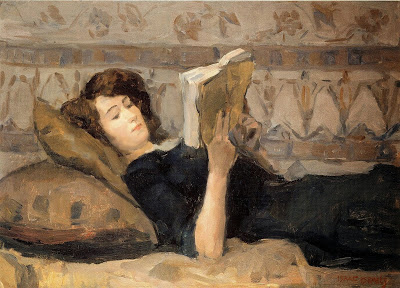
Isaac Lazarus Israëls

Joan was a perfectly practical person.

It’s been a long time since I read Mark Twain’s Personal Recollections of Joan of Arc. When I came across the quote below it made me want to read it again — though I can see the good in reading a different biographer.

The Scholé Sisters presented again their idea of the 5×5 reading plan. You pick five topics or genres of books and try to read five books in each category. Personally, I won’t be officially joining the group challenge, but this organizing of my stacks does sound appealing. Already “Women” was one of the categories that immediately came to my mind, and a book about Joan of Arc would fit very nicely. I wish Chesterton had written one; this is from his book Orthodoxy:

“Joan of Arc was not stuck at the Cross Roads either by rejecting all the paths like Tolstoy or by accepting them all like Nietzsche. She chose a path and went down it like a thunderbolt. Yet Joan, when I come to think of her, had in her all that was true either in Tolstoy or Nietzsche — all that was even tolerable in either of them.

“I thought of all that is noble in Tolstoy: the pleasure in plain things, especially in plain pity, the actualities of the earth, the reverence for the poor, the dignity of the bowed back. Joan of Arc had all that, and with this great addition: that she endured poverty while she admired it, whereas Tolstoy is only a typical aristocrat trying to find out its secret.

“And then I thought of all that was brave and proud and pathetic in poor Nietzsche and his mutiny against the emptiness and timidity of our time. I thought of his cry for the ecstatic equilibrium of danger, his hunger for the rush of great horses, his cry to arms. Well, Joan of Arc had all that and, again, with this difference, that she did not praise fighting, but fought. We know that she was not afraid of an army, while Nietzsche for all we know was afraid of a cow.

“Tolstoy only praised the peasant; she was the peasant. Nietzsche only praised the warrior; she was the warrior. She beat them both at their own antagonistic ideals; she was more gentle than the one, more violent than the other. Yet she was a perfectly practical person who did something, while they are wild speculators who do nothing.”

G.K. Chesterton, in Orthodoxy

Because time.

More than ten years ago I first posted this poem, after my late husband and I had been laughing over Cope’s poetry while drinking our morning coffee. 

Now, I’m amused, and wondering, at how fast January has gone by. Because time, and the unstilled wheel still turning. We may as well keep a sense of humor about it!

A NURSERY RHYME
as it might have been written 

by T.S. Eliot

Because time will not run backwards
Because time
Because time will not run
                                         Hickory dickory
In the last minute of the first hour
I saw the mouse ascend the ancient timepiece,
Claws whispering like wind in dry hyacinths.
One o’clock,
The street lamp said,
‘Remark the mouse that races towards the carpet.’
And the unstilled wheel still turning
                                                          Hickory dickory
                                                          Hickory dickory

dock

— Wendy Cope             

Let us be candles pure and sweet.

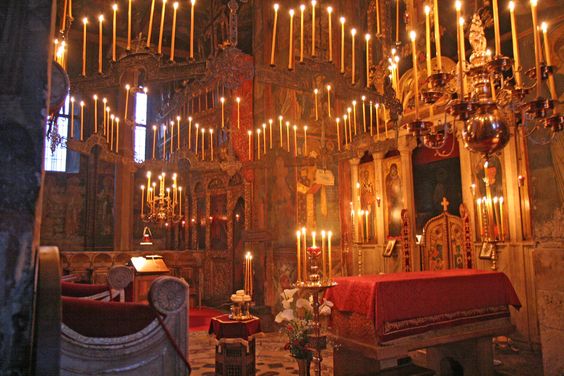
As part of our celebration of the Feast of the Presentation of Christ in the Temple, in the Orthodox Church we bless candles. Maybe some other Christian traditions still do this, as it is the ancient feast of Candlemas, and many cultures and nations have their many practices around it. I’d be interested to hear of any that linger among my readers’ communities.

As to candles, I found this helpful article from St. Gabriel Orthodox Church in Ashland, Oregon, about some of the symbolism in our use of of them, “handed down to us from St. Symeon of Thessaloniki (c. 1381–1429).”

1 – As the candle is pure (pure beeswax), so also should our hearts be pure.

2 – As the pure candle is supple (as opposed to the paraffin), so also should our souls be supple until we make it straight and firm in the Gospel.

3 – As the pure candle is derived from the pollen of a flower and has a sweet scent, so also should our souls have the sweet aroma of Divine Grace.

4 – As the candle, when it burns, mixes with and feeds the flame, so also we must struggle to achieve theosis.

5 – As the burning candle illuminates the darkness, so must the light of Christ within us shine before men that God’s name be glorified.

6 – As the candle gives its own light to illuminate a man in the darkness, so also must the light of the virtues, the light of love and peace, characterize a Christian. The wax that melts symbolizes the flame of our love for our fellow men.

So let us pray that the Light of Christ may illumine us as well!

In a monastery.