Nothing is sweeter!

Nothing is sweeter!
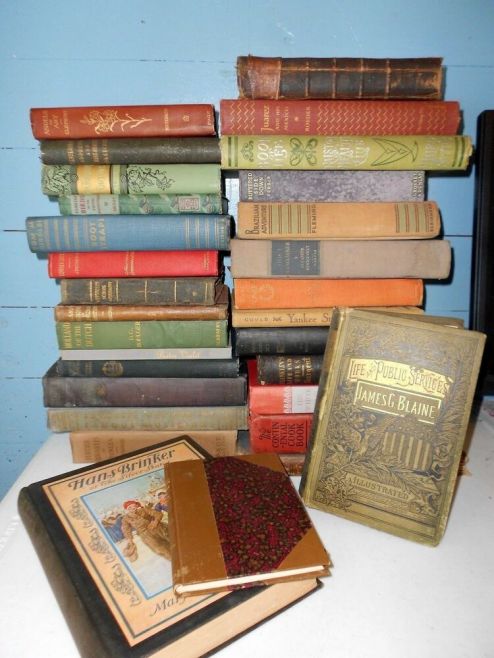
One thing I love about used books is that their physical selves, regardless of the subject or literary content or the reason I want them, have history. I’m always pleased if I find even the name of a person (or a library) and possibly an inscription, giving evidence of its life before coming into my possession. I have discovered a few other little items, like a theater ticket or a clipped newspaper review of the book. But no money, or bacon, and no love letters.
 Pippin just sent me this picture of a tortilla that was found in a library book; it looks like the tortilla came with salsa and cheese, too. She remembered an article I’d passed on years ago from the Abe Books Community page: “Things Found in Books.” I thought I’d blogged on this subject, but I can’t find that I did. So I’m passing on that link, plus this one:
From Atlas Obscura: “Best Things Found Between the Pages of Old Books,” including the story of a woman who found a small negative in a book she bought at a used bookstore, developed it, and found it was a photo of her as a child.
You can probably find more such lists online, and maybe have already. I’d be more interested in things that you, my own readers, have found in books, even if it’s only inscriptions. Let me know in the comments, and possibly I will write an update post.
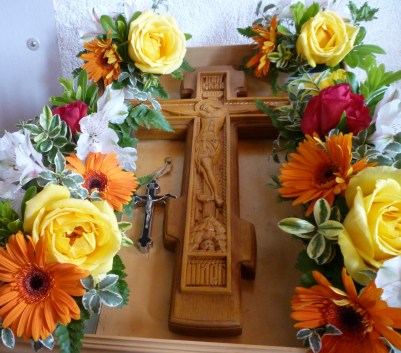
 “The cross is raised and appears above the earth, which until recently malice had kept hidden. It is raised, not to receive glory (for with Christ nailed to it what greater glory could it have?) but to give glory to God who is worshiped on it and proclaimed by it.
“It is not surprising that the church rejoices in the cross of Christ and robes herself in festal clothes, revealing her bridal beauty as she honors this day. Nor is it surprising that this great throng of people has gathered together today to see the cross exposed aloft and to worship Christ whom they see raised upon it. For the cross is exposed in order to be raised and is raised to be exposed.
“What cross? The cross, which a little while ago was hidden in a place called ‘The Skull’ but now is everywhere adored. This is what we rejoice over today; this is what we celebrate; this is the point of the present feast; this is the manifestation of the mystery. For this hidden and life-giving cross had to be exposed, set on high like a city on a hill or a lamp on a stand, for all the world to see.
“We who worship Christ on the cross must try to grasp the greatness of his power and all the wonders he has wrought through the cross on our behalf. The holy David says: ‘Our God and eternal King has wrought salvation throughout the world.’ For through the cross the nations were caught as in a net and the seeds of faith are sown everywhere. With the cross, as though with a plow, the disciples of Christ cultivated the unfruitful nature of humankind, revealed the Church’s ever-green pastures, and gathered in an abundant harvest of believers in Christ.
“By the cross the martyrs were strengthened, and as they fell they smote down those who struck them. Through the cross Christ became known, and the Church of the faithful, with the scriptures ever open before her, introduces us to this same Christ, the Son of God, who is truly God and truly Lord, and who cries out: ‘Any who wish to come after me must deny themselves and take up their cross and follow me.’”
-St Andrew of Crete – 8th century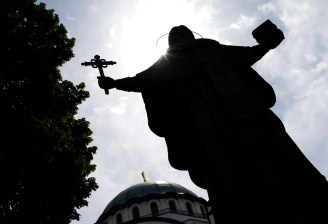
Each year on September 14 Orthodox Christians commemorate this of the Twelve Great Feasts: The Feast of the Exaltation of the Holy Cross. Pascha (Easter) is the Feast of Feasts and isn’t counted in this list of other important events in our salvation history.
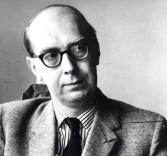 Philip Larkin’s poetry is often bleak in various ways, but his uniquely beautiful voice draws me. So I borrowed a fat collection of his work from the library to peruse; it was fascinating. In a few poems, even though I don’t claim to see halfway to their depths, I catch glimmers of our common humanity and perspective, and am prompted to pray for him.
This one was unpublished in his lifetime.
Come then to prayers
And kneel upon the stone,
For we have tried
All courages on these despairs,
And are required lastly to give up pride,
And the last difficult pride in being humble.
Draw down the window-frame
That we may be unparted from the darkness,
Inviting to this house
Air from a field,
air from a salt grave,
That questions if we have
Concealed no flaw in this confessional,
And, being satisfied,
Lingers, and troubles, and is lightless,
And so grows darker, as if clapped on a flame,
Whose great extinguishing still makes it tremble.
Only our hearts go beating towards the east.
Out of this darkness, let the unmeasured sword
Rising from sleep to execute or crown
Rest on our shoulders, as we then can rest
On the outdistancing, all-capable flood
Whose brim touches the morning. Down
The long shadows where undriven the dawn
Hunts light into nobility, arouse us noble.
-Philip Larkin

