
 My husband didn’t speak to me from the grave, but I did get a pertinent message from him — and from myself, too — and it was delightful. You know how below each individual post on my blog there are three links to “related” posts from the past? At the bottom of yesterday’s was one titled “Walking in 2012.” As I was finishing my breakfast this morning and ready to leave for the gym I clicked on it to see what I had written about back then. (I have published almost 1000 posts and have forgotten many of them by now.)
It was about a brief conversation I had with my dear husband at the very beginning of the  new year of 2012, and about a neighborhood walk I took as a result. Reading what he said, and what I said…I could hear us all over again and laugh at how we were. What I recounted of that walk and all that I learned, well, it was just what the doctor ordered. I thanked God and Mr. Glad, and I changed my plan and set off for a walk in the outdoors instead of driving to the gym.
Rain had fallen last night and early this morning, but the clouds had all blown away to the edges of the sky, and the sun was shining. I walked along the creek, and the sweet earthy smells emanating from all the plants and the ground were so delicious. I started thinking about the time my husband and I were walking in the rain forest. That was a pleasant and vivid memory.
I hadn’t brought anything but my cell phone, and I was glad to have it because very soon I began taking pictures of trees. So many of them seemed to look extra handsome with some dark gray clouds in the background.
One of the first I noticed was an olive tree (above) that seemed to fit very nicely in a front yard, and had been pruned so as to keep it looking the way an olive should. Some neighbors on my block have four or five olives in front of their house and they prune them like lollipops twice a year. I wanted to plant an olive in my new landscape but many people discouraged me, partly because they get so big. So I will keep two of mine that are in pots, and get them matching pots, and study the best way to prune them according to their natural bent.
This redwood tree I saw this morning must be the healthiest and best formed specimen in town. I could hardly believe it was a redwood, it is so thick and green, and standing all by itself, too! Coast redwoods much prefer to be in groups, where they can preserve moisture and coolness against dry weather. Most of them along the avenues here are not planted that way, and they have suffered terribly in the last few years.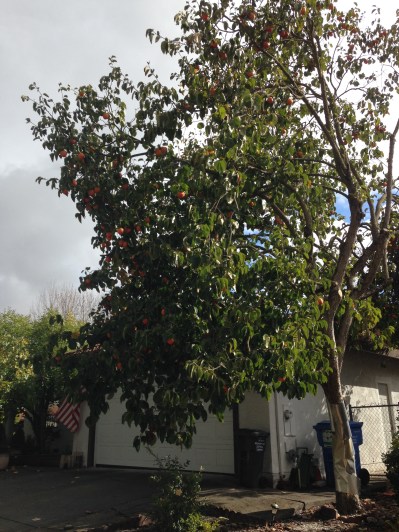
One yard on my way had both a giant fig tree and a very tall persimmon tree. I was admiring them when the neighbor came out of his house and we said, “Good morning.” I remarked about the beauty of the persimmon tree and he said,

“I guess… I get the trimmers out here all the time and try to keep it away from my gutters.” You can see how it is indeed very one-sided after that kind of pruning, but it looks as though it would still give the owners plenty of fruit, on top of what they get from the fig tree.

I noticed then that even though the sun was shining warmly on me, tiny drops of rain were starting to fall, too. Oops — I wasn’t prepared for that, and only had a pocket of my flannel shirt in which to put my phone. But first, I had to snap another olive tree, this one an example of what you do not want your olive to look like. Those are lots of suckers growing at the base of the tree.
Hmmm…the rain was heavier, and I looked for a tree that might be close to the sidewalk and with a dry area underneath. I found it in this palm tree; here is my view from under its thick canopy, with the added interest of a fig tree growing out of its tidy trunk.
I stayed under that roof for a minute or two, but not knowing how long the shower might last, I was soon braving the wet again, after having wrapped my phone with two handkerchiefs I’d found in the other shirt pocket.
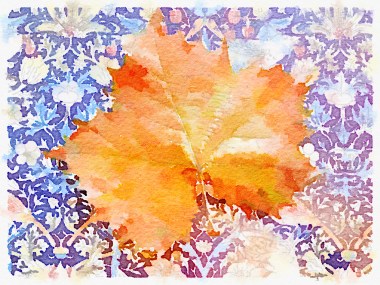
With it under cover, I had to pass by several more lovely tree specimens without taking note of them with the camera. I came upon a big redwood with lots of dry ground under it, so I paused again and took a picture of its underside, but I will spare you. That’s the first time I’ve preferred a palm to a redwood. Soon I was on my way, after picking up a big leaf. When I got it home I put my Waterlogue phone app to painting it. That tool is addictive, but I find that most of the pictures I take don’t convert very well.
That was my adventure, much more fun, I’m sure, than I’d have had at the gym. I didn’t even get very wet, though I had the joy of walking in the rain. I made new tree friends, and renewed the lessons I’d been taught almost four years ago, with the help of my late husband. I told you he wasn’t very far away.




 ul specimen of tree. And so big already, stretching its arms wide, eager to grow on a trellis in the corner of my yard, behind a sitting area.

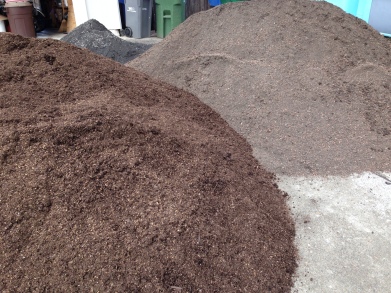 of dirt/rock into my driveway: base rock to form a good foundation for the gravel utility yard, compost to mix into the unknown stuff that was packed into the pool cavity, and vegetable planting mix to fill the boxes.
 arth.
arth.
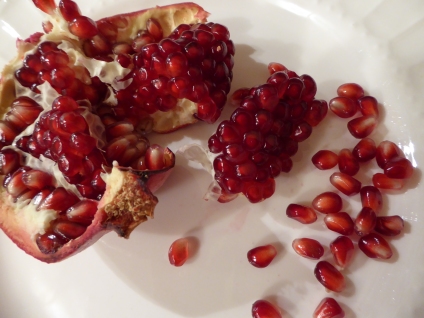
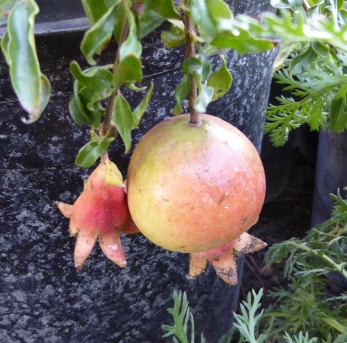
 omb of juicy red seeds. My grandson Liam eats each seed carefully, biting it and sucking out the juice, discarding the (mostly) pithy part.
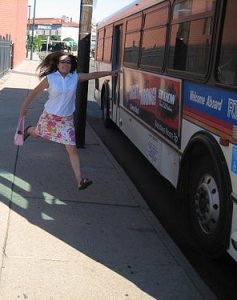 and nearly all the time, we live as if we were trying to catch a bus.
 question ‘What?’ It answers the question ‘Who?’ Eternity is God, God who is always contemporaneous with each moment of time; He is always there, completely stable, unchanged and unchangeable because He already has in Himself, before the first thing was, all the richness necessary to meet all things and all situations. He does not need to change in order to be contemporaneous.
