Category Archives: books

Middlemarch – Ladislaw’s force of unreason.

One Saturday evening Will Ladislaw is thinking about the foolishness of his current situation, in which he has taken work in the town near to where our heroine Mrs. Casaubon lives, because of his feelings for that woman “for ever enthroned in his soul.” But he has been forbidden by Dorothea’s jealous husband to visit their home. So, “he could hardly ever see her.”

His thoughts are going irritably round and round on this subject when, “suddenly reflecting that the morrow would be Sunday, he determined to go to Lowick Church to see her.” It’s not his parish, and his presence would annoy Casaubon certainly, but he reasons,

“It is not true that I go to annoy him, and why should I not go to see Dorothea? Is he to have everything to himself and be always comfortable? Let him smart a little, as other people are obliged to do. I have always liked the quaintness of the church and congregation; besides, I know the Tuckers. I shall go into their pew.”

Having silenced Objection by force of unreason, Will walked to Lowick as if he had been on the way to Paradise, crossing Halsell Common and skirting the woods, where the sunlight fell broadly under the budding boughs, bringing out the beauties of moss and lichen, and fresh green growths piercing the brown. Everything seemed to know that it was Sunday, and to approve of his going to Lowick Church. Will easily felt happy when nothing crossed his humour, and by this time the thought of vexing Mr. Casaubon had become rather amusing to him, making his face break into its merry smile, pleasant to see as the breaking of sunshine on the water — though the occasion was not exemplary…. Will went along… chanting a little, as he made scenes of what would happen in church and coming out….The words were not exactly a hymn, but they certainly fitted his Sunday experience….

…. Sometimes, when he took off his hat, shaking his head backward, and showing his delicate throat as he sang, he looked like an incarnation of the spring whose spirit filled the air — a bright creature, abundant in uncertain promises.

This is one of a thousand passages in Middlemarch that so delightfully convey the personality and the feelings of one of the characters. I wish that I could transcribe a score of them just because I admire so much Eliot’s art. In this case Will is to himself in happy concord with even the weather and the season, and with the landscape that the author paints with a few perfect phrases. I think that Eliot is a little bit in love with Will Ladislaw, for how else could she make me fall in love with him?

The last phrase, though, comparing Will and springtime, is suddenly ominous, because, as we all know, the weather is unpredictable at this time of year. And the spirit of spring — I am as susceptible to its easy promises as anyone.

I did read this novel aloud with my husband 15 years ago, an acquaintance that was too shallow and distant for me to retain more than vague impressions. This time, on my own, I’m more engaged and enraptured, but still, I don’t want to take a year to read as thoroughly and meditatively as this book seems to warrant. So I’m glad Arti proposed two months, and I look forward to the remaining weeks and stories.

photo credit: Pippin

Slipping from the tedious plane.

I was telling Mr. Greenjeans about how An American Childhood by Annie Dillard encouraged me in my writing. He comes from the author’s hometown of Pittsburgh, Pennsylvania, which is the backdrop for her growing-up adventures told from her vividly revealing point of view. I took the book off the shelf to put aside for him, and turned the pages a while, seeing passages I’d marked long ago.

Hers is a unique point of view, of course, as each of us is an unrepeatable individual looking out on our world. Whether it is her perspective that is unusual as well, or only her ability to convey it in words, I don’t know. I do know that few children today have the liberty of youth that Dillard describes as regularly offering periods of time so deep and distraction-free that you can “lose yourself.” In a chapter on her love of books and reading, she tells how she felt:

The actual world is a kind of tedious plane where dwells, and goes to school, the body, the boring body which houses the eyes to read the books and houses the heart the books enflame. The very boring body seems to require an inordinately big, very boring world to keep it up, a world where you have to spend far too much time, have to do time like a prisoner, always looking for a chance to slip away, to escape back home to books, or to escape back home to any concentration–fanciful, mental, or physical–where you can lose your self at last. Although I was hungry all the time, I could not bear to hold still and eat; it was too dull a thing to do, and had no appeal either to courage or to imagination. The blinding sway of their inner lives makes children immoral. They find things good insofar as they are thrilling, insofar as they render them ever more feverish and breathless, ever more limp and senseless on the bed.

-Annie Dillard, in An American Childhood

The most fragrant dispensation.

Since Pascha I have been reading The Eucharist by Father Alexander Schmemann. It is so much more than I expected; I don’t know what I did expect — maybe with such a simple title I imagined something “dry and scholarly”? We can count on Fr. Alexander to be scholarly, but we can also count on his words to be infused by the Holy Spirit and to convey his own obvious joy in the Holy Spirit.
My priest was graced to hear these words as seminary lectures; the author died before he could finish the English edition of his book, but use was made of the original Russian and the French translation in the publishing of the edition I am reading, in 1987.  It’s another of those many lasting gifts that Fr. Alexander has given us.

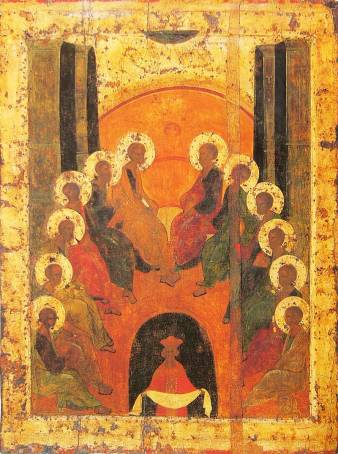
Much in the section on “The Sacrament of the Kingdom” is especially fitting for the celebration of Pentecost this week, so I share from the riches I’m receiving:

…Through his coming on the “last and great day of Pentecost” the Holy Spirit transforms this last day into the first day of the new creation and manifests the Church as the gift and presence of this first and “eighth” day.

Thus, everything in the Church is by the Holy Spirit, everything is in the Holy Spirit and everything is partaking of the Holy Spirit. It is by the Holy Spirit because with the descent of the Spirit the Church is revealed as the transformation of the end into the beginning, of the old life into the new. “The Holy Spirit grants all things; he is the source of prophecy, he fulfills the priesthood, he gathers the entire church assembly” (hymn of Pentecost). Everything in the Church is in the Holy Spirit, who raises us up to the heavenly sanctuary, to the throne of God. “We have seen the true light, we have received the heavenly Spirit” (another hymn of Pentecost).

Finally, the Church is entirely oriented toward the Holy Spirit, “the treasury of blessings and giver of life.” The entire life of the Church is a thirst for acquisition of the Holy Spirit and for participation in him, and in him of the fullness of grace. Just as the life and spiritual struggle of each believer consists, in the words of St. Seraphim of Sarov, in the acquisition of the Holy Spirit, so also the life of the Church is that same acquisition, that same eternally satisfied but never completely quenched thirst for the Holy Spirit.

I can imagine that there are writings about the Holy Spirit that are “dry,” if the writer is not skilled, or has not experienced life in Christ. But the Holy Spirit himself cannot be dry — he is sent to water our souls with divine life. At the close of this section Father Alexander gives us a prayer from the compline canon of the Feast of the Holy Spirit:

“Come to us, O Holy Spirit, and make us partakers of your holiness,
and of the light that knows no evening, and of the divine life,
and of the most fragrant dispensation….”

Middlemarch has me laughing so soon.

Today is May 1st, so it’s the official date of the Read-Along of Middlemarch that Arti is hosting for the next two months. She wrote a new post about the project for today, which you can read by clicking on the book cover image in my sidebar. It includes some ungracious things that Henry James said about how George Eliot’s mind made him fall in love with her even though she was not pretty – but he did not put it so euphemistically.

I did start reading the book about ten days ago but I haven’t read every day, so I am only three days’ worth of pages jump-started. I was surprised at how quickly the author makes  her characters’ personalities known to the reader, through the most natural and revealing dialogue, as when Dorothea and her sister discuss Mr. Casaubon’s looks, only a few pages in. The two girls had already endeared themselves to me, charming opposites to one another but both sympathetic, and their conversation about their differing perspectives made me laugh out loud in spite of myself as I sat in the corner of my garden.

Because I’m not traveling so much in the coming months, it seems I should have time available to enjoy this big and wonderful book, though it’s been a very long time since I have used my leisure for deep reading of such a long novel. It will be good.