Category Archives: books

I take a longish Sunday drive.

P1130357In my last post I told you about Mr. Glad’s 40th day of repose in the Lord. On the 41st day I drove north in response to the invitation from a granddaughter to be present at the exhibit of her photography. If it hadn’t been for the request of my presence on a specific date, I’d probably have put off traveling a few weeks longer, but I took it as a gentle prod from Heaven.

In spite of many episodes of homesickness, the excursion turned out, as I knew it would, to be full of fun, beauty, and love – all good things for someone in my situation.

Sundial 5-3-15
Sundial Bridge


The first day’s drive took me about eight hours, which is too long, in my mind, to be reasonable and healthy, even if I did stop a few times and even took pictures at my favorite rest area among the olive groves. In the future I hope I can break up car trips so that no one leg of a journey keeps me behind the wheel more than half that long.

It shouldn’t be hard, because I have friends and family all over the place who can make an overnight stay worth the pause in getting to whatever place where I might sojourn longer.

In the car I listened to the radio when I could get a good classical or jazz station, and also to some more of The Big Read book introductions from the National Endowment for the Arts. I told you previously about that program and two of the recordings in this post.

The disks I found at the library for this trip were introductions to:

Housekeeping by Marilynne Robinson
The Death of Ivan Illyich by Leo Tolstoy
Old School by Tobias Wolff
The Heart is a Lonely Hunter by Carson McCullers
To Kill a Mockingbird by Harper Lee

This batHeart - McCullersch of recordings were produced between 2006 and 2008. For each one you get to hear some passages read from the book; background on the author or how the book came to be written, often from the author herself speaking; interesting music that seems to have been carefully chosen to go with the tone or setting; and many sound bites of other people’s responses to the story. Even if you have read the books — perhaps especially if you have read the books — it is very enriching to delve into them this way.
Robert Duvall, whose film debut was as Boo Radley in “To Kill a Mockingbird,” tells us his feelings about that story and the experience of acting in what is considered one of the truest film adaptations of a novel you can find. Elizabeth Spencer is a southern writer who also contributes quite a bit to the To Kill a Mockingbird intro. She sounds like someone who might have lived in the fictional town of the novel, and I found her very appealing, for both the sound of her voice and for her comments such as, “This is a book that hits the bulls-eye, and that bulls-eye is the heart. Too few books have a basis in love.”Old School Wolff

Tobias Wolff is himself one of the commentators on the intro to his book, which is somewhat autobiographical, about a prep school in which all the boys want to be writers. Marilynne Robinson also speaks on the recording about her book, musing on the process of writing Housekeeping, and how she came up with the name of Fingerbone.

I am so impressed with the artistry that goes into these audio presentations, and even more appreciative of them at this time, when I can’Sundial & water 5-3-15t seem to engage with a whole novel in the deep way I am used to. I’m afraid I am somewhat apathetic right now about vicarious experiences and fictional characters, but I really enjoyed these Big Read introductions.

My route up Highway 5 to southern Oregon took me through the town of Redding, and the cramped feeling in my legs by that time was demanding more than a brief stop at a rest area. It made sense to visit the relatively new Sundial Bridge that spans the Sacramento there very close to the freeway, with the lovely and leisurely Riverfront Park paths on either side. I think my visit last week was my third, to this bridge that is only for pedestrians and bicycles, and I had come on a perfect spring day. I was still wearing long sleeves, having started out in cool temps at noon, but all the walkers and cyclists were in tank tops and shorts.

I walked along the trail on one side of the river and followed some goslings with thesundial 5-15 geese byir parents, until they went under the bank and out of sight. Then I crossed the bridge with its watery blue-green glass bricks, to the path on the north shore. I bought a mango Italian ice, to lick as I walked briefly through an uninspired perennial garden, and then back to the bridge for a few more photos.

My little walk along the river was very therapeutic I guess, because I arrived at my destination without any of the aches and pains I often would have after sitting and driving so long. After visiting with Pathfinder’s tribe I fell into bed so I’d be ready for the next day’s fun.

Sundial horiz 5-3-15

Reading letters by the fire.

Pippin and The Professor gave us a book for Christmas, Letters of Note, letters of notea compilation by Shaun Usher, whom I might call Usher the Gusher, he is that enthusiastic a promoter of his book. I wish he would let the letters speak for themselves, but his glowing commentary doesn’t detract too much from the delightful pastime of reading the letters.
It’s the best kind of browsing book, and makes me want to dig up and display cherished letters I have been blessed to receive over the years from relatives and friends. It also makes me want to write more letters myself…I actually should be writing some Christmas thank-yous right now!

This evening I’m very tired in body and mind, and am so happy to have such reading material — it could only be improved by being in two volumes so that a weary woman could more comfortably hold one while sitting in a straight-backed chair by the fire. The wind is blowing icily here these days, and it seems that windy cold is better than still because it is chasing the pollutants away and making it o.k. for us to burn wood.

Nixon letter from boy crp

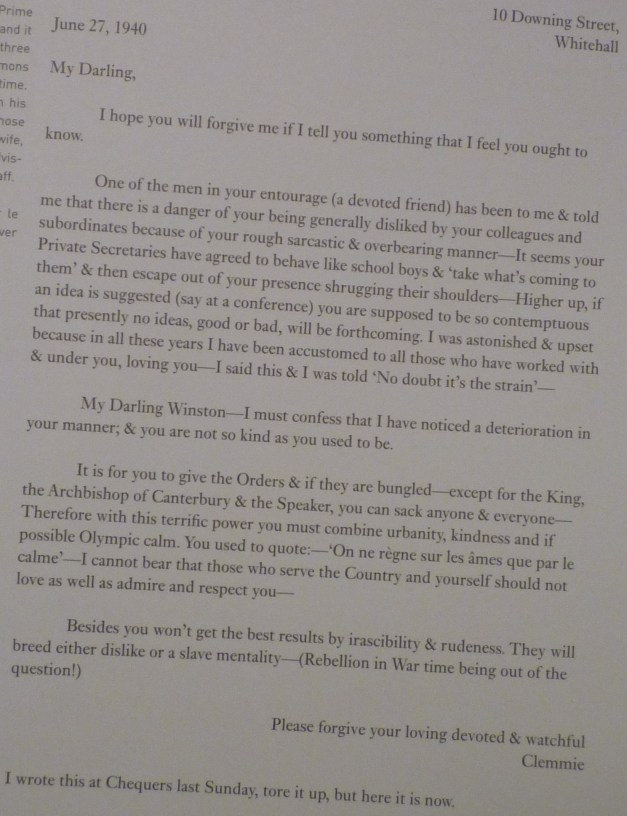
So far I have read at least a couple dozen letters including some from children to government leaders, e.g. Fidel Castro to FDR, and the one pictured above, in a very different spirit; letters from widows and widowers to their deceased spouses, e.g Richard Feynman and Katherine Hepburn;  and a letter from Clementine Churchill to her husband advising him to rise above his stressful situation and be a nicer man (below).

Clementine to Winst crp

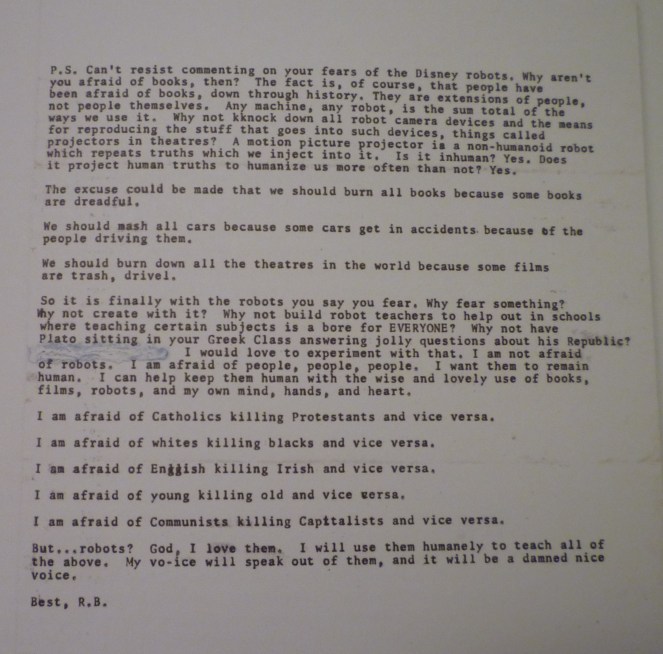
Many of the letters are shown in a facsimile of their original typed or handwritten form, like this one from Ray Bradbury responding to a letter from someone who had concern about the effects of robots on society.

Ray Bradbury letter - robots

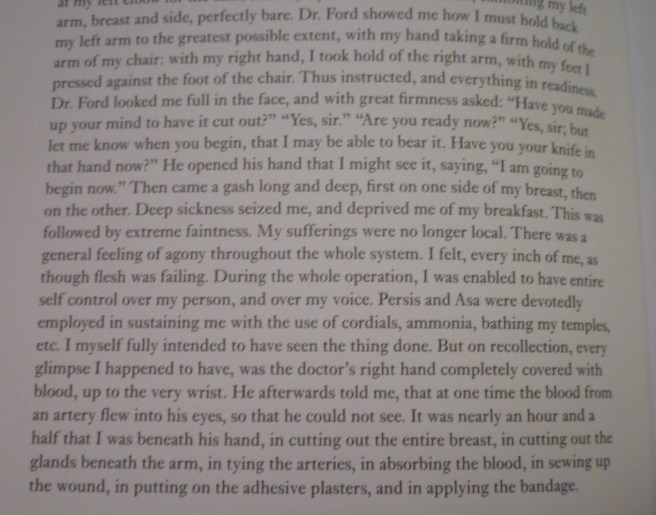
One of the most compelling so far is from Lucy Thurston, who endured a mastectomy without any anesthetic. In the 19th century she was a missionary from Massachusetts to Hawaii along with her husband. After the surgery in 1855 she lived another 21 years. This letter of which I show a small part is to her youngest daughter:

mastectomy report

mastectomy survivor
Mary Thurston

The book includes 125 letters, but when I run out I can go to Usher’s website, also called Letters of Note, where 900 missives await my discovery. Some of those no doubt are printed in the book, but that still leaves 775….

Going now to stoke the fire.

Gleanings – Fashionable Philosophy

I’m going along slowly through David Bentley Hart’s book The Experience of God: Being, Consciousness, Bliss. It takes me longer to eat my soup at lunchtime, because I so often put down my spoon and pick up a pencil to underline one passage after another, sometimes just because the most obvious ideas are expressed in eloquent prose that makes me happy.

On the other hand, I also have to stop and consult the dictionary about quite a few words I don’t know, some that seem completely new to me and others I just haven’t read for several years and whose meanings have become foggy. Sapient, proleptic, etiolated, deracinated, lacunae, phylogenic, otiose. Really, I should make myself a Vocabulary List to keep handy for study and review, and maybe I wouldn’t forget so soon. This list should include scores of words I have circled on the pages of almost every book I read, words that I don’t often take the time to investigate right then — or sometimes ever.

In the second chapter, from which the following paragraphs are taken, Hart is discussing “Pictures of the World,” and he cautions the reader that “the philosophical tendencies and presuppositions of any age are, to a very great degree, determined by the prevailing cultural mood or by the ideological premises generally approved of by the educated classes.”

“…inasmuch as the educated class is usually, at any given phase in history, also the most thoroughly indoctrinated, and therefore the most intellectually pliable and quiescent, professional philosophers are as likely as their colleagues in the sciences and humanities (and far more likely that the average person) to accept a reigning consensus uncritically, even credulously, and to adjust their thinking about everything accordingly.”

“…I think it is fair to say that a majority of academic philosophers these days tend toward either a strict or a qualified materialist view of reality (though many might not use those terms), and there may be something of a popular impression out there that such a position rests upon a particularly sound rational foundation. But, in fact, materialism is among the most problematic of philosophical standpoints, the most impoverished in its explanatory range, and among the most willful and (for want of a better word) magical in its logic, even if it has been in fashion for a couple of centuries or more.”

–David Bentley Hart in The Experience of God, Chapter 2

Peony

I am so blessed to have met the appealing character of Peony in Pearl S. Buck’s novel about Jews in China. It seems that as early as the 8th century Jewish traders settled in China and their tribe increased through the centuries. Buck thoroughly researched their history and includes many authentic details in this story that tells about their community in the city of K’aifeng in the northern province of Honan. She gives a short intro and timeline of the Jewish presence in China in a preface, and my Kindle edition includes an afterword by Wendy R. Abraham with a thorough history up to about 1990.
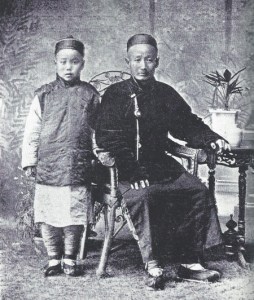
The events take place in the middle of the 19th century. At this time the last rabbi died and the Jews were in the final stages of being assimilated into the Chinese culture. One big reason can be summed up in this question that several of the characters ask themselves: “…here [in China], where all are friends to us and receive us eagerly into their blood, what is the reward for remaining apart?”

The story is told from the point of view of the Chinese bondmaid Peony, who belongs to a Jewish household and for her own survival uses all her resources to promote this abandonment of her owners’ practice of their Jewish lifestyle. She and the Young Master of the household grew up as playmates and good friends, and now that they have come of age she works to turn his heart away from the faith that has been passed down from his parents. That may sound bad, but she is honestly playing her part in this drama in which each one tries to follow the most prudent path he can, while at the same time honoring his elders. From the distance of time or in a novel we can see a broad view, but when you are thrust into a role with no script, you can only do your best.

The substance of the Jewish faith portrayed in the novel is somewhat vague. Other than the goals of “remaining separate” and remembering their history, any tenets of faith mentioned were ideas the Chinese neighbors could and did easily agree with. An example of this is in a synagogue mentioned in the story, on whose stones are written “‘The Temple of Purity and Truth,’ and beneath the words are carved the history of the Jews and their Way, and it is there said, ‘The Way has no form or figure, but is made in the image of the Way of Heaven, which is above.'”

The name of the temple is factual, and if the confusing statement about The Way comes from Pearl Buck’s imagination, it is probably based on the truth of what it is like to try to live out a faith tradition that is more history than reality. This experience is certainly not foreign to many moderns.

I don’t know when I last read such a wonderful work of fiction. It was a page-turner because I could not at all imagine how the plot would flow. The setting in China was the primary strange aspect for me; I don’t think I’ve read any of Buck’s other works set in that country and I’ve been fairly incurious about Asia generally. But recent exposure to the writings of Lin Yutang has made the history and culture of China seem much more accessible and intriguing, and prepared me to enter into this tale.

Peony is a young Chinese girl whose depiction I fully trust, because Pearl S. Buck grew up in China as the daughter of Presbyterian missionaries and was immersed in that world. She returned as an adult and wrote many books about China and its people, including the most famous one, The Good Earth. Lin Yutang himself was a friend of hers and they seem to have encouraged each other in their writing.

Peony was sold by her mother to the family whom she serves; she has no one else but them in the world. So she sees that it is in her interest to be the very best servant she can be, and she truly loves not only the Young Master but his parents. About the Young Master she thinks, “His heart was centered in himself, and so must hers be centered in him.”

Her love for the family increases as the years go by, even as they come to depend on her in countless ways. That’s o.k., because she always tries to make things work out for their health and welfare. Her own happiness must be found in the context of disappointment, and in relationship with people who take her for granted.

When she is still fairly young she asks the older servant a philosophical question:

Was life sad or happy? She did not mean her life or any one life, but life itself— was it sad or happy? If she but had the answer to that first question, Peony thought, then she would have her guide. If life could and should be happy, if to be alive itself was good, then why should she not try for everything that could be hers? But if, when all was won, life itself was sad, then she must content herself with what she had.

“You cannot be happy until you understand that life is sad,” Wang Ma declared. “See me, Little Sister! What dreams I made and how I hoped before I knew that life is sad! After I understood this truth I made no more dreams. I hoped no more. Now I am often happy, because some good things come to me. Expecting nothing, I am glad for anything.”

Getting to know Peony and watching how she matures over the years was pure pleasure. She has good sense and character even as a teenager, and as she responds to the sometimes cataclysmic changes in the household her competence and wisdom grow, often through struggling to overcome her own desires and heartache. Through her we get an idea of how the Jewish religious practices might have appeared to the Chinese, and she also epitomizes many of the best qualities of the Chinese and their outlook on life that I was only recently reading about in Lin Yutang’s books.

For me the Jewish characters in the story were also unpredictable, though they are well-drawn and believable. They are people of their particular time and place, most of them already a unique blend of the Chinese and Hebrew. The patriarch of the family is of mixed-blood, having had the “consolation” of “a rosy, warm little Chinese mother.” This image is contrasted with his own wife who is almost single-handedly trying to preserve their religious tradition, and who causes a Jewish friend to muse, “For a woman to love God too much was not well, he now told himself. She must not love God more than man, for then she made herself man’s conscience, and he was the pursued.”

This theme of women and their power is another element of the story that fascinated me, being myself a woman with power. Of the only son David we read,

His mother, Leah, Peony, Kueilan, these four women who had somehow between them shaped his life were shaping him still. He longed to be free of them all, and yet he knew that no man is ever free of the women who have made him what he is. He sighed and tossed and wished for the day when he could return to the shops and the men there who had nothing to do with his heart and his soul.

In the end it is Peony who has the best and sweetest sort of influence. Her conversation with the father when she is giving him a foot-rub:

Peony knew his thoughts. Nevertheless, she asked, “Why do you sigh, Master?” “Because I do not know what is right,” Ezra replied. She laughed softly at this. “You are always talking of right and wrong,” she said. Now she was pressing the soles of his feet. They were hard and broad, but supple. She went on in her cheerful way. “Yet what is right except that which makes happiness and what is wrong except that which makes sorrow?” “You speak so because you are not confused between Heaven and earth,” he said. “I know I belong to earth,” she said simply.

I’ve tried not to spoil the story by telling too much. One review I read ahead of time said something about the ending being sad, but I didn’t find it so. We find Peony considering her life and that of the people she has served, and wondering if she had been wrong to have a part in closing the book on the Jewish tradition in her city. In keeping with her outlook on life and religion, she concludes that it’s all o.k.:

Long she pondered, and as often happened to her in her great age, the answer came to her. She had not done wrong, for nothing was lost. “Nothing is lost,” she repeated. “[The Jew] lives again and again, among our people,” she mused. “Where there is a bolder brow, a brighter eye, there is one like him; where a voice sings most clearly, there is one; where a line is drawn most cleverly to make a picture clear, a carving strong, there is one; where a statesman stands most honorable, a judge most just, there is one; where a scholar is most learned, there is one; where a woman is both beautiful and wise, there is one. Their blood is lively in whatever frame it flows, and when the frame is gone, its very dust enriches the still kindly soil.”

kaifeng-jews-450x532