Category Archives: culture

Poetry is on the side of being.

A Touchstone magazine article from a while back ponders “On the Loss of Poetry as Necessary Knowledge.” In it Stephen Faulkner warns,

“Our modern poetry is in pieces…. This makes a defense of poetry difficult. But defend it we must, for poetic knowledge is an essential kind of knowledge. Without it, our understanding of the world suffers a severe distortion. It is as if we have grown up in an age of one-eyed men who have heard rumors that people could once judge distances, depths, and colors by the use of two eyes, but are now reduced by this flat, prosaic information age that relies on scientific analysis as virtually our only source of knowledge. We are a century of Cyclops.”

Though Faulkner wrote that in the 20th century, I doubt whether he would think the situation has improved in the 21st. In the same year as the Touchstone article, Czeslaw Milosz published this offering that is a form of therapy for our distorted vision: In the introduction to the anthology of poetry that he compiled, The Book of Luminous Things, he writes:

“Many poems that I like or admire are not in this anthology because they do not correspond to my criteria of size and accessibility to the reader.”

“My proposition consists in presenting poems, whether contemporary or a thousand years old, that are, with few exceptions, short, clear, readable and, to use a compromised term, realist, that is, loyal toward reality and attempting to describe it as concisely as possible. I act like an art collector who, to spite the devotees of abstract art, arranges an exhibition of figurative painting….”

He also thinks we moderns are missing something essential to our soul’s health. Whereas Faulkner writes metaphorically of a problem with our eyes, Milosz says, also metaphorically but more generally, “We seem to be missing some vital organs…”

“I have written elsewhere of this deprivation as one of the consequences brought about by science and technology that pollutes not only the natural environment but also the human imagination. The world deprived of clear-cut outlines, of the up and the down, of good and evil, succumbs to a peculiar nihilization, that is, it loses its colors, so that grayness covers not only things of this earth and of space, but also the very flow of time, its minutes, days, and years. Abstract considerations will be of little help, even if they are intended to bring relief.

“Poetry is quite different…. Since poetry deals with the singular, not the general, it cannot — if it is good poetry — look at things of this earth other than as colorful, variegated, and exciting; and so, it cannot reduce life, with all its pain, horror, suffering and ecstasy, to a unified tonality of boredom or complaint. By necessity poetry is therefore on the side of being and against nothingness.”

Almost all of the poems are introduced with a line or two about what he likes about that one, as an example of good poetry. None of his own poems is included. Here is one from the collection with a teacherly comment from Milosz to introduce it:

Walt Whitman

“The strong presence of a thing described means that the poet believes in its real existence. That is the meaning of a programmatic and unfinished poem by Walt Whitman, ‘I Am the Poet,’ which rehabilitates a ‘naïve’ approach and rejects philosophy’s unfavorable opinion on the direct testimony of our senses.”

I AM THE POET

I am the poet of reality
I say the earth is not an echo
Nor man an apparition;
But that all the things seen are real,
The witness and albic dawn of things equally real
I have split the earth and the hard coal and rocks and the solid bed of the sea
And went down to reconnoitre there a long time,
And bring back a report,
And I understand that those are positive and dense every one
And that what they seem to the child they are
[And that the world is not a joke,
Nor any part of it a sham].

-Walt Whitman

Thinking about babies and Barbie.

As I may have said here before, I have probably watched fewer movies than anyone you know. So I don’t often mention them. The two I saw most recently were “My Octopus Teacher” and “Babies,” both of which I’ve enjoyed more than once. I watched “Babies,” a 2010 French documentary, with my four-year-old grandson just last month. Its subjects are four babies in their first year of life, in Namibia, Mongolia, Tokyo, and San Francisco.

I very much love that movie, for the meditative and close-up way it shows vastly different styles of mothering across cultures and around the world. I admit, my own style doesn’t exactly fit with any of those shown, but if I had to choose among the four, I feel most akin to the Mongolian way. In any case, all the families in the movie are pretty traditional for the local culture in which they are raising their children.

The contrast between that movie and the current one everyone is talking about, “Barbie,” didn’t cross my mind until I read this article in Salvo Magazine“Existential Barbie: A World Without Love is Never Kenough,” by Annie Brownell Crawford. The author starts with a brief introduction:

“The plot begins when Barbie suddenly starts thinking about death, her feet fall flat, and she discovers cellulite on her thighs. To solve her existential crisis, Barbie travels to the real world with her unwanted Ken tagging along. When she arrives in California, Barbie is shocked to discover a world of exaggerated patriarchy where men think of her as an object and girls hate her for her beauty. Here, as the teen character Sasha explains, ‘Men hate women, and women hate women.’

Crawford notes that “the film moves chaotically between satire and sincerity,” and she wouldn’t be quick to draw conclusions from the above statement alone, but there are reasons to think it was meant seriously. So she responds,

“Modern feminists seem to hate women as much as they believe men do, for the female body confronts all of us with our intrinsic dependence on one another and ultimately upon God. As the apostle Paul reminds us, ‘woman is not independent of man, nor is man independent of woman. For as woman came from man, so also man is born of woman. But everything comes from God.’ (I Corinthians 11)  We only know ourselves as women and as men through our relationship with each other, and we only know ourselves as humans in relationship to the God we image. The female body reminds us of this interdependence and the givenness of our existence, for our mothers literally gave us life.”

Of course the biggest difference between these two movies is that one is all about babies, and the other one lacks babies entirely, except for the unfortunate baby dolls:

“The film opens with an origin story wherein the newly created Barbie rescues little girls from being forced to play with baby dolls. After independent, infertile Barbie arrives, the young girls of the world celebrate their liberation from motherhood by smashing their babies to bits.”

I’m not enough of a movie buff that I am likely ever to see “Barbie,” but if I did, I might afterward go on to read some of the critics who are saying that if you dig deep through those layers of irony and satire, it’s actually anti-feminist and conservative in its message. Maybe how you feel about that depends partly on what you think The Patriarchy is. Is Ken in or out of it?

I wonder if Kimberly Ells has seen “Barbie”…. She attended the Commission on the Status of Women at the United Nations this spring and heard much about the desire to “smash” and “eradicate” the patriarchy; so she started asking around at the event, What is The Patriarchy, exactly? She wrote succinctly about the answers she got in this article: “In Praise of Men.”

I’d be interested to hear if any of my readers has thoughts about these movies or the questions raised by “Barbie.” And if you haven’t seen “My Octopus Teacher” or “Babies,” I definitely recommend those!

A Mongolian mother and child.

Man was also a culture-bearer.

The trees and bushes in my garden get bigger year by year, requiring more attention from me; and several other aspects of my present life prevent me from having the leisure I once had, to write reviews of the books I read. For example, A Canticle for Leibowitz, which I only finished this month. It is the first post-apocalyptic novel I’ve ever read, published in 1959.

It made a big impression on me, which I probably wouldn’t be able to analyze or articulate to my satisfaction, so I didn’t even begin to try, but immediately moved on to a different book. (It’s my experience that reading books doesn’t require the same quality of leisure as writing reviews.) But O happy day! Jeff Bilbro mentioned the book, with a quote, in the newsletter of The Front Porch Republic, so I will just pass that on, with thanks to him. I also commend the other articles on that site, or their print journal, as worthy of your consideration. Here’s Jeff:

“I recently read Canticle for Leibowitz by Walter M. Miller Jr., and I found it a moving narrative exploring the proper cultural and religious conditions for rightly valuing knowledge. The novel follows a monastic order that forms in the wake of a nuclear holocaust, and they carefully preserve remnants of the former industrial civilization through generations of warfare until human civilization is ready to rediscover natural science and its applications. Can such knowledge ever be used wisely, or does increased technical know-how inevitably lead cultures to abandon religious and moral wisdom? Miller offers no easy answers. In this passage, an abbot of this monastic order reflects on the significance of the rising interest in their archives:

‘Now a Dark Age seemed to be passing. For twelve centuries, a small flame of knowledge had been kept smoldering in the monasteries; only now were their minds ready to be kindled. Long ago, during the last age of reason, certain proud thinkers had claimed that valid knowledge was indestructible—that ideas were deathless and truth immortal. But that was true only in the subtlest sense, the abbot thought, and not superficially true at all. There was objective meaning in the world, to be sure: the nonmoral logos or design of the Creator; but such meanings were God’s and not Man’s, until they found an imperfect incarnation, a dark reflection, within the mind and speech and culture of a given human society, which might ascribe values to the meanings so that they become valid in a human sense within the culture. For Man was a culture-bearer as well as a soul-bearer, but his cultures were not immortal and they could die with a race or an age, and then human reflections of meaning and human portrayals of truth receded, and truth and meaning resided, unseen, only in the objective logos of Nature and the ineffable Logos of God. Truth could be crucified; but soon, perhaps, a resurrection.’

“Thanks for spending some time with us on the Porch,

Jeff Bilbro”

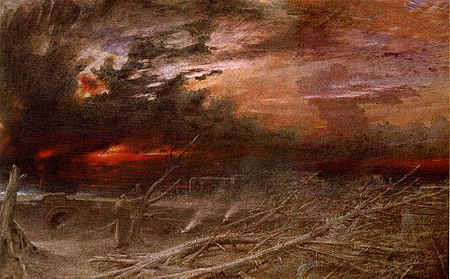
Apocalypse by Albert Goodwin

Notable birthdays of May 29th.

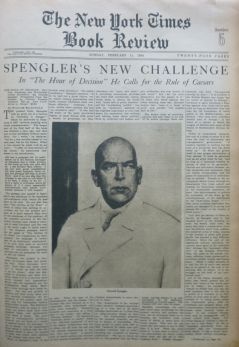
I frequently look in on Garrison Keillor’s The Writer’s Almanac, but rarely do I find every item from his column interesting, as I did today. Today is a reprint of what was in the column in 2017. Of course, it being the birthday of G.K. Chesterton, I wanted to read what Keillor might say about that favorite writer of mine. But Bob Hope and Oswald Spengler were also born on the 29th of May. Spengler studied the history of civilizations, and published the book The Decline of the West in 1918.

A quote from Christopher Hitchens is included in this piece, which I found quite a contrast to the legacies of the other three men; it made me feel sorry for him.

Keillor leads off with the poem, “A Dream of the Future,” by Joyce Sutphen, which I think ties in nicely with the subject of Spengler’s thesis about the “blossoming and withering” of cultures over time.

If any of this piques your interest, check out The Writer’s Almanac.