Category Archives: history

Sun temples don’t celebrate in winter.

Why is Christmas on December 25? Did Christians make use of a pagan festival date when they decided to celebrate Christ’s birth? Very unlikely, as you will understand if you read William J. Tighe’s  “Calculating Christmas.”

“In the Julian calendar, created in 45 B.C. under Julius Caesar, the winter solstice fell on December 25th, and it therefore seemed obvious [to some] that the day must have had a pagan significance before it had a Christian one. But in fact, the date had no religious significance in the Roman pagan festal calendar before Aurelian’s time, nor did the cult of the sun play a prominent role in Rome before him.

“There were two temples of the sun in Rome, one of which (maintained by the clan into which Aurelian was born or adopted) celebrated its dedication festival on August 9th, the other of which celebrated its dedication festival on August 28th. But both of these cults fell into neglect in the second century, when eastern cults of the sun, such as Mithraism, began to win a following in Rome. And in any case, none of these cults, old or new, had festivals associated with solstices or equinoxes.”

Tighe explains that “…the pagan festival of the ‘Birth of the Unconquered Sun’ instituted by the Roman Emperor Aurelian on 25 December 274, was almost certainly an attempt to create a pagan alternative to a date that was already of some significance to Roman Christians. Thus the ‘pagan origins of Christmas’ is a myth without historical substance.”

If they didn’t choose December 25 for that reason, why did they? For reasons we never would have thought of in modern times. Read the whole brief article to find out.
It could be new.

Elizabeth Jennings was younger than I am now when she wrote the poem below, which includes lines about “not fitting in,” and about  being old and unnoticed. But the finish, “At last you can be…” is so promising, and expresses what I want to be learning.

Have you seen the meme of the month, as we see the 2020’s drawing near? (Mostly young) people are posting photos of themselves from the beginning of the decade to compare with others more recent, sometimes with an assessment of, or a thanksgiving for, what has happened in their lives in those ten years. Izzy’s photos were the most striking, because ten years ago she was still a chubby pre-teen, and her Now photo shows an adult holding my great-granddaughter; Izzy is a blossoming and lovely wife and mother.

My daughter Pearl’s thankful husband posted pictures of her, from 1999, 2009, and this year, and they are stunning to me, as they not only show how she has become more beautiful with every decade, but hint that her beauty flows from some of that liberty that this poem explores, and it shines out from her countenance as peace and joy.


From my vantage point, on the outside I seem to have changed little in ten years, and God only knows what has happened on the inside; it’s not for me to assess. I am astonished most mornings at His mercy and grace in giving me one more day of strength to engage with my struggles, and to love His creation, including the humans.

I’m sure the title of this poem carries multiple meanings — related also to what is communicated in the last lines, where “to include them all” might mean two things: First, to be all the things that the young and old can’t have, to have in your person and consciousness the blessings and wisdom of all the ages that you ever have been; and also, to include all of those who for various reasons ignore or scowl at you. To hold them in your love, and in your prayers.

Happy Thanksgiving!

ACCEPTED

You are no longer young,
Nor are you very old.
There are homes where those belong.
You know you do not fit
When you observe the cold
Stares of those who sit

In bath-chairs or the park
(A stick, then, at their side)
Or find yourself in the dark
And see the lovers who,
In love and in their stride,
Don’t even notice you.

This is a time to begin
Your life. It could be new.
The sheer not fitting in
With the old who envy you
And the young who want to win,
Not knowing false from true,

Means you have liberty
Denied to their extremes.
At last now you can be
What the old cannot recall
And the young long for in dreams,
Yet still include them all.

-Elizabeth Jennings

Bishop Latour meets the elegant goats.

I’ve read Death Comes for the Archbishop by Willa Cather three times, including an audio recording narrated by David Ackroyd which I only recently completed. These three readings were so far apart that each time seemed a fresh introduction to the characters and the setting. And yet, I do think that the first two readings helped to form a love in my soul for the Southwest territories of the United States, so that this third time I found it there waiting for me, like the warm sand beneath a red rock butte, a place where I might bed down for the night under the stars and feel whole.

Ackroyd’s voice and narrative style seem perfect for the story. There is a steadiness and a lack of hurry that aligns with the faithful dailiness of the lives of the two missionary priests as they try to meet the spiritual needs of a vast diocese that had just enlarged by nearly 30,000 square miles with the Gadsden Purchase.

They are based in Santa Fe, New Mexico, but make frequent trips by horse or mule of hundreds and thousands of miles, even into Old Mexico, to take care of ecclesiastical affairs, to baptize babies and perform marriages, and to serve Mass. Their characters are sympathetic and rich; the story of their friendship over the decades is a thread woven through the novel, made up of small stories scattered through the years.

I’m using this audio book now the way I have two or three others in the last years since I sleep alone, for the times when I don’t sleep. I put a well-known story to play on my phone, set the timer for 30 minutes, and let David or another nice person read me to sleep. This only works with voices that do not draw attention to themselves in various ways, usually by being overly dramatic.
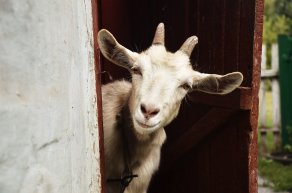
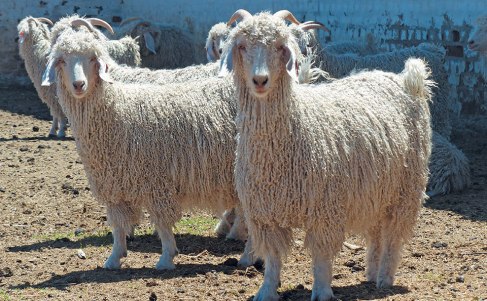
That means I am reading/listening to the book, based on a true story by the way, a fourth time. Because every anecdote and scene seems more luminous and meaningful than ever when it is told or described by a warm human voice, I may post here some passages that appear plain and dry to you poor people who may never have breathed the air of New Mexico or seen the Arizona desert in bloom. But today, it’s only goats we will consider, and I imagine that they are goat-ish the world over.

“After the feast the sleepy children were taken home, the men gathered in the plaza to smoke under the great cottonwood trees. The Bishop, feeling a need of solitude, had gone forth to walk, firmly refusing an escort. On his way he passed the earthen threshing-floor, where these people beat out their grain and winnowed it in the wind, like the Children of Israel.

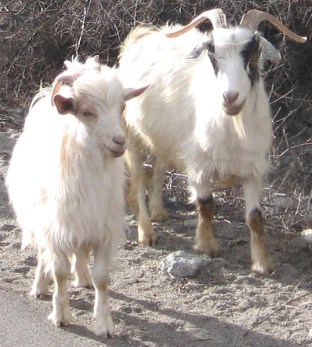
“He heard a frantic bleating behind him, and was overtaken by Pedro with the great flock of goats, indignant at their day’s confinement, and wild to be in the fringe of pasture along the hills. They leaped the stream like arrows speeding from the bow, and regarded the Bishop as they passed him with their mocking, humanly intelligent smile. The young bucks were light and elegant in figure, with their pointed chins and polished tilted horns. There was great variety in their faces, but in nearly all something supercilious and sardonic. The angoras had long silky hair of a dazzling whiteness.

“As they leaped through the sunlight they brought to mind the chapter in the Apocalypse, about the whiteness of them that were washed in the blood of the Lamb. The young Bishop smiled at his mixed theology. But though the goat had always been the symbol of pagan lewdness, he told himself that their fleece had warmed many a good Christian, and their rich milk nourished sickly children.”

-Willa Cather in Death Comes for the Archbishop

The poetry of a wise man might crack your shell.

Many people seem to think that politics will save us, that if we could just get the right people, or “our people” in office, they would begin to set things right, however we envision that. Anthony Esolen in the article Listening Up, in the Nov-Dec 2019 issue of Touchstone magazine, discusses some reasons for this idea, and its often corresponding impulse to judge our human forefathers for their sins, judgment not “by eternal verities, but by the cheap modern substitute, the ‘political.'”

He believes we lack historical imagination, and he sets out to consider the different ways one might make better use of stories and history in general, giving examples first from antiquity:

“So to attempt to transpose Xenophon or Cyrus to the current day, and to grill him with ‘political’ questions, is not to think politically at all, but to replace reality with a caricature. You will learn nothing from Xenophon that way. You may instead be out to teach him a lesson, him, that is, being the cartoon Xenophon you have made. At no time do you allow yourself to be still and to learn, so that the poetry of a wise man might penetrate your shell, crack it open, and show you the stars.

“Once you enter the world of history, you encounter the maddening complexity of human affairs, not to mention that labyrinth called the human heart. With hindsight we can say, with some confidence, that the young Octavius was far better suited for governing the Roman world than was the elder and more experienced Antony. We cannot be so sure of ourselves, though, when it comes to the noble-minded Brutus, and the ambitious and capable Julius Caesar, whom he assassinated.”

Esolen goes on to mention American leaders of note, and of complex history and character, such as William Tecumseh Sherman, and Stonewall Jackson, “a genuinely kindly owner of slaves.” And then he comes to his “three broad categories of modern man, each of them characterized by the stories they listen to and tell”: The Man of Faith, The Man of Wistful Unbelief, and the Man of Superstition.

I found his categories to be very helpful in understanding differences between people in the first two groups especially, and their stories that nourish our hearts. Oh, if only the third group would quiet down and listen to some true stories! But they don’t like the stories of the other two groups, and have their own ever-changing and doubtful heroes.

“History is too dark and tangled a forest for them, sacred Scripture too high a mountain to climb. Therefore they fall into worship of the biggest or most prominent things near them: sex, themselves, the State.”

“They are not brave enough to enter the dark caverns of the human heart…. they cannot forgive what men and women really are. They have no sense of sin, which afflicts everyone, including themselves, but they grasp at being among the elect, by having the most up-to-date pseudo-political opinions.”

You can read the whole article here: “Listening Up.”

People who make history know nothing about history.
You can see that in the sort of history they make.
-G.K. Chesterton