“Worship the Lord in the beauty of holiness.” -Psalm 96:9
Back when my new garden was in its immaturity, and gave the impression of rolling hills of orangey mulch, with lonely plant starts like trees on the prairie, I knew that I wanted an icon there, to honor the presence of Christ and his saints. I invited artistic Christian guests to sit over dinner in the garden and discuss the eventual placement of the stand for the icon that I didn’t own yet; I didn’t know at that point whose iconic image I wanted.

Years went by after I had decided on the spot, and a thousand decisions about other things crowded out any research I might do on this question, other than browsing pictures of such displays online, by which I developed a vague idea of what sort of frame and post I wanted. And I knew the icon must be of a material that wouldn’t be damaged by the weather.
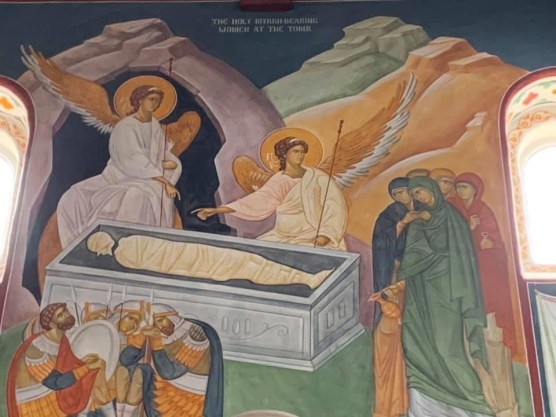
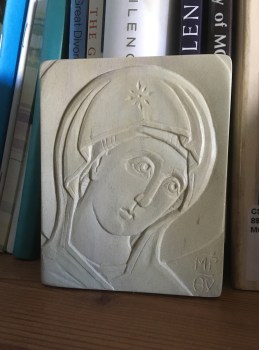 Then one day, I think it was in 2019, I happened to see on Facebook this stone icon of the mother of Christ, carved by Jonathan Pageau, and it was available. I hadn’t been looking, and it wasn’t up very long; now I wonder if God didn’t arrange the whole thing, knowing that I would never finish my project if He didn’t put her right in front of me. Later I thought how natural it is that she would be the subject of sacramental art in my garden, she who was certainly in that historic garden 2,000 years ago — the place where her Son revealed Himself to have conquered death, and where women first discovered the empty tomb.
Eventually I asked my dear woodworking friend Aaron if he would build the stand, in his spare time – ha! What diligent husband and father of four has spare time? But he really wanted to do it, and he and I conferred over the last few months about the design and what wood he would use. The pandemic and resulting quarantine recently gave him the extra time he needed.
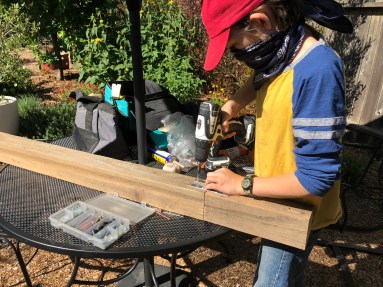
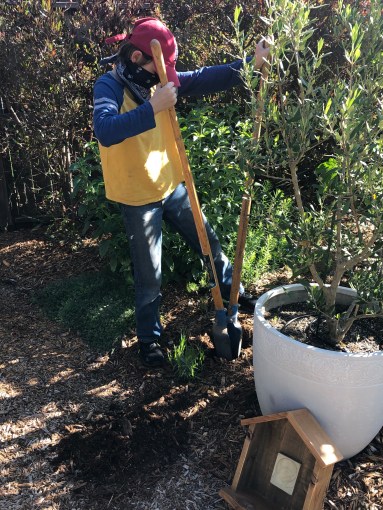


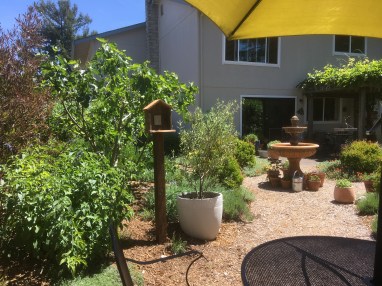
It was nearly on the eve of Myrrhbearers’ Sunday that he let me know he was ready, and he came with his older son to install it. Their appreciative sharing of my natural paradise for an hour was added joy for all of us. O glorious day! And now, though the beautiful plants will bloom and fade, come and go with the seasons and years, this reminder of permanent and heavenly realities is finally here, and I feel that my garden is complete.
“Through icons the Orthodox Christian receives a vision
of the spiritual world.”
-Timothy Ware

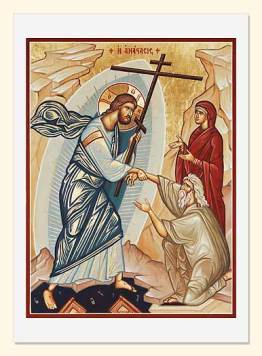 Until a recent vocabulary expansion, I knew little Italian beyond pizza and zucchini. Now I know mandorla, which means almond. In the language of iconography, it means a background shape, often an almond shape but not always, which conveys meaning having nothing to do with the nut.


 Gladsome Lights