Category Archives: poetry

He made comely poems.

I was so sorry to hear a couple of weeks after the event that the poet Richard Wilbur had fallen asleep in death. It’s interesting to read about the ambivalence within the community of literary critics regarding his work throughout his career and now at his passing.

The New York Times quotes its own reviewer David Orr who mused that “Mr. Wilbur had ‘spent most of his career being alternately praised and condemned for the same three things’ — for his formal virtuosity; for his being, ‘depending on your preference, courtly or cautious, civilized or old-fashioned, reasonable or kind of dull’; and finally for his resisting a tendency in American poetry toward ‘conspicuous self-dramatization.’”

Might it be that one’s opinion about Wilbur’s poetry has something to do with whether you appreciate his perspective on things? If when you read his poems you find they quicken your own love for life and the cosmos? In another quote from the New York Times: “’I feel that the universe is full of glorious energy,’ he said in an interview with The Paris Review, ‘that the energy tends to take pattern and shape, and that the ultimate character of things is comely and good.'” My favorite not-so-recent article on Wilbur draws attention to his Christian vision and is found in First Things.

Over the life of my blog many of Wilbur’s poems have shown up here — which you might find by putting his name in the search box on the right —  and I’ve been wanting to post his poem “Worlds” for a year or more now. I first read it when David Bentley Hart’s book The Experience of God was fresher in my mind, and I had some brilliant idea that linked the two philosophers… that thought has dimmed to the vanishing point. Now I offer the poem as a picture of two ways of looking at the world, represented by Alexander the Great and Isaac Newton. If Richard Wilbur imagined himself in this poem, I’m sure he would hope to be found serenely playing alongside Newton, another man of faith and great vision. May God grant him the Kingdom.

WORLDS

For Alexander there was no Far East,
because he thought the Asian continent
ended with India.
Free Cathay at least
did not contribute to his discontent.

But Newton, who had grasped all space, was more serene.
To him it seemed that he’d but played
With a few shells and pebbles on the shore
Of that profundity he had not made.

– Richard Wilbur


The happening illimitably earth.

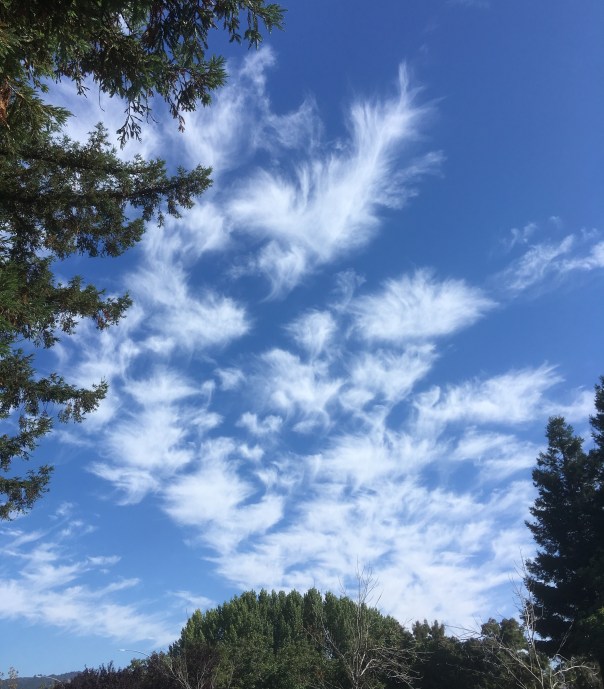
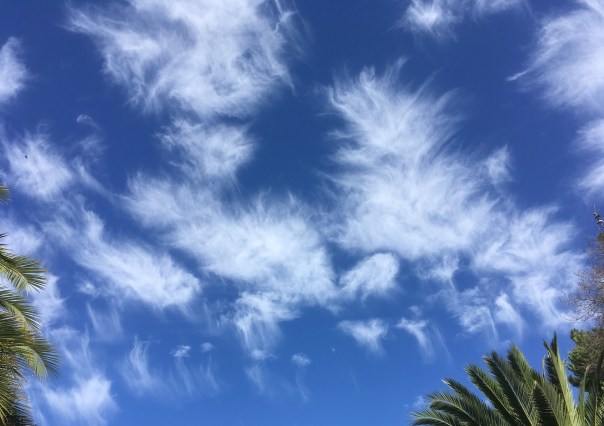
I wanted to go walking on the earth this morning. It was still dark when sleep left me, so I waited a little while, and put some water in the fountain, and saw a perfect half moon in the seemingly illimitable sky. It had rained in the night and the air was damp and cool, but not at all cold.


I walked half a block, and looking east, I saw the prelude to the sun’s birthday.

Along the redwood-lined path, I sniffed the woodsy scent; I walked along the mowed hayfield where the essence of sage-y weeds was carried in the humidity. And then along the creek, with swampy smells wafting across the way.

And the sky! It was big. God was big and so rich toward me, in His earth and creation, His presence. My senses were not adequate to the feast and I knew I would be drunk before breakfast. Glory to God in the highest! It was the birthday of (my) life and love.

i thank You God for most this amazing
day: for the leaping greenly spirits of trees
and a blue true dream of sky; and for everything
which is natural which is infinite which is yes
(i who have died am alive again today,
and this is the sun’s birthday; this is the birth
day of life and of love and wings; and of the gay
great happening illimitably earth)
how should tasting touching hearing seeing
breathing any – lifted from the no
of all nothing – human merely being
doubt unimaginable You?
(now the ears of my ears awake and
now the eyes of my eyes are opened)

–e.e. cummings

My Delta Sunflowers are big, and as they grow tall they break and fall over, so I have cut some, and made tangled and droopy bouquets that seem to be better suited to the patio table than the kitchen counter, where the flowers hung down and dropped little piles of pollen on the stone, on the appliances, whatever.

The lamb’s ears need thinning. My two species are so different! Here are the new ones, after cleaning up, in the front yard:

And here are the old survivors that keep growing just as vigorously, and even make flowers. But they look scraggly by comparison. I have to love my old vintage ears more; because they are thinner and gangly, they don’t make a convenient nest for the earwigs the way the fat and lush ones did this summer:

I found plums on the Elephant Heart Plum trees after all. First I spied one on the ground from the kitchen window: “Hey! That’s a plum!” So I went out right away and picked it up, and rummaged through the two trees to see if I had missed any others. I found three more fruits that didn’t seem to be quite ripe, hiding very effectively. So I ate the one that had fallen, and it was yummy. Since then I’ve been out twice to check on the other three, and they are nowhere to be found.

But our recent heat-smoke-humidity wave has started my figs ripening. This was the first one, which I discovered on the day when it had overnight turned from green to black. After taking its picture, I ate it, and it was everything a fig should be: juicy and sweet and more refreshing than a glass of water.

This is tasting touching hearing seeing breathing – yes.

The blackness cannot eclipse this.

Some of us celebrate the Feast of the Transfiguration on August 6th, which is on Sunday this year. Here is an excerpt from “Transfiguration” by Malcolm Guite:

“The Love that dances at the heart of things
Shone out upon us from a human face
And to that light the light in us leaped up…”

Do skip over to Guite’s page so you can hear him read his latest poem himself.


All night picking peaches.

I think this poem is about a dream. Do you think so? I wish a few of my dreams might have been transformed into such lush stories, thereby preserved as memories of the occasional nocturnal fantasies that are not best forgotten.

The Leaving

My father said I could not do it,
but all night I picked the peaches.
The orchard was still, the canals ran steadily.
I was a girl then, my chest its own walled garden.
How many ladders to gather an orchard?
I had only one and a long patience with lit hands
and the looking of the stars which moved right through me
the way the water moved through the canals with a voice
that seemed to speak of this moonless gathering
and those who had gathered before me.
I put the peaches in the pond’s cold water,
all night up the ladder and down, all night my hands
twisting fruit as if I were entering a thousand doors,
all night my back a straight road to the sky.
And then out of its own goodness, out
of the far fields of the stars, the morning came,
and inside me was the stillness a bell possesses
just after it has been rung, before the metal
begins to long again for the clapper’s stroke.
The light came over the orchard.
The canals were silver and then were not.
and the pond was–I could see as I laid
the last peach in the water–full of fish and eyes.

~Brigit Pegeen Kelly

Update: I love how M.K. responded by “thrashing” the poem on her blog.