Category Archives: reality

To think about the nature of lies.

“A lie seeks to make true something that has no true existence. It is an ‘alternate,’ make-believe universe to the one in which we live. Our desire for alternatives (and our fear of reality) are among the many motivations behind lies. It is revealing, however, to think about the nature of lies (which also reveals the nature of the truth). It is, at the very least, a matter of existence.”

“That which is true, is that which truly exists. As such, it is always its own strongest argument. If it truly exists, it will continue whether I believe in it or not. The truth does not require ideology. This carries the corollary of a lack of anxiety. If the truth abides, whether I believe it or not, then I am not bound to ‘make it so’ through the efforts of a culture war. It is, rather, for me to live it, to give thanks for it, and enjoy its fruit in the world.”

-Father Stephen Freeman, in this article: “‘Make It So!’ vs. ‘Let It Be!'”

My non-philosophy that is reality.

Karl Jaspers

Why would a Christian like me want to read a whole book about existentialism? At least a few of my readers are confused about that. I may in the future share more of my gleanings from this book as it helps me understand this modern age that we live in, but now let me just clarify that it is the enlightening presentation by William Barret that I find beautiful, not the anxiety and “spiritual homelessness” of the Europeans whom he includes in the lonely camp of existentialists.

In contrast to their interesting but ultimately unsatisfying way of thinking, Father Stephen Freeman writes about our existence in a non-existentialist way. If I hold to a philosophy, it is this non-philosophy, which is reality, my life in God:

“The modern movement of secular thought has been to move existence into an independent and self-defining realm, relegating God and religion to a specialized interest of those who find themselves religiously minded. This is the death of religion – or rather a religion of death. For as soon as our existence is moved away from God and grounded in something else, God Himself has been abandoned. It is not possible for God to be a lesser concern. Either He is the very ground of our existence or He is no God.”

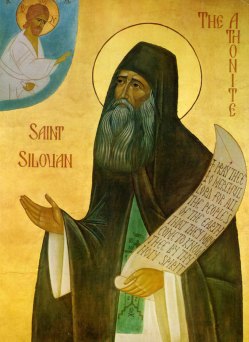
“As Met. John Zizioulas has famously stated, ‘Being is communion.’ In such a context we are able to move towards authentic existence – a mode of being that is not self-centered nor self-defined, but that is centered in the Other and defined by communion. Sin is removed from its confines of legalism and mere ethics and placed at the very center and character of existence itself. Sin is a movement towards non-being. In contrast, to know God is to love and its greatest test is the love of enemies. As St. Silouan taught: ‘We only know God to the extent that we love our enemies.’”

“Christ is, as He said: the Way, the Truth and the Life. His death and resurrection are the movement of God’s love to rescue humanity from a self-imposed exile from true and authentic existence which is found only in communion with God… It presses the question upon us all: ‘What is the truth of my existence?'”


One thing does not exist.

EVERNESS

One thing does not exist: Oblivion.
God saves the metal and he saves the dross.
And his prophetic memory guards from loss
The moons to come, and those of evenings gone.
Everything in the shadows in the glass
Which, in between the day’s two twilights, you
Have scattered by the thousands, or shall strew
Henceforward in the mirrors that you pass.
And everything is part of that diverse
Crystalline memory, the universe;
Whoever through its endless mazes wanders
Hears door on door click shut behind his stride,
And only from the sunset’s farther side
Shall view at last the Archetypes and the Splendors.

-Jorge Luis Borges
translated by Richard Wilbur


Since we are poor, a warmth.

FINAL SOLILOQUY OF THE INTERIOR PARAMOUR

Light the first light of evening, as in a room
In which we rest and, for small reason, think
The world imagined is the ultimate good.

This is, therefore, the intensest rendezvous.
It is in that thought that we collect ourselves,
Out of all the indifferences, into one thing:

Within a single thing, a single shawl
Wrapped tightly round us, since we are poor, a warmth,
A light, a power, the miraculous influence.
Here, now, we forget each other and ourselves.
We feel the obscurity of an order, a whole,
A knowledge, that which arranged the rendezvous.

Within its vital boundary, in the mind.
We say God and the imagination are one…
How high that highest candle lights the dark.

Out of this same light, out of the central mind,
We make a dwelling in the evening air,
In which being there together is enough.

-Wallace Stevens

I discovered this poem on the blog Kingdom Poets, where the poet-blogger D.S. Martin wonders if Stevens ought even to be “mentioned in a blog about Christian poetry.” Martin also quotes a few speculative lines from a biographer of Stevens, as to the lifelong skeptic’s motives for receiving Christian baptism on his deathbed. I’d like to read more of what he wrote later in life, but the images and evocations of this poem are familiar enough to me to make me think that Wallace Stevens had truly tasted of the Kingdom of God, that Holy Spirit-quickened heart where Christ dwells, of which He spoke when He said, “The Kingdom of God is within you.”

St. Porphyrios said provocatively, “Whoever wants to become a Christian must first become a poet.Father Stephen Freeman has quoted the saint when he writes about “what can drive us both to poetry as well as theology”:

“The reduction of the world and its ‘history’ are the tools of those who lack the imagination and patience to find the truth. The Fathers tell us to ‘pay attention.’ This is true with regard to the heart, but it is also true with regard to the world around us. Attention does not solve the mystery, but it at least acknowledges its presence and gives rise to enough wonder to make understanding possible at some point.”

“Evil is never creative. It is destructive and occasionally diverse in its activities. But creativity requires energy and commitment. Evil’s own entropy always reduces it to banality and boredom. It prefers prose: poetry is too much work.”

Fr. Stephen also quotes a poem from e.e. cummings, including the lines, “i do not know what it is about you… only something in me understands…”

The type of somethings that e.e. cummings refers to can’t be known intellectually, but they are the testimony of our own experience that “mystery is not only an aspect of the divine, but part of the nature of all reality. Everything is far more than it appears.”

I am eternally grateful to writers like Wallace Stevens who commit their strength of mind and length of days to sharing their glimpses of the mysterious reality behind the obvious,

…since we are poor, a warmth,
A light, a power, the miraculous influence.