Category Archives: saints

They become resplendent.

At the Feast of the Presentation of Christ in the Temple, we bless candles in church. I liked this letter from Abbot Tryphon in which he reminds us that the Light of Christ is what our lamps and candles represent, and what makes the saints shine:

“Vigil lights are placed before the icons of the saints, according to Saint Symeon the New Theologian, as a way of showing that without the Light, Who is Christ, the saints are nothing. It is only as the light of Christ shines on them that they become alive and resplendent.
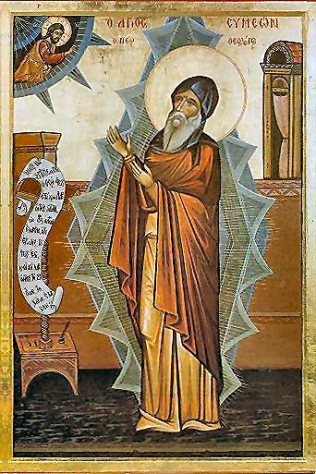
St. Symeon the New Theologian

“The saints show us what a glorious destiny we have in God, and through the example of their lives, point the way to our becoming ‘partakers of divine nature.’ The saints, as the cloud of witnesses in heaven, are present in the divine services, worshiping the Holy Trinity with us. They, as our friends, intercede before the Throne of God on our behalf, having won the good fight, and we are encouraged by the memory and example of their lives, as we struggle on our own path to God.

“It has been said that there are two kinds of people in the world: sinners who think they are saints, and saints who know they are sinners. A saint is a Christian who lets God’s light shine through, and whose life has been transformed by the power of the Holy Spirit.

“We venerate the saints as we seek their intercession with God, but we adore and worship only God in Trinity, the Father, the Son, and the Holy Spirit. We venerate the images (icons) as well as the relics of the saints and martyrs. Yet according to the decisions and Canons of the Seventh Ecumenical Council, this veneration relates not to the icons as such, but to their prototypes, or to the persons whom they represent.

“The interior walls of our temples are adorned with the icons and frescoes of the saints as a reminder that we are surrounded by the cloud of witnesses, the saints, and that the Church Militant (here on earth) is not separated from the Church Triumphant (in heaven). In Christ, death does not divide us, for the saints are not dead, but alive in Christ Jesus.

“Glory to Jesus Christ, Who is glorified in His saints.

“With love in Christ,
Abbot Tryphon”
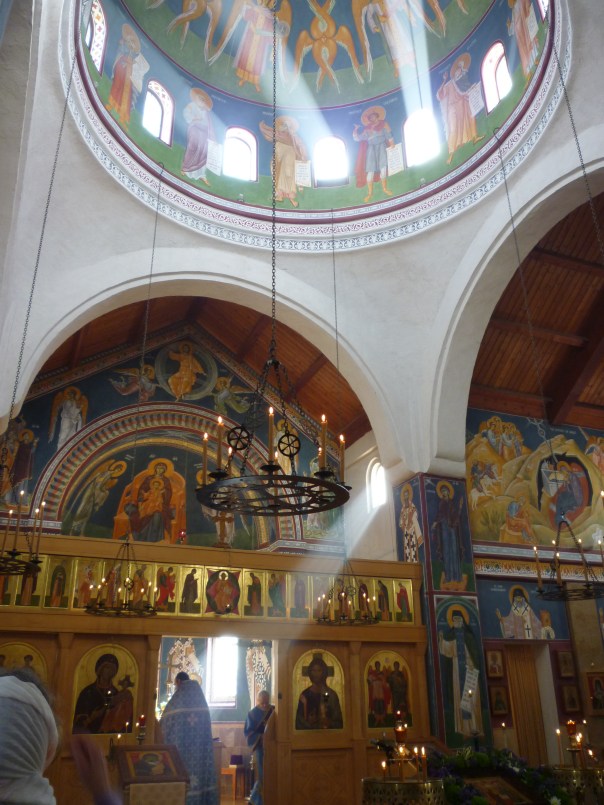
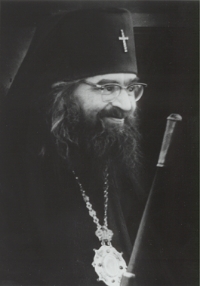
St. John of Shanghai and San Francisco

In memory of St. John the Wonderworker I am posting this story of a day of which he was the main part, one day in the last months of my late husband’s life. Today is his feast day and I am not taking part in any communal celebrations, but I wanted to at least share again a bit of his story and mine. I hope you will follow the link to read more about him.

From November 2014:

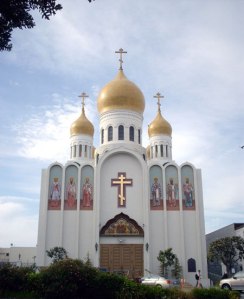
Our friends Mr. and Mrs. C drove Mr. Glad and me to San Francisco this morning for a visit to Holy Virgin Cathedral, the “Joy of All Who Sorrow.” We were going there for the same reason many people come from all over the world, to pray at the relics of St. John (Maximovitch) of Shanghai and San Francisco.

Strange as it may seem to find those cities sharing a place in the name of this saint, they form an outline of his fascinating and famous life. He was in particular famous to his many adopted children and flock of Orthodox, some of those who had settled in China years before his arrival, after fleeing from the Bolsheviks. In 1949 as the Communists John-of-San-Francisco photo smilewere coming to power there, he helped 5,000 of these expatriates to emigrate, eventually to the United States. Later still he established the cathedral in San Francisco where his incorrupt relics remain.
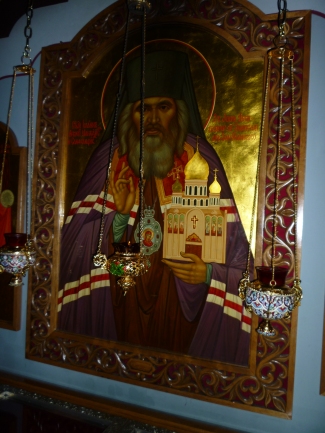
In the car on the way we told what stories we could remember about St. John. One thing he was famous for was ending up barefoot much of the time because he was always coming across someone who was without any footwear; again and again he would take off his own shoes and give them away.

Fr. John was glorified (recognized as a saint by the Orthodox Church) in 1994, and is often called St. John the Wonderworker. It was a joy to visit this place — my third time — with our friends and to pray together, asking St. John’s prayers as well.

P1110790

We were the only ones in the church for quite a while, but as we were leaving we met a few people coming in who were from Romania. The bishop in the group, it turns out, had served the liturgy at the canonization of St. John back in 1994! We were really pleased to meet someone who had such a special connection to the saint, and who was obviously thrilled to be visiting again.

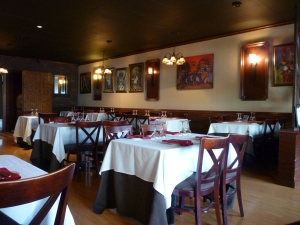
P1110802Afterward we needed lunch, so we followed the advice of the candle desk attendant at the cathedral and ate at a Russian restaurant called The Red Tavern that was also in that Richmond District neighborhood. We were the only people there, too, though from the name we half expected when we went through the door to see a group of Bolsheviks plotting in the back corner.
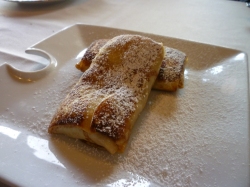
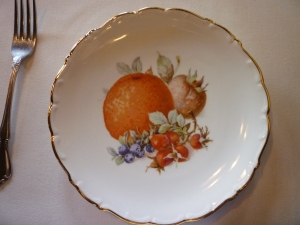
A young woP1110798man only recently from Ukraine was our waitress and we enjoyed talking to her and eating the wonderful food. I didn’t think that I liked Russian food much, but everything I tasted was superb: dark brown bread scented with caraway, fresh cabbage salad with golden raisins and tomatoes; thinly sliced fried potatoes; and barley-mushroom soup with a complex and rich flavor. We all shared some Polish poppy seed dessert that we could tell had marzipan in the filling. We cut the two pieces into two more and ate them off these pretty dishes that the waitress said were their “dessert plates.”
P1110800

The forecast had been for cold and foggy weather in San Francisco today, but the sun was shining on our day and we didn’t even need our sweaters. Also, in our souls, we felt the warmth of Christ and of our friendship.

Malachai 4:2 But for you who fear my name, the Sun of Righteousness shall rise with healing in his wings. You shall go out leaping like calves from the stall.

holy-virgin-cathedral-1 sf

From Britain to the the Black Sea….

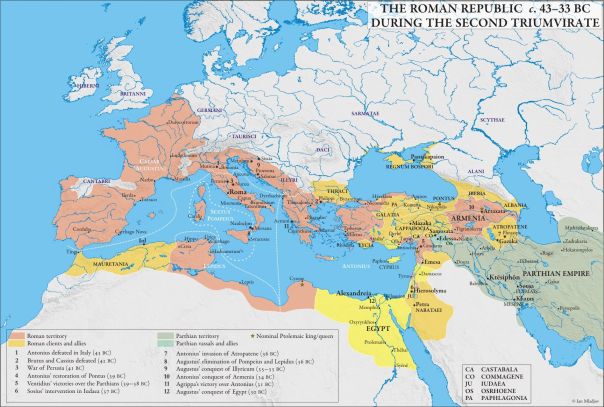
It is believed by the Orthodox Church that our Lord’s disciple Simon the Zealot was martyred in what is now the Republic of Georgia. I’ve been looking at maps of that world from the first century, but mine is never a systematic study, when I gaze at maps. Rarely do I come away with a clearer idea of geography or topography, or in this case, history. It’s one of those cases of too-muchness, and I no more hope to retain anything in particular than when I enjoy the view of of trees and plants from a hilltop.
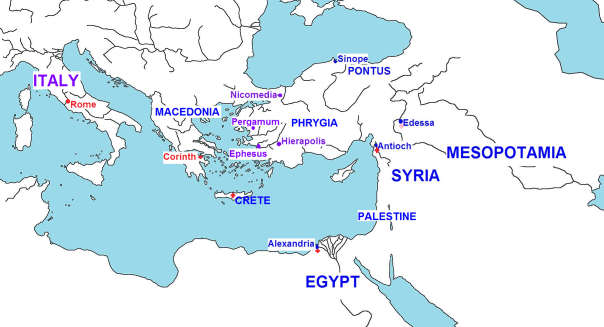
After I leave the map I never can visualize where Georgia or the Black Sea are. I should put a map just above my computer monitor, where I could gaze at it more frequently; I might even switch it out for another part of the world every few months.

Did any of you ever see the curriculum called Mapping the World by Heart? I once bought a copy of the original hard copy version for myself, not my children, thinking that I could work on it at least once a week and learn my geography. But no.

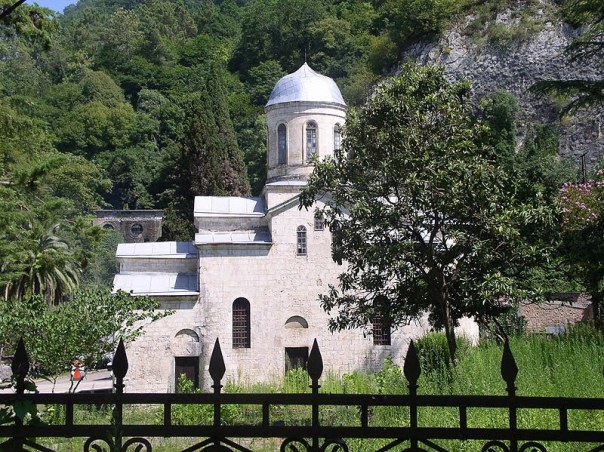
What first piqued my interest in the journeys of St. Simon was an article by John Sanidopoulos titled St. Simon the Zealot and Apostle to Georgia, in which he discusses the sources of his name Zealot and also Simon the Canaanite. He might have been the groom at the Marriage at Cana! And he is said to have traveled in Britain. There are photographs in that post of holy sites associated with the saint, like this church in Novy Afon (New Athos).

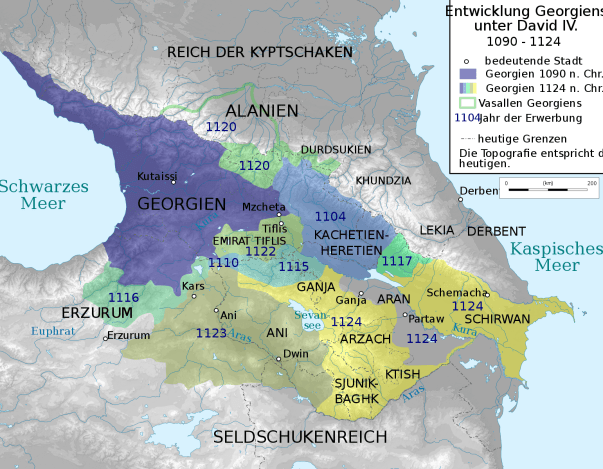
The article contains no maps, but when I set about refreshing my memory by means of a few, I came across beautiful depictions of different eras, such as this German map below, showing the 12th century in my favorite colors.

The identifying words at left, “Schwarzes Meer” are sweetly evocative of the day I swam in the Black Sea for a few hours when I was 17, near Istanbul somewhere. I wish I had a print of the picture that I took to refer to, but it is indelibly inked on my mind: A brilliant and dark cerulean sea under a cloudless sky; our feet in the warm, clean sand, and my laughing friend Viv, willowy in her swimsuit, with white-blond hair flying in the breeze.

If I ever get back to Turkey, or visit Georgia, I’d like to spend time by the Black Sea again! Whether that happens  or not, it gives me joy to think about the gorgeous places on the earth, and about the many people who have lived out their lives here or there, many of them with faith, all of them by means of God’s multitude of gifts.

Sometimes when I am just walking through my house or garden I am surprised when I notice that here I am, in my place, alive and with work to do, a life to love. God put me here. I exist. Wonders never cease!

Did St. Simon feel this, as he lived out his life, doing God only knows what? There are many sometimes conflicting stories and traditions about him, but when you think of how many years he walked the earth, there had to be at least a few thousand interesting hours and events that no one ever took much account of, which only God and maybe St. Simon remember.

I ran across this stamp commemorating the saint that was issued in Georgia in the 1990’s:

The day set aside for St. Simon the Zealot in particular was back in May, so I am posting this on the day when he is remembered with all of Christ’s apostles. Rejoice, Holy Father Simon!

I want to be famous.

Five years ago I shared this poem, on the occasion of my name day, which is the day some Orthodox commemorate Joanna the Myrrhbearer. That day is coming up this weekend, and I was longing for a poem to feed on. This is the right one for me now, again.

FAMOUS

The river is famous to the fish.

The loud voice is famous to silence,
which knew it would inherit the earth
before anybody said so.

The cat sleeping on the fence is famous to the birds
watching him from the birdhouse.

The tear is famous, briefly, to the cheek.

The idea you carry close to your bosom
is famous to your bosom.

The boot is famous to the earth,
more famous than the dress shoe,
which is famous only to floors.

The bent photograph is famous to the one who carries it
and not at all famous to the one who is pictured.

I want to be famous to shuffling men
who smile while crossing streets,
sticky children in grocery lines,
famous as the one who smiled back.

I want to be famous in the way a pulley is famous,
or a buttonhole, not because it did anything spectacular,
but because it never forgot what it could do.

-Naomi Shihab Nye, from Words Under the Words: Selected Poems