In the Orthodox Church we start fasting from meat a week before full-on Lent. And this week we don’t restrict ourselves otherwise, even on Wednesday and Friday. I thought I might post an appropriate recipe … but I’ve run out of time, so instead I’m just going to put up a few pictures of such foods as I have cooked, and might cook again, during these seven days.
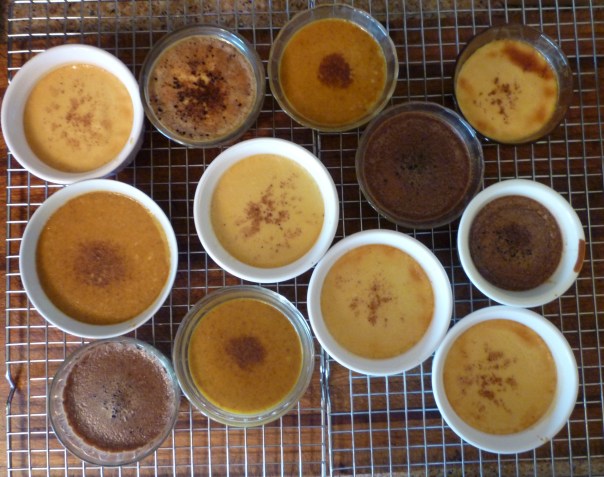
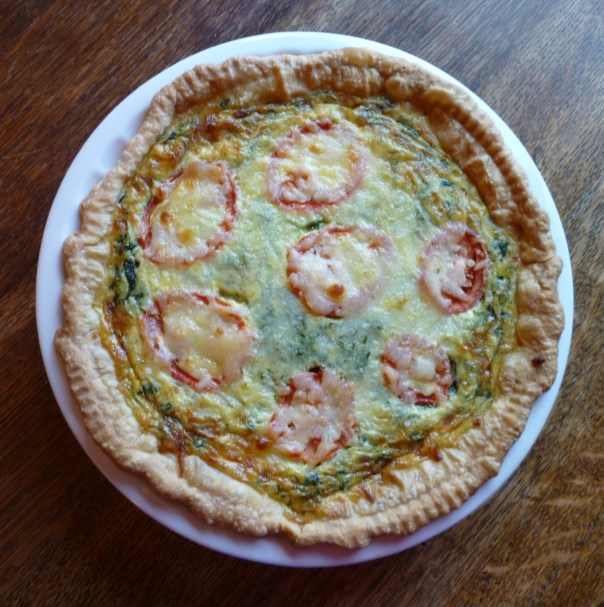
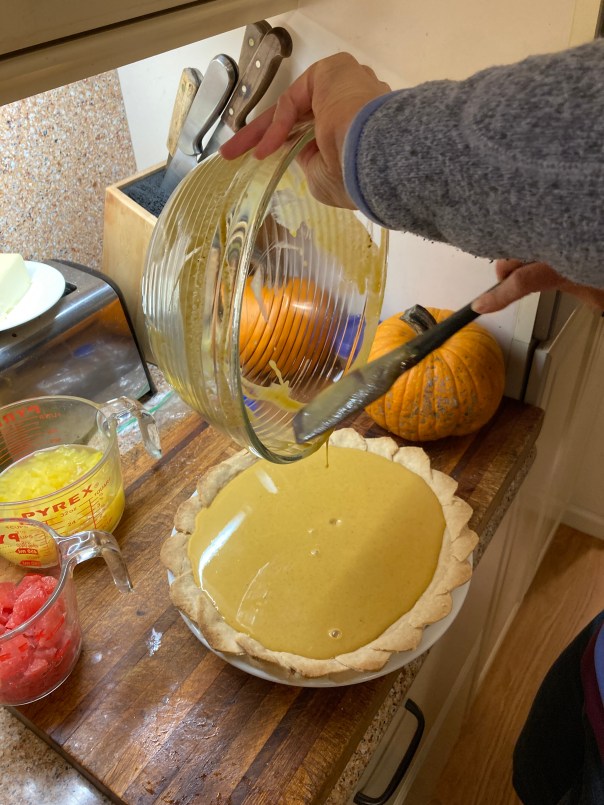
Butter Week QuicheSalty Honey Pie
As I eat more butter than cheese always, I prefer to call it Butter Week,
but Cheesefare Week is also a good name.
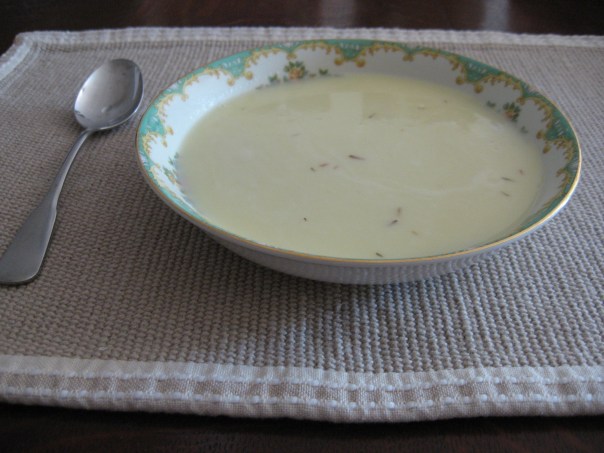
Egg Lemon Soup
I can make Egg Lemon Soup with vegetable broth instead of the traditional chicken broth, but I can’t see making it without eggs, though I’ve seen recipes for such a thing. But please, give it a new name if you are going to do that!
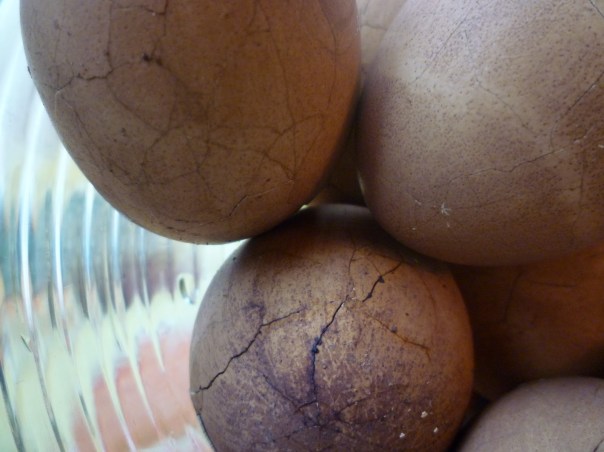
Tea Eggs
You know I’ve never even flirted with the idea of being vegan.
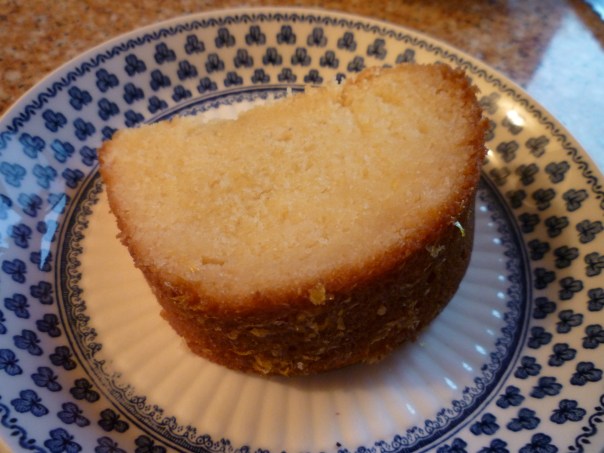
Lemon Sour Cream Cake
You can find some of these recipes on my Recipes page tabbed above.
Happy Butter Week!
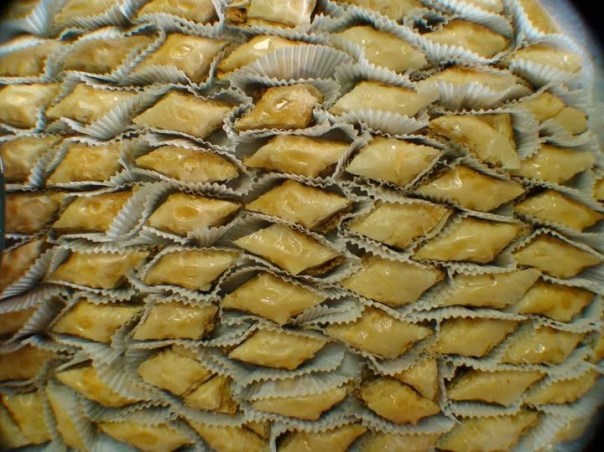
Ten years ago, when I was reading The Supper of the Lamb by Robert Farrar Capon, and writing multiple blog posts about that delicious book, I promised to share here the recipe for baklava that our parish uses. The idea came to me when reading Capon’s words on butter and pastry, and I warned my readers not to use his recipe for baklava. Since then I’ve learned more about the many and various ways that people prepare that confection in different cultures, and am no longer closed-minded about it at all. If you have a different recipe you like, I hope you will share it in the comments.
Though I love honey, I prefer baklava without it, because in the examples I have eaten, the honey overpowers the flavors of nuts and butter, and makes a heavy piece of dessert — honey is in fact a heavy and dense food. This version that we learned to make from a long-time member of the parish is somehow “lighter” in flavor, while losing none of the richness that is essential.
BAKLAVA
About 30 pieces
SYRUP:
3/4 cup water 1 1/2 cups sugar 1 tablespoon fresh lemon juice
2. Prepare the syrup: Combine water and sugar; bring to a boil and cook over moderately high heat, stirring, until thickened. Stir in lemon juice, cook 3 more minutes and set aside to cool.
2. Grind nuts in a food processor. Transfer to a bowl, add sugar and mix thoroughly.
3. Spread half the filo dough flat on a buttered 9” X 13” jellyroll pan. Cut and piece as necessary. Spread nut-and-sugar mix evenly over dough; then lay the remaining dough over the top.
4. Cut pastry, either into 2” squares, or for traditional diamond-shaped pieces, make lengthwise cuts 1 1/2” apart, and cuts at a 45 degree angle 1 1/2” apart. This will yield diamonds about 4 1/2” long, with sides about 2 1/2” long.
5. Pour 1 cup of the melted butter evenly over the top. Place the pan in the oven and reduce heat to 300°. Bake for 40 minutes, turning the pan after 20 minutes for even browning. Repeat, using remaining butter and baking again for 20 minutes, turning after 10 minutes.
7. Remove pan from oven and immediately pour cooled syrup over the hot pastry. Let stand and cool approximately 24 hours.
Clarified Butter
Melt butter in a heavy saucepan over low heat. After it has melted, some of the milk solids will drop to the bottom of the pan while others will rise as foam. Skim off the foam and pour the clarified butter out of the pan, leaving the milk solids at the bottom, or strain it through a double layer of cheesecloth.
If you are interested in what the book The Supper of the Lamb is about, you can find all the posts in which I wrote anything about it here: Robert Farrar Capon.
My friend Timothy told me yesterday that the only people he knows who can truly multi-task are mothers of young children. It’s true, when you are a mother, you often are solving their problems, teaching them, or nurturing their souls more generally even while sweeping the floor or cooking, etc.
But if like me you are often alone and can fully focus on one thing at a time, that is best. One of my favorite quotes on this subject has long been from St. Seraphim of Sarov: “Whatever you do, do it gently and unhurriedly, because virtue is not a pear to be eaten in one bite.” And this morning I read on Lisa’s blog this good word from Fr. Jacques Philippe:
“To live today well we also should remember that God only asks for one thing at a time, never two. It doesn’t matter whether the job we have in hand is sweeping the kitchen floor or giving a speech to forty thousand people. We must put our hearts into it, simply and calmly, and not try to solve more than one problem at a time. Even when what we’re doing is genuinely trifling, it’s a mistake to rush through it as though we felt we were wasting our time. If something, no matter how ordinary, needs to be done and is part of our lives, it’s worth doing for its own sake, and worth putting our hearts into.”
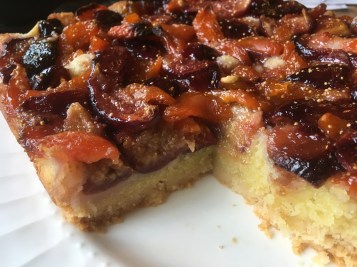
When I read that, I had just finished eating a piece of the most delectable cake — while reading at the computer. Everyone knows that is a bad thing for an overeater to do! But the other unfortunate thing is, I missed the full experience of this cake, which I don’t exactly want to put my heart into, but which I do want to receive “gently and unhurriedly,” in a way that promotes the greatest thankfulness and encourages virtue.
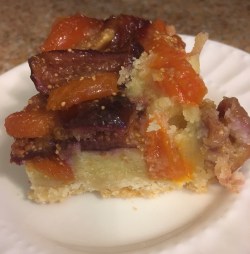
I’d been wanting to try this cake to make use of my fig harvest; I think of it as an autumn cake because it is now that the figs really come in. The recipe is from Martha Stewart, but I combined the figs with dried apricots instead of fresh plums, because I had just bought the wonderfully rich Blenheim apricots from Trader Joe’s, and did not have plums on hand. The apricots were both more flavorful and colorful than plums would have been. Also I cut down on the sugar.
I don’t think I’ve ever had a more buttery cake, but the flavor of butter was even lovelier — is that possible? — by being in combination with the almonds and fruit. As it turns out, the fruit and nuts and eggs are all products of California farms or gardens, and perhaps the butter as well? So mine is a California Cake, but yours might be otherwise.
You start with a cookie-like crust that gets pre-baked, an eggy almond-flour paste spread on top, then the fruit over all, before it goes in the oven again for a long time. I added a little water to the fruit to make up for the apricots being dried. I definitely had to give the whole process my full attention.
AUTUMN FIG CAKE
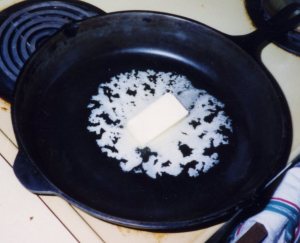
Trying to warm the butter a bit.
2 sticks unsalted butter, cool room temperature, cut into pieces, plus more for pan
1 pound fresh figs, halved or quartered
6 oz dried apricots, preferably Blenheim variety, sliced
1/4 cup water
1 1/4 cups unbleached all-purpose flour, divided
Almost 1 cup sugar, divided
1 teaspoon salt, divided
1/4 teaspoon baking powder
1 cup finely ground almond flour
2 large eggs, room temperature
1/4 teaspoon pure almond extract
Preheat oven to 350 degrees. Butter a 9-inch square cake pan; line with 2 wide pieces of parchment, leaving a 2-inch overhang on all sides. Butter parchment. Toss fruit with 1/3 cup sugar, and 1/4 teaspoon salt. If you are using dried fruit add the 1/4 cup water; set aside and stir occasionally.
In a food processor, pulse 1 cup all-purpose flour, 1/4 cup sugar, and 1/4 teaspoon salt to combine. Add half of butter and pulse until fine crumbs form. Transfer to prepared cake pan and use floured fingers to press dough evenly into bottom of pan. (If too soft to easily press in, refrigerate 10 minutes.)
Bake until crust is light golden in color, about 20 minutes; transfer to a wire rack and let cool 15 minutes.
In food processor, pulse remaining half of butter, 1/2 cup sugar, and 1/2 teaspoon salt with baking powder until combined. Add almond flour, remaining 1/4 cup all-purpose flour, eggs, and almond extract; process until smooth.
Spread batter evenly over crust. Gently stir fruit to reincorporate sugar mixture and arrange on top of batter (cut-side up). Bake until fruit is bubbling and filling is firm, about 1 hour and 5 minutes (Mine took 10 minutes longer). Let cool in pan 15 minutes, then use parchment overhang to lift cake out of pan and transfer to a wire rack. Let cool 1 hour and serve. Cake can be stored in an airtight container up to 2 days.
Wouldn’t the base of this cake be good with just about any fruit topping? I think it would.
Whatever you make of it, when you do partake,
I hope you can do it with attentive thanksgiving. 🙂
This poet’s experience was not my own, except perhaps during my brief visits to my Grandma, to whom I am forever grateful for not being a buyer or consumer of margarine. I can still see the giant pat of butter that she would lay on top of a baked potato that she had slit and pinched open to receive the gift.
That mystical event of the tiger spinning himself into a pool of butter on the ground was early etched in my memory, too. It’s a food with special powers.
BUTTER
My mother loves butter more than I do,
more than anyone. She pulls chunks off
the stick and eats it plain, explaining
cream spun around into butter! Growing up
we ate turkey cutlets sautéed in lemon
and butter, butter and cheese on green noodles,
butter melting in small pools in the hearts
of Yorkshire puddings, butter better
than gravy staining white rice yellow,
butter glazing corn in slipping squares,
butter the lava in white volcanoes
of hominy grits, butter softening
in a white bowl to be creamed with white
sugar, butter disappearing into
whipped sweet potatoes, with pineapple,
butter melted and curdy to pour
over pancakes, butter licked off the plate
with warm Alaga syrup. When I picture
the good old days I am grinning greasy
with my brother, having watched the tiger
chase his tail and turn to butter. We are
Mumbo and Jumbo’s children despite
historical revision, despite
our parents’ efforts, glowing from the inside
out, one hundred megawatts of butter.

 Let stand and cool approximately 24 hours.
 My friend Timothy told me yesterday that the only people he knows who can truly multi-task are mothers of young children. It’s true, when you are a mother, you often are solving their problems, teaching them, or nurturing their souls more generally even while sweeping the floor or cooking, etc.
 , never two. It doesn’t matter whether the job we have in hand is sweeping the kitchen floor or giving a speech to forty thousand people. We must put our hearts into it, simply and calmly, and not try to solve more than one problem at a time. Even when what we’re doing is genuinely trifling, it’s a mistake to rush through it as though we felt we were wasting our time. If something, no matter how ordinary, needs to be done and is part of our lives, it’s worth doing for its own sake, and worth putting our hearts into.”

 Gladsome Lights