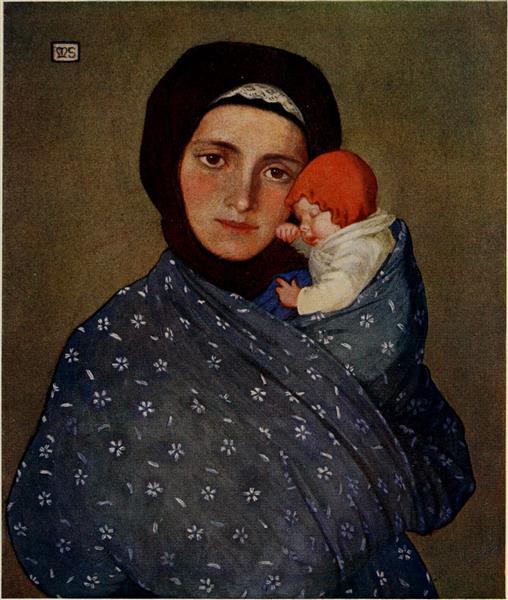
“After birth, the child further develops this primal resonance. This doesn’t happen haphazardly. The child achieves a kind of symbiosis with the mother through its creative imitations of her sounds and facial expressions; in this way, it will feel what she feels. As it takes on its mother’s happy expression, it also feels her joy; if it takes on her sad expression, it shares in her unhappiness.
“Something similar applies to the exchange of sounds: In the clinking and clanging of the mother’s language trembles the well and woe of her being, and the child who imitates that language resonates with it on the same psychological wavelength. This early resonance between child and its (social) environment leads to a unique phenomenon: The young child’s body gets ‘loaded’ with a series of vibrations and tensions that become embedded in the deepest and finest fibers of its body. They form a kind of ‘body memory’ that not only programs the function of the musculature, glands, nerves, and organs, but also predisposes the child to certain psychological conditions, or disorders.
“The human body is, in the most literal sense, a stringed instrument. The muscles that span the skeleton, and the body’s other fibers, are put on a certain tension in early childhood through imitative language exchanges. This tension determines with which (social) phenomena one will resonate; it determines the frequencies to which one will be sensitive in later life. That’s why certain people and certain events can literally strike a chord; they touch the body and, as such, touch the soul. It is for this reason that the voice can make the body ill. Or, conversely, heal it. That is why the voice is of vital importance, especially at an early age. Lack of a voice is fatal to the young child.”
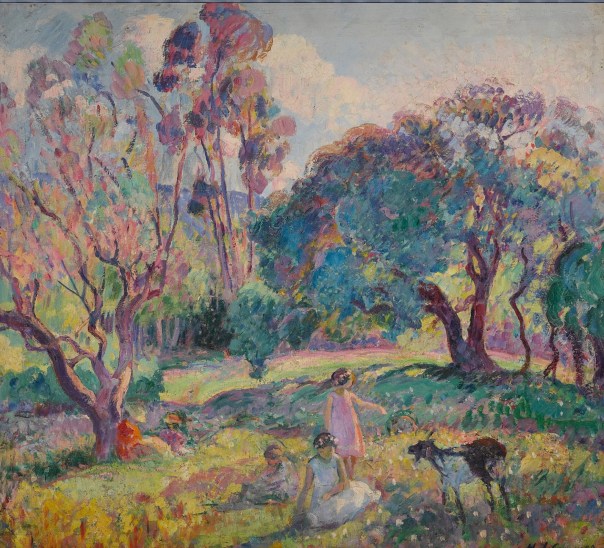
“We could never have loved the earth so well if we had had no childhood in it, if it were not the earth where the same flowers come up again every spring that we used to gather with our tiny fingers as we sat lisping to ourselves on the grass, the same hips and haws on the autumn hedgerows, the same redbreasts that we used to call ‘God’s birds’ because they did no harm to the precious crops. What novelty is worth that sweet monotony where everything is known and loved because it is known?”
From the heart of this dark, evacuated campus I can hear the library humming in the night; a choir of authors murmuring inside their books along the unlit, alphabetical shelves, Giovanni Pontano next to Pope, Dumas next to his son, each one stitched into his own private coat, together forming a low, gigantic chord of language.
I picture a figure in the act of reading, shoes on a desk, head tilted into the wind of a book, a man in two worlds, holding the rope of his tie as the suicide of lovers saturates a page, or lighting a cigarette in the middle of a theorem. He moves from paragraph to paragraph as if touring a house of endless, paneled rooms.
I hear the voice of my mother reading to me from a chair facing the bed, books about horses and dogs, and inside her voice lie other distant sounds, the horrors of a stable ablaze in the night, a bark that is moving toward the brink of speech.
I watch myself building bookshelves in college, walls within walls, as rain soaks New England, or standing in a bookstore in a trench coat.
I see all of us reading ourselves away from ourselves, straining in circles of light to find more light until the line of words becomes a trail of crumbs that we follow across a page of fresh snow; when evening is shadowing the forest and small birds flutter down to consume the crumbs, we have to listen hard to hear the voices of the boys and his sister receding into the words.
-Billy Collins
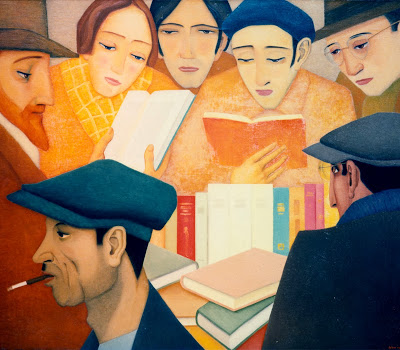
Johan van Hell – Boekenstalletje
This poem was the perfect one for me to find right now, because I myself have been acting out all the verbs: following, straining, hearing and touring… and listening hard, to the humming of a choir. This choir of authors aren’t all consciously “singing” in harmony, or even intending to write about the same things, but their voices, the sounds, the crumbs I am following “across a page of fresh snow” all seem to be parts of a whole. The rooms I am touring are all in one house; it must be the place where the human soul lives.
My “circles of light” sometimes seem like a 60’s light show, beautiful and confusing, when I am waiting rather for illumination and clarity. So many authors have shined their little lights out into the world, but how many reveal the reality of things?
Over the last several months I have been reading a lot, with no resulting book reviews and few even small illuminations of the sort I might write about here. The Eucharist was very focused and wonderful and I do want to say some things about it eventually, but instead of stopping for that I kept working my way through Irrational Man, which is such a tour de force that it’s hard to know what to say about — everything. It mostly makes me want to read more books that William Barrett reminds me of.
Like Flight From Woman by Karl Stern, which I read some years ago and thought brilliant; but at the time I knew I needed to read it a second time to digest it. Barrett explains the duality of selves in Sartre’s philosophy, how he considers not the “fruitful, excessive, fruitful blooming nature” to be the true self, but only that of the radically free and active man who has projects. Now I want to go back and read Stern on this topic.
But I am determined to finish a couple more books first. The Rise and Triumph of the Modern Self is like another long chapter, maybe the closing chapter, of Western Philosophy, so it will be good if I can move right on to finishing it after Barrett.
On my recent road trip I listened to Come on Shore and We Will Kill and Eat You All: A New Zealand Story, by Christina Thompson, a title so embarrassing on several fronts that I considered leaving this accomplishment unrecorded. But even this book, which was about as deep as I could go on all that freeway driving, provided a few revealing glimpses of how ideas from the other books I mentioned play out in real life, especially the central one: What is the self?
About halfway through The Cross of Loneliness I began to have a difficult time knowing what these two men were talking about, but I will finish that book, too, before long. My really easy, small book to read under the covers right now is The Bookshop by Penelope Fitzgerald, which I found in the little free library up at the lake.
And then, the sweetest, which will be easy to finish, as it’s like swimming slowly through a small and refreshing pond to the other side: The Scent of Water, which our book club is reading together. It is coming to an end way too fast.
Oh, yes, there are a dozen more sitting nearby, that I plan to continue with eventually, but they are not at the moment as current as these, these rooms full of delicious crumbs that I trust are leading me always to brighter places.
In regard to my own life and reading, I don’t relate to the progression of Collins’s poem, in its hearkening back to the experiences of childhood and youth, and the mood of evening and shadow descending. I am just very thankful for all the good writers I have at my disposal, and for the lovely song that they are trying to learn and to sing.
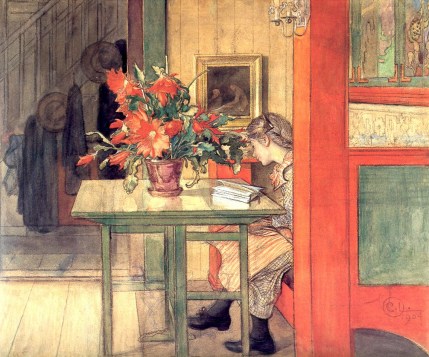
“The day was so delightful that I wished one could live slowly as one can play music slowly…. It was warm as high summer, and bars of sunshine lay honey-coloured across the floor, the air above them shimmering with motes; and bees droned about a purple branch of viburnum in a vase on the mantelpiece. We four girls were bathed in a sense of leisure we had never enjoyed before and were never to enjoy again, for we were going to leave school at the end of term, and we had passed all the examinations which were to give us the run of the adult world. We were as happy as escaped prisoners, for we had all hated being children.”
-Rebecca West, from the first page of This Real Night

 Like Flight From Woman by Karl Stern, which I read some years ago and thought brilliant; but at the time I knew I needed to read it a second time to digest it. Barrett explains the duality of selves in Sartre’s philosophy, how he considers not the “fruitful, excessive, fruitful blooming nature” to be the true self, but only that of the radically free and active man who has projects. Now I want to go back and read Stern on this topic.
 And then, the sweetest, which will be easy to finish, as it’s like swimming slowly through a small and refreshing pond to the other side: The Scent of Water, which our book club is reading together. It is coming to an end way too fast.
 Gladsome Lights