 My friend Timothy told me yesterday that the only people he knows who can truly multi-task are mothers of young children. It’s true, when you are a mother, you often are solving their problems, teaching them, or nurturing their souls more generally even while sweeping the floor or cooking, etc.
But if like me you are often alone and can fully focus on one thing at a time, that is best. One of my favorite quotes on this subject has long been from St. Seraphim of Sarov: “Whatever you do, do it gently and unhurriedly, because virtue is not a pear to be eaten in one bite.” And this morning I read on Lisa’s blog this good word from Fr. Jacques Philippe:
“To live today well we also should remember that God only asks for one thing at a time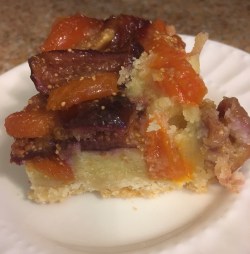 , never two. It doesn’t matter whether the job we have in hand is sweeping the kitchen floor or giving a speech to forty thousand people. We must put our hearts into it, simply and calmly, and not try to solve more than one problem at a time. Even when what we’re doing is genuinely trifling, it’s a mistake to rush through it as though we felt we were wasting our time. If something, no matter how ordinary, needs to be done and is part of our lives, it’s worth doing for its own sake, and worth putting our hearts into.”
When I read that, I had just finished eating a piece of the most delectable cake — while reading at the computer. Everyone knows that is a bad thing for an overeater to do! But the other unfortunate thing is, I missed the full experience of this cake, which I don’t exactly want to put my heart into, but which I do want to receive “gently and unhurriedly,” in a way that promotes the greatest thankfulness and encourages virtue.

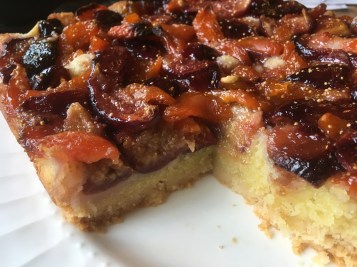
I’d been wanting to try this cake to make use of my fig harvest; I think of it as an autumn cake because it is now that the figs really come in. The recipe is from Martha Stewart, but I combined the figs with dried apricots instead of fresh plums, because I had just bought the wonderfully rich Blenheim apricots from Trader Joe’s, and did not have plums on hand. The apricots were both more flavorful and colorful than plums would have been. Also I cut down on the sugar.
I don’t think I’ve ever had a more buttery cake, but the flavor of butter was even lovelier — is that possible? — by being in combination with the almonds and fruit. As it turns out, the fruit and nuts and eggs are all products of California farms or gardens, and perhaps the butter as well? So mine is a California Cake, but yours might be otherwise.
You start with a cookie-like crust that gets pre-baked, an eggy almond-flour paste spread on top, then the fruit over all, before it goes in the oven again for a long time. I added a little water to the fruit to make up for the apricots being dried. I definitely had to give the whole process my full attention.
AUTUMN FIG CAKE

2 sticks unsalted butter, cool room temperature, cut into pieces, plus more for pan
1 pound fresh figs, halved or quartered
6 oz dried apricots, preferably Blenheim variety, sliced
1/4 cup water
1 1/4 cups unbleached all-purpose flour, divided
Almost 1 cup sugar, divided
1 teaspoon salt, divided
1/4 teaspoon baking powder
1 cup finely ground almond flour
2 large eggs, room temperature
1/4 teaspoon pure almond extract
Preheat oven to 350 degrees. Butter a 9-inch square cake pan; line with 2 wide pieces of parchment, leaving a 2-inch overhang on all sides. Butter parchment. Toss fruit with 1/3 cup sugar, and 1/4 teaspoon salt. If you are using dried fruit add the 1/4 cup water; set aside and stir occasionally.
In a food processor, pulse 1 cup all-purpose flour, 1/4 cup sugar, and 1/4 teaspoon salt to combine. Add half of butter and pulse until fine crumbs form. Transfer to prepared cake pan and use floured fingers to press dough evenly into bottom of pan. (If too soft to easily press in, refrigerate 10 minutes.)
Bake until crust is light golden in color, about 20 minutes; transfer to a wire rack and let cool 15 minutes.
In food processor, pulse remaining half of butter, 1/2 cup sugar, and 1/2 teaspoon salt with baking powder until combined. Add almond flour, remaining 1/4 cup all-purpose flour, eggs, and almond extract; process until smooth.
Spread batter evenly over crust. Gently stir fruit to reincorporate sugar mixture and arrange on top of batter (cut-side up). Bake until fruit is bubbling and filling is firm, about 1 hour and 5 minutes (Mine took 10 minutes longer). Let cool in pan 15 minutes, then use parchment overhang to lift cake out of pan and transfer to a wire rack. Let cool 1 hour and serve. Cake can be stored in an airtight container up to 2 days.
Wouldn’t the base of this cake be good with just about any fruit topping? I think it would.
Whatever you make of it, when you do partake,
I hope you can do it with attentive thanksgiving. 🙂
 and nearly all the time, we live as if we were trying to catch a bus.
 question ‘What?’ It answers the question ‘Who?’ Eternity is God, God who is always contemporaneous with each moment of time; He is always there, completely stable, unchanged and unchangeable because He already has in Himself, before the first thing was, all the richness necessary to meet all things and all situations. He does not need to change in order to be contemporaneous.
 Gladsome Lights