Tag Archives: reading

An eleven-book day.

Later in the spring, 2019.

The bookishness of today was out of the ordinary in my recent life; shall we say, the last 20 years of it? And it only slightly resembled former days when going to the library was a regular thing, and between the several children and me we’d bring home bagfuls of books every few weeks, after browsing the shelves as long as we could manage.

This morning I visited our church library, looking for a specific book on the Psalms, but couldn’t find it. I did borrow two related books, though, and three more on other subjects.

On the way home I stopped at my town’s public library to pick up what I had placed on hold via the library’s website. They email you when your holds are ready, you drive to the library and phone them, and they bring your books out in a bag and put them on a table. I have formed a habit of going to the library every Friday, so that I can return books too; currently you can only do that on Fridays and Saturdays. I had four books ready to pick up, as it turned out.

When I pulled into my driveway a few minutes later, it was pleasantly warm in  my car, and I knew the house was chilly, so I sat there and looked over those four books, which were all children’s books. The three that were by the same author I left in the car, because I will just take them back; I didn’t like the particular theme that the author seemed to be stuck on.

The fourth book I had borrowed because I noticed this week that two Orthodox priests I follow on Goodreads had given it five stars, and it was a book I wasn’t familiar with. I began to read it and didn’t stop, just sat there behind the wheel for the next hour being charmed, by The 13 Clocks. I have over my life enjoyed many things James Thurber has written, so I’m not surprised. It was really fun, and I’d have liked to read it through again right then.

But I was getting ready to go back to church, this time for a service. My priest wrote me that he was sure he’d seen that book I wanted in a box of titles that hadn’t been shelved yet (lacking enough shelves), so I went back early and looked through not one but four boxes. There was a book with a similar title by the same author, Fr. Patrick Reardon, not about the Psalms, and which I already own. But I found two more books in those boxes that called to me, to take them home, one of them being Four Arguments for the Elimination of Television, which I read a long time ago but don’t remember much of. So eleven books came home with me, and three stayed in the car. Here are the eight books that remain.

What is strange is to bring so many books into the house in one day, and not one of them did I buy! I can take them back to their places whenever I want, no remorse. These days there isn’t such pressure even with the public library system to return books promptly; they stopped charging overdue fines even before covid, and the books take a long time in process once you do drop them in the return slot, so they have to be lenient about everything.

Maybe I won’t have any of these very long, but for now, I have happily filled more crannies and nooks with more delicious books!

To gather all the elements.

“Positivist man is a curious creature who dwells in the tiny island of light composed of what he finds scientifically ‘meaningful,’ while the whole surrounding area in which ordinary men live from day to day and have their dealings with other men is consigned to the outer darkness of the ‘meaningless.’ Positivism has simply accepted the fractured being of modern man and erected a philosophy to intensify it.

“Existentialism, whether successfully or not, has attempted instead to gather all the elements of human reality into a total picture of man. Positivist man and Existentialist man are no doubt offspring of the same parent epoch, but, somewhat as Cain and Abel were, the brothers are divided unalterably by temperament and the initial choice they make of their own being.”

-William Barrett, Irrational Man

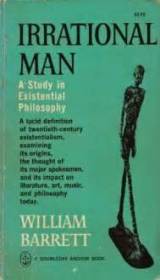
These paragraphs are from a book I’ve had on my shelf for a couple of years, since it was highly recommended to me by one of my most philosophical Christian friends. The subtitle is A Study in Existential Philosophy. I bought a paperback copy, but probably was unconsciously put off by the size of the print and the absence of white space on the pages.
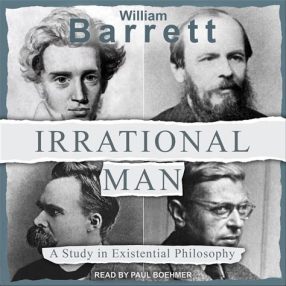
Recently I discovered that the book is on Audible, so I began yesterday on my drive  to the beach to listen to it, though I wasn’t very hopeful about being able to attend to the subject matter that way, having an “ear gate” that is extra narrow or full of obstacles or something… It’s particularly hard for me to read non-fiction when I can’t underline or take notes.

It’s a testimony to the clarity and beauty of Barrett’s writing that I was swept up into the story, as he tells it so engagingly, of the context and development of Modern Existentialism. As, in his words above, the need is for true philosophy “to gather all the elements of human reality into a total picture,” so also Barrett shows us a holistic picture by describing the interplay of cultural and historical roots of existentialism and of its effects.

Since high school I’ve had an inkling, or an awareness, that I needed to understand existentialism, but I feel that I’ve made little progress toward that goal. This book and I came into the world in the same decade, but I’ve been waiting for it my whole life!

Himself at last.

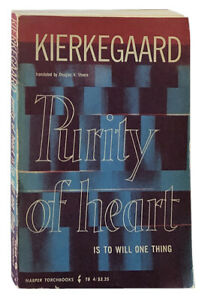
I would like to read more of Søren Kierkegaard’s writings. My intent is on display in the form of four titles by him that I have had sitting on the mobile bookshelf here in my kitchen/family room, for a year at least. I guess if I could decide which to read that would be a good start. A biography of him I am not likely to get to, but who knows…? In the meantime, I am reading this homage by Dana Gioia in the form of a poem. Seems like after this I owe it to Kierkegaard to read at least one more of his own works, though not in hopes of explaining any “riddles.” Only God can do that, and we know that He will — all of them, all of us.

HOMAGE TO SOREN KIERKEGAARD

Work out your own salvation
with fear and trembling.
—St. Paul

I was already an old man when I was born.
Small with a curved back, he dragged his leg when walking
the streets of Copenhagen. “Little Kierkegaard,”
they called him. Some meant it kindly. The more one suffers
the more one acquires a sense of the comic.
His hair rose in waves six inches above his head.
Save me, O God, from ever becoming sure.
What good is faith if it is not irrational?

Christianity requires a conviction of sin.
As a boy tending sheep on the frozen heath,
his starving father cursed God for his cruelty.
His fortunes changed. He grew rich and married well.
His father knew these blessings were God’s punishment.
All would be stripped away. His beautiful wife died,
then five of his children. Crippled Soren survived.
The self-consuming sickness unto death is despair.

What the age needs is not a genius but a martyr.
Soren fell in love, proposed, then broke the engagement.
No one, he thought, could bear his presence daily.
My sorrow is my castle. His books were read
but ridiculed. Cartoons mocked his deformities.
His private journals fill seven thousand pages.
You could read them all, he claimed, and still not know him.
He who explains this riddle explains my life.

When everyone is Christian, Christianity
does not exist. The crowd is untruth. Remember
we stand alone before God in fear and trembling.
At forty-two he collapsed on his daily walk.
Dying he seemed radiant. His skin had become
almost transparent. He refused communion
from the established church. His grave has no headstone.
Now with God’s help I shall at last become myself.

-Dana Gioia, 99 Poems

Chattering, reading and resisting sleep.

“I liked thinking about people reading books in the Paris metro, since they are underground, in the earth’s dark shadow, in the artificial light of electric bulbs, with the mute, graffiti-covered walls of corridors and tunnels rushing by their windows….”

“Above us, in the airplanes, someone is also reading a book — most often one with shiny covers, devoid of mystery, constructed on simple premises and the sincere desire for abundant royalties, but it may also be that someone up in those expanses is studying a Sufi epic or Dante and will experience illumination.

“And if this reader looks out the little window, he or she will see not black walls, as in the metro’s labyrinths, but the white gleam of clouds, a splendid, perpetually sunlit landscape, and below the threads of rivers quivering like children’s thermometers, strips of highways streaked by cars, like nervous insects, the yellow strips of sand along the sea, the dark smears of forests, sometimes snow-topped mountains, profoundly motionless, self-absorbed, autistic, and also cities chattering in different languages, resisting sleep, glowing even at midnight with feverish neon lights. Above the earth and below the earth, in metro cars and airplanes, someone is always reading books.”

-Adam Zagajewski, in Slight Exaggeration, © 2011

Nowadays most people I see on public transit or airplanes, if they are not chatting with their seatmate or sleeping, are looking at their phones or laptops. You can’t tell if they are reading an e-book or playing a game, or just working.

(I know, I know, it’s the era of masks and distancing, but please humor me. It may be temporarily necessary to do without some beloved activities, but I can still remember, and muse.)

Whenever I see anyone with an actual print book, I find it hard not to stare, to strain my neck and eyes in an effort to see just what author he is interacting with, revealing this private activity so publicly. It’s not voyeurism that motivates me, but a feeling of kinship with other readers, in an era when our numbers are diminishing. Of course, the statistics on reading trends show that a huge number of people continue to read, and I notice a few of them at the library. What’s different about the readers the plane is that I might watch them over the course of an hours-long journey; they are specific examples, and encouraging in a way that statistics can never be.

Zagajewski’s musings made me think about how we readers sometimes look outwardly like the “profoundly motionless, self-absorbed” mountain, when inside we are actually engaged in intense conversation that makes us more like the cities that “resist sleep.” I have a lot of experience with that lately, without going anywhere!

On my solo travels, twice that I remember clearly I was able to talk to perfect strangers about our reading, and I think in both cases the other person spoke to me first. The last time this happened I was looking at my Kindle Paperwhite while in line at Mumbai’s airport security, when a well dressed man next to me interrupted to ask what I was reading. Always honest in the instant, as soon as I answered I felt embarrassed and wished that I had thought to name some other, less boring recent read.

But his question was just an icebreaker, so he could find out why I was in India; talking with him, I forgot to notice how slowly the line was moving. I wonder if I will get the chance again to practice his kind of boldness and make the acquaintance of commuting or traveling readers. I would like to convey somehow my happiness to meet on my journey another lover of the printed word, who might just then be on her way to experiencing illumination.

(All photos found online.)