Tag Archives: The Sun

The heat and the oxygen.

“I ask this much” was the title of a post I wrote ten years ago, not long after my husband died. My thoughts then were inspired by the poem below, which I recently revisited. Yesterday I began to notice afresh the near constancy of my murmuring and complaining; today I was encouraged by the testimony of my former self, who wrote back then,

And every day, I feel a great Love surrounding me, like the pleasant air that holds me and gives me oxygen even while I am having those pity parties. Or like the sun whose heat is keeping me alive and giving me energy.

Let us be up and doing! And let’s start by asking the great Maker of the sun and of us, for His light, and strength, and joy. Our asking will be the beginning of the receiving.

PRAYER at SUNRISE

O mighty, powerful, dark-dispelling sun,
Now thou art risen, and thy day begun.
How shrink the shrouding mists before thy face,
As up thou spring’st to thy diurnal race!
How darkness chases darkness to the west,
As shades of light on light rise radiant from thy crest!
For thee, great source of strength, emblem of might,
In hours of darkest gloom there is no night.
Thou shinest on though clouds hide thee from sight,
And through each break thou sendest down thy light.

O greater Maker of this Thy great sun,
Give me the strength this one day’s race to run,
Fill me with light, fill me with sun-like strength,
Fill me with joy to rob the day its length.
Light from within, light that will outward shine,
Strength to make strong some weaker heart than mine,
Joy to make glad each soul that feels its touch;
Great Father of the sun, I ask this much.

–James Weldon Johnson 1871-1938

Planets confirm the tidings.

THE SPACIOUS FIRMAMENT ON HIGH

The spacious firmament on high,
with all the blue ethereal sky,
and spangled heavens, a shining frame,
Their great Original proclaim.
The unwearied sun from day to day
does his Creator’s power display;
And publishes to every land
the work of an almighty hand.

Soon as the evening shades prevail,
the moon takes up the wondrous tale,
and nightly to the listening earth
repeats the story of her birth;
whilst all the stars that round her burn,
and all the planets in their turn,
confirm the tidings, as they roll
and spread the truth from pole to pole.

What though in solemn silence all
move round the dark terrestrial ball?
What though no real voice nor sound
amid their radiant orbs be found?
In reason’s ear they all rejoice,
and utter forth a glorious voice;
for ever singing, as they shine,
“The hand that made us is divine.”

-Joseph Addison, 1712 (after Psalm 19)

This psalm, and its poetic rendering by Addison, was C.S. Lewis’s favorite. Why did he love it so much? Because it speaks of the wondrous, shining, singing, rejoicing cosmos, the firmament, the heavens, in the voice of the medieval mind, of which Lewis was an expert — and he thought that vision most beautiful.
In the last few years I’ve reread and re-reread the trilogy of novels by C.S. Lewis originally titled the Space Trilogy. Lewis was never happy with that name for the three books, because of the bleak connotations of the word space. He preferred the medieval vision of the cosmos and the heavens. Lately, lovers of the world that Lewis created in these novels have been calling them the Ransom Trilogy, after the protagonist of all three.

One can read about medieval cosmology in Lewis’s own work, The Discarded Image, which I plan to do. This year my introduction to the mind of Lewis on this topic was through the works of Michael Ward, who is probably the preeminent C.S. Lewis scholar alive today. His beautifully written book, Planet Narnia: The Seven Heavens in the Imagination of C.S. Lewis, has been on my shelf for years, long enough for me to forget about it; to my chagrin I didn’t remember until a few days before our church book group’s discussion of the Ransom Trilogy, but I was able to listen to a shorter presentation of his treatise on Audible, read by the author himself: C.S. Lewis: Christology and Cosmology. You can also read an even briefer summary of it in this article in Touchstone Magazine: “Narnia’s Secret.”

I am just a beginner in all of this, as far as it being an academic subject, and I don’t have the time or understanding to say any more about it. For now, I just wanted to share this psalm-poem, which Michael Ward puts on the very first page of his book. Because I also love the heavens and their divine message.

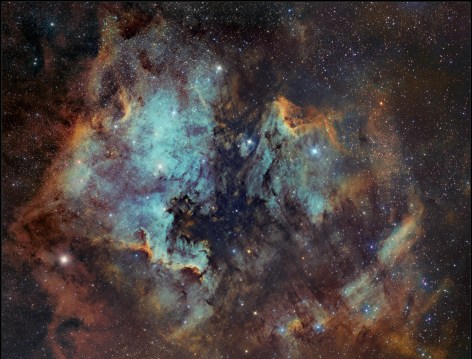
Hubble – Nebulae in Cygnus

Head of flames exploding.

SOLAR

Suspended lion face
Spilling at the centre
Of an unfurnished sky
How still you stand,
And how unaided
Single stalkless flower
You pour unrecompensed.

The eye sees you
Simplified by distance
Into an origin,
Your petalled head of flames
Continuously exploding.
Heat is the echo of your
Gold.

Coined there among
Lonely horizontals
You exist openly.
Our needs hourly
Climb and return like angels.
Unclosing like a hand,
You give for ever.

-Philip Larkin

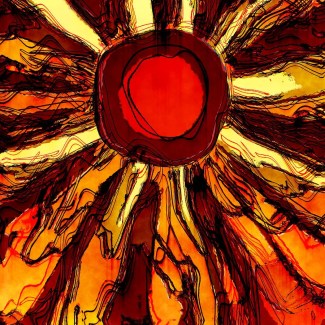
Solar Heat, David G Paul

A blaze and a blur, and a reasonable moon.

Yesterday when I set out on my walk it was already noon, but I was chilly from working at my computer in the cold corner of the house. I thought about how if I looped my path counterclockwise the southern sun would be at my back as I walked north on a long straight stretch out in the open. And it turned out just as I’d hoped. At least five minutes of heaven’s heat lamp bringing me up to a comfortable temperature.

But this pale and clear morning I left the house before sunrise and before the thermometer had climbed past 40°. Soon the cold was stinging my earlobes and hands, and my nose and eyes were watery. I saw the sun rise over the foothills to the east – what a privilege to witness that daily gift. A quote from G.K. Chesterton came to mind, about the sun rising daily because God decides again that He would like to raise it, but I can’t find that one. [Note: DeAnn found the quote for me and you can read it in the Comments below!] This from my files also stirs the mind and soul:

“The one created thing which we cannot look at is the one thing in the light of which we look at everything. Like the sun at noonday, mysticism explains everything else by the blaze of its own victorious invisibility. Detached intellectualism is (in the exact sense of a popular phrase) all moonshine; for it is light without heat, and it is secondary light, reflected from a dead world. But the Greeks were right when they made Apollo the god both of imagination and of sanity; for he was both the patron of poetry and the patron of healing.

“Of necessary dogmas and a special creed I shall speak later. But that transcendentalism by which all men live has primarily much the position of the sun in the sky. We are conscious of it as of a kind of splendid confusion; it is something both shining and shapeless, at once a blaze and a blur. But the circle of the moon is as clear and unmistakable, as recurrent and inevitable, as the circle of Euclid on a blackboard. For the moon is utterly reasonable; and the moon is the mother of lunatics and has given to them all her name.”

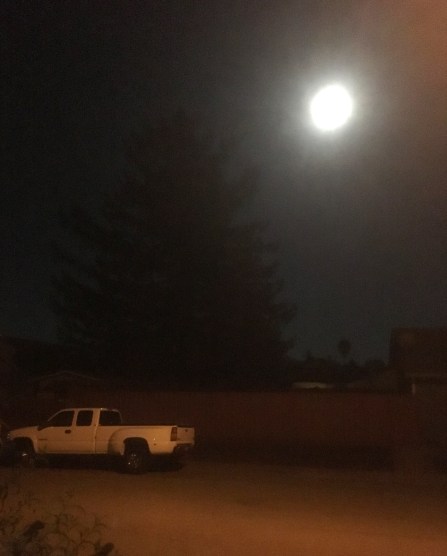
As I was beginning to type here, a friend wrote me that I really should look at tonight’s big harvest moon — so I went out front, and there it was in my favorite setting above the tree across the street, and well worth the interruption! Yes, light without heat, but beautiful, and a joyous link between me and all my loved ones who are looking up tonight at the same reflecting ball.

The Queen Anne’s Lace above the creek did not keep blooming as long as I expected. But some of the blooms are quite spectacular in their dramatic and seed-full drying-out. This was the main thing I wanted to show you tonight!

Queen Anne’s Lace in late September

HAPPY OCTOBER!