Monthly Archives: April 2015

To be without God and to die of it.

I find myself in a phase of grief where from time to time during the day I feel acutely lost without my husband, the absence of him like a soreness in my spirit, an ache in the middle of my chest telling me that something is very wrong with me. Yes, something is wrong!! It’s death that is wrong – it’s wrong for us to be separated, for me to lose the heart of my heart. I have known this truth in my mind and for the world generally – now I understand it in my bones.
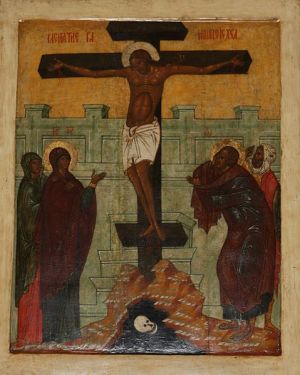
Crucifixion wikimediaBut as I’ve said here more than once already, I have the peaceful assurance that we are not absolutely separated, and a huge thankfulness as well that neither of us has been cut off from the Source of our life and existence. Sometimes we humans use the figure of speech that we will “die of grief,” because it feels that wrenching. But I know even as I am feeling it and railing against it, that I will live through it. This is all because Christ suffered for us, and he overcame death. My pain is like a pinprick compared to what Christ endured on our behalf. As  for my husband, “Blessed are the dead who die in the Lord.”

These words from Metropolitan Anthony Bloom that I first read in God and Man two years ago are even more meaningful to me on this Holy Saturday:

When in the Apostles’ Creed we repeat “And he descended into Hell,” we very often think “That’s one of those expressions,” and we think of Dante and of the place where all those poor people are being tortured with such inventiveness by God.

But the Hell of the Old Testament has nothing to do with the spectacular hell of Christian literature. The Hell of the Old Testament is something infinitely more horrid; it is the place where God is not. It is the place of final dereliction; it’s the place where you continue to exist and there is no life left.

Harrowing-Dionisius

And when we say that he descended into Hell, we mean that having accepted the loss of God, to be one of us in the only major tragedy of that kind, he accepted also the consequences and goes to the place where God is not, to the place of final dereliction; and there, as ancient hymns put it, the Gates of Hell open to receive Him who was unconquered on earth and who now is conquered, a prisoner, and they receive this man who has accepted death in an immortal humanity, and Godlessness without sin, and they are confronted with the divine presence because he is both man and God, and Hell is destroyed — there is no place left where God is not.

The old prophetic song is fulfilled, “Where shall I flee from thy face — in Heaven is thy throne, in Hell (understand in Hebrew — the place where you are not), you are also.” This is the measure of Christ’s solidarity with us, of his readiness to identify himself, not only with our misery but with our godlessness. If you think of that, you will realise that there is not one atheist on earth who has ever plunged into the depths of godlessness that the Son of God, become the Son of Man, has done. He is the only one who knows what it means to be without God and to die of it.

— Metropolitan Anthony Bloom

Mystical Supper

mysticalsupper02

On Thursday of Holy Week (today) we commemorate the first eucharist as the Lord Jesus instituted it, what we Orthodox call The Mystical Supper. On the Orthodox Wiki discussion page I found that someone had asked for clarification of what the Real Presence is, according to Orthodoxy; it seemed confusing to them. Then various people gave input. One said that it may be confusing because it is a Mystery. [Think smiley face] It is a common joke in or on the Church that this is a facile answer.

But it points to the true nature of the faith, that our relationship with God is not purely intellectual. We do not know Him by putting together all the facts we’ve learned; He doesn’t reveal Himself through our intellects alone, or even primarily.

Fr. Thomas Hopko says, “The mystery of the holy eucharist defies analysis and explanation in purely rational and logical terms. For the eucharist — and Christ himself — is indeed a mystery of the Kingdom of Heaven which, as Jesus has told us, is ‘not of this world.’ The eucharist — because it belongs to God’s Kingdom — is truly free from the earth-born ‘logic’ of fallen humanity.”

The page on The Holy Mysteries, what we call the sacraments, is very good! It starts right out with this perspective and reality about the Church that I love:  “…the Orthodox Church considers everything which is in and of the Church as sacramental or mystical.” I suppose this is why “There has never been a universal declaration within the Orthodox Church that there are only seven sacraments.”

I knew that, but I learned some other things, more historical and not so mystical, reading these pages today: “While the Synoptics do give the Last Supper as a Passover seder, John’s Gospel (which the Church privileges over the others) has it happen before the Passover.” The contributors all seemed to agree on these points though they differed on their theological significance.

On a more personal note, while I am grieving the death of my husband, I’ve been so grateful that we are in Holy Week, with its numerous opportunities to participate in this sacrament, this mystery of the Kingdom of Heaven — and truly, in all the abundant graces of the Church. It’s not facts that have been sustaining me, but His Real Presence.

Lazarus and Flowers

In the West it is the end of Good Friday as I write, but this year for us Orthodox it issymp white roses the beginning of Lazarus Saturday, when we remember an event that starts out very poignantly, with Jesus’s friends lamenting the death of their brother, and Jesus Himself weeping.


This story of a death and of friends and family sorrowing is timely in my own life right now, and of course I have done some weeping lately – but mostly I wanted to write about the flowers that have come to me, and I may be stretching a bit to connect all these thoughts together.

Flowers have been coming into our house nearly every day for more than two weeks. They are beautiful bouquets and arrangements and plants, and when the first one arrived, before my husband died and on our wedding anniversary, the circumstances made it obvious that God had sent it by the hand of an angel, to convey His love and to assure me that Hebouquet CMc 2 will be my Husband, as it says in Isaiah 54: “For your Maker is your husband; the LORD of hosts is his name; and your Redeemer the Holy One of Israel….” I cried a good deal over that bouquet, and as the florist delivery man and I became better acquainted day by day, I received every new gift with joy.

We know flowers not just as symbols, but primarily as real and exquisite works of art, lovely in themselves. I think the florist noticed the repeated name on each order and tried to make every creation a little different; we have been enjoying dozens of varieties and species of blooms, ferns, branches of shrubs, succulents in ever-changing combinations, all gorgeous.

Other friends brought their own original and unique arrangements, or sometimes just a contribution to a nosegay. Each was given a place in the house where it could minister to the crowd of family who were coming and going for a fortnight and often sleeping here (One night 15 of us slept under this roof.), but I think I was the symp mix w lupinemost nourished of anyone by all the sweet flower-love. These real and aromatic things helped to keep me aware of God’s presence as much as did the kind messages in cards, and the care packages of fruit and candy.

They also gave me a job to do. While my children took over the more difficult practical matters of phone calls, shopping, cooking and organizing a funeral, I was able to wander about tending my flowers, trimming the stems, changing the water, removing spent ones and recombining the longer-lasting blooms (Carnations win the prize for aging well.). It was and is an easy sort of gardening, and very soothing.

People have given our family flowers and other kindnesses because they love us; that makes them feel our sorrow with us. We don’t really need any more explanation than that, but there is another aspect to our sorrowing. I find what Fr. Alexander Schmemannsymp azalea says about Jesus’s tears to be helpful:

He weeps because He contemplates the miserable state of the world, created by God, and the miserable state of man, the king of creation… “It stinketh,” say the Jews trying to prevent Jesus from approaching the corpse, and this “it stinketh” can be applied to the whole of creation. God is Life and He called the man into this Divine reality of life and “he stinketh.” At the grave of Lazarus Jesus encounters Death — the power of sin and destruction, of hatred and despair. He meets the enemy of God. And we who follow Him are now introduced into the very heart of this hour of Jesus, the hour, which He so often mentioned. The forthcoming darkness of the Cross, its necessity, its universal meaning, all this is given in the shortest verse of the Gospel — “and Jesus wept.”
….

symp tulips The power of Resurrection is not a Divine “power in itself,” but the power of love, or rather, love as power. God is Love, and it is love that creates life; it is love that weeps at the grave and it is, therefore, love that restores life… This is the meaning of these Divine tears. They are tears of love and, therefore, in them is the power of life.

Perhaps Mary and Martha didn’t have as many flowers as I do when Lazarus died. They likely did have flower essences in the ointment they would have used to prepare their brother’s body for burial.

And they had the Lord, not just weeping with them for the wrongness of death, but in His love giving the ultimate gift, His own Self. Without the knowledge of that Love and the assurance of a coming Resurrection, what flowers can give wouldn’t be very satisfying. But while my husband walked this earth he and I shared Christ’s life-creating Love, and we still do. Flowers are one more reminder of that reality to my still-weeping heart.

symp w carnation

The wounds are consecrated.

P1120829 holy unctionI attended a Holy Unction service with my goddaughter last night. Before the service proper our priest read an article on The Grace of Suffering. An excerpt:

Weakness and sickness wipe away everything superficial in us. We are inwardly purified when we are baptized with tears of suffering. The Lord always visits us there, while we are dry  on the inside, truly thirsting for living water and reaching out for Him in what we know, deeply and seriously.

He also told us about various responses he has seen in people who were healed from their sicknesses, and said that usually if we are relieved of one form of suffering, it is for further suffering.

It was a long service, including psalms, hymns, prayers, and seven anointings with oil, each preceded by an epistle reading and a Gospel reading. Before each Gospel reading a candle was lit, which helped us keep track of where we were in the service. Seven times the ill and afflicted lined up to be anointed on their forehead, cheeks, lips, chest, and hands.

I was a bit scattered in mind and heart and didn’t feel able to participate with as much attention as I’d have liked, but it was a great blessing nonetheless to help in little practical ways and by praying along. Having my mind washed by the Word, and being in the church with so many repentant hearts singing, “Hearken unto me, O Master, Hearken unto me, O Holy One….” was soothing to my own soul.

Here is an excerpt from another article about this sacrament:

The express purpose of the sacrament of holy unction is healing and forgiveness. Since it is not always the will of God that there should be physical healing, the prayer of Christ that God’s will be done always remains as the proper context of the sacrament. In addition, it is the clear intention of the sacrament that through the anointing of the sick body the sufferings of the person should be sanctified and united to the sufferings of Christ. In this way, the wounds of the flesh are consecrated, and strength is given that the suffering of the diseased person may not be unto the death of his soul, but for eternal salvation in the resurrection and life of the Kingdom of God.

It is indeed the case that death inevitably comes to man. All must die, even those who in this life are given a reprieve through healing in order to have more time on the earth. Thus, the healing of the sick is not itself a final goal, but is merely “instrumental” in that it is given by God as a sign of his mercy and as a grace for the further opportunity of man to live for him and for others in the life of this world.