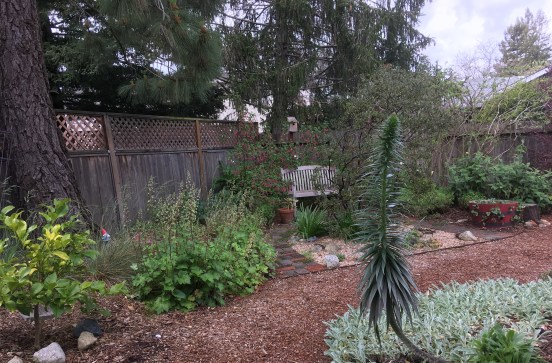
When I looked out the kitchen window at the rain-washed garden, it was heartbreakingly lovely and full of light…the tree trunks dark wet and all the leaves and needles bright green from having slurped up every bit of water they could squeeze into their fat cells. I bet they have completely forgotten what drought feels like.
I saw all this in a moment, and the moment was like being handed a wake-up gift from my Father, “Here, Honey, is a little something I made for you today.” And that moment was a place to be with Him. I was pretty much bowled over by the whole fact of me living on this earth that is full of His glory.
It’s National Poetry Month, and also Lent, which is a helpful confluence. “Less TV and more poetry” sounds to me like going in the right direction. But I don’t watch TV… What about my own tendencies to less housework, less attentiveness, less prayer…? Clearly, these things must be worked out on an individual basis, and may God give you wisdom. We are early in the month and I don’t think I’ve overindulged in poetry yet. I want to take advantage of the reminder and post a couple of poems before the month is over.
My thoughts about children’s books and Lent converge on this excerpt from Richard Wilbur’s More Opposites, which I think one of The Most Fun collections of poems and drawings. I don’t even require another person to read Wilbur’s humorous poems to — they often make me chuckle contentedly or muse to myself. I see that I already posted this particular one, but it was years ago, and I for one can benefit from a rereading.
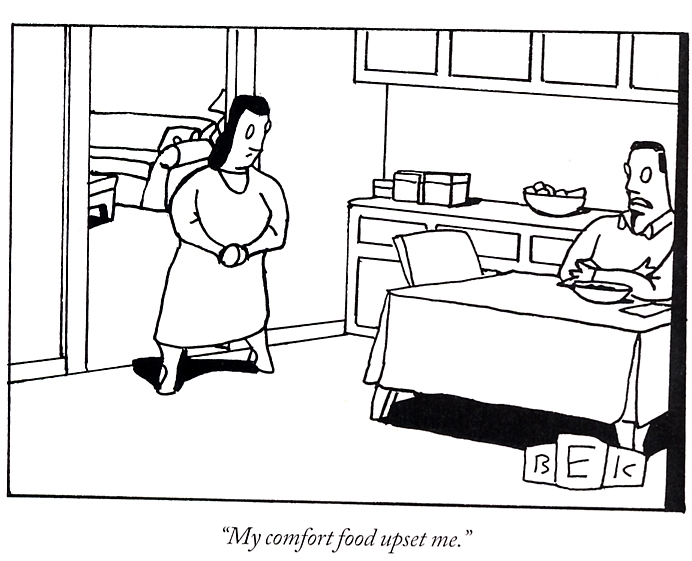
The illustrations of this question in the book include a simple drawing of people with distressed faces holding their tummies. I think the cartoon at bottom makes a similar companion to the poem. It’s
#15 in the More Opposites book:
The opposite of less is more.
What’s better? Which one are you for?
My question may seem simple, but
The catch is — more or less of what?
“Let’s have more of everything!” you cry.
Well, after we have had more pie,
More pickles, and more layer cake,
I think we’ll want less stomach-ache.
The best thing’s to avoid excess.
Try to be temperate, more or less.
-Richard Wilbur
There is a Mennonite cookbook titled More With Less, from which I gleaned many good cooking ideas in the early days of my homemaking career. But more valuable than the actual recipes was the refreshing concept that one might have more health and more enjoyment of eating and probably more money to spend on other things if you ate less.
Of course this is something we need to keep in mind all the time, not just during Lent. The church fathers caution us not to eat so much food that we aren’t able to pray after eating it; an overfull stomach hinders prayer. If it’s possible that Less Food = More Prayer….
The sky hangs up its starry pictures: a swan,
a crab, a horse. And even though you’re
three hundred miles away, I know you see
them, too. Right now, my side
of the bed is empty, a clear blue lake
of flannel. The distance yawns and stretches.
It’s hard to remember we swim in an ocean
of great love, so easy to fall into bickering
like little birds at the feeder fighting over proso
and millet, unaware of how large the bag of grain is,
a river of golden seeds, that the harvest was plentiful,
the corn is in the barn, and whenever we’re hungry,
a dipperful of just what we need will be spilled . . .
This morning I drove on many narrow and winding roads that I’d never been on before,
on my way to the coast to meet Pippin’s family at the oyster farm.
On the way there, I lost cell service, and lost my way, but until I realized how late I was going to be, I was oohing and aahing at the scenery and hoping to take pictures on the way home. After that, I just drove as fast as I could and made myself carsick.
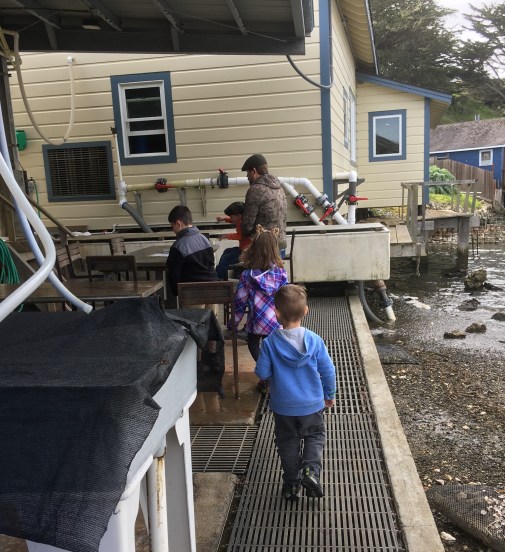
But I got there, and pulled up behind the familiar black van; Pippin and the children were standing next to Highway 1 looking for me, and Ivy ran up and declared, “It’s stinky!” With that we began our tour of the Hog Island Oyster Company. Hog Island is an island in Tomales Bay, where these oysters are raised, several million every year.
< < Oyster shells are put to good use
in the parking areas.
Isn’t that an interesting crack-like body of water? It can’t be a fjord, because this is California. The San Andreas Fault, which is “a transform fault–where plates pass one another like cars on a two way street,” runs in a line down the middle of the bay. This classic photo (at left) of a displaced fence shows what happened as a result of the San Francisco Earthquake of 1906, and why rock formations on the east and west sides of the bay are so very different. Earthquake country! Here is another map of the area if you want to get your bearings. It is the county just north of San Francisco.
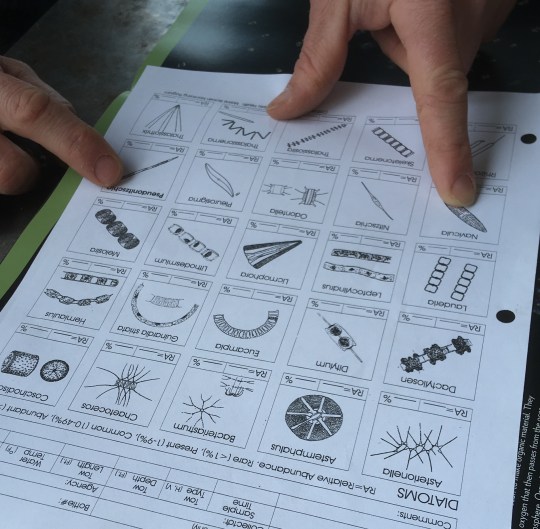
Oysters really like to grow here, because of the particular mix of fresh and salt water, the currents, temperature, and the rich variety of plankton. The farmers keep constant and close tabs on everything, including bacteria, temperature, and those plankton. The plankton are counted every week! Here’s a chart they use when they are looking through their microscopes at the seawater samples:
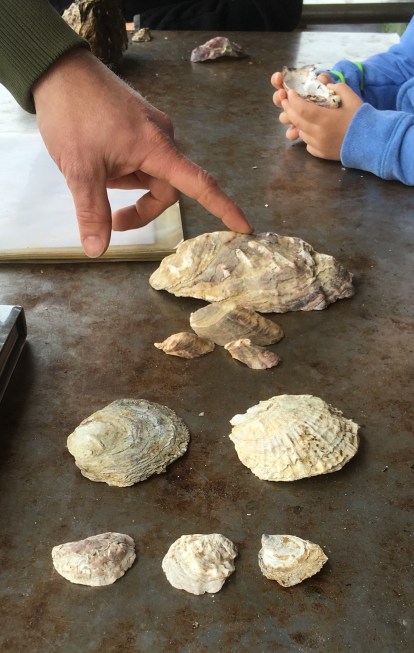
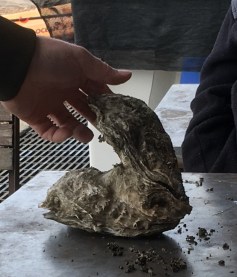
(Sorry, I was also looking at it upside-down.) We saw samples of different types of oysters such as French, Pacific, Atlantic… As you might guess, the Pacific oysters are what they grow the most of here. Oysters naturally grow and fuse together and if left to themselves will eventually form a solid oyster wall in the water. Farmers have to be stirring them up all the time or breaking them apart to keep them growing in the most usable form, and a typical smallish Pacific oyster takes one and a half years from seed to harvest.
baby oysters found on the ground“wild” oyster
These farmers typically harvest 60% of what they plant. There are frequent quarantines for a few days every time it rains, or if a strange bacterium is found in the bay. Regulations come from the government at both federal and state levels, and they can conflict and cause delays that have nothing to do with safety. You can be pretty sure that the oysters you buy or eat here are fresh and safe, but oysters are like Petri dishes if you drive a couple of hours on a warm day, carrying them home in the trunk of your car. With all of the possible complications in oyster farming, I’m surprised that they aren’t more expensive to buy.
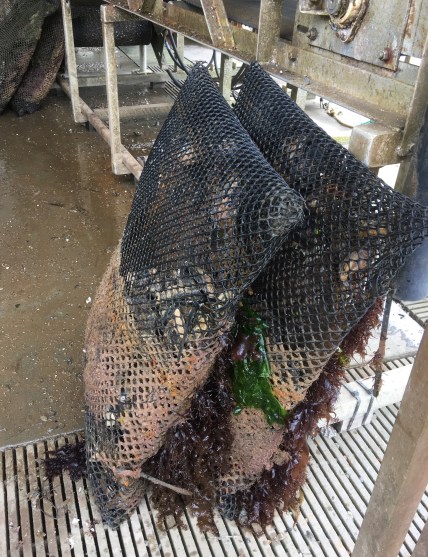
The oysters here are raised in bags on a line under the water, and the bags are frequently flipped to jostle them and keep them from growing on to each other. These are a couple of bagsful just harvested.
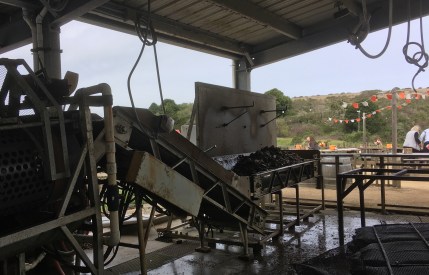
We did get to eat a few oysters, too, and several other delectable things from the picnic café right next to the barn where they are sorting. With all the variableness of growing conditions and regulators’ decisions, oyster farming is not consistently profitable, so many farmers have branched out and are operating restaurants as well, from which they can earn a somewhat more steady income. Here in Marin they have a lot of clientele from Marin County and the East (San Francisco) Bay.
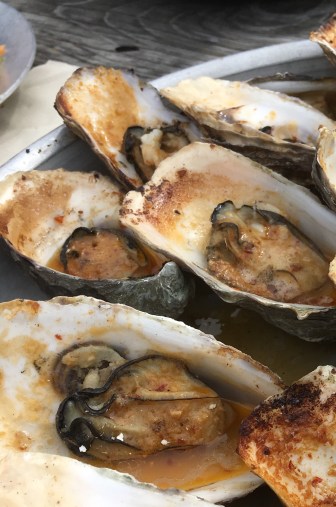
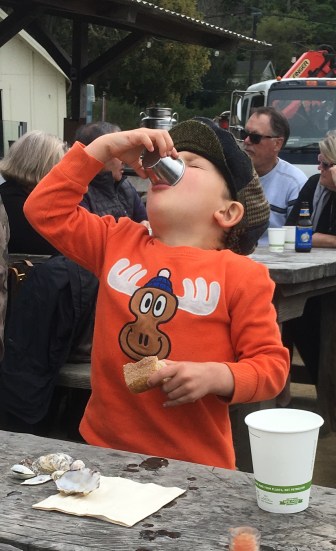
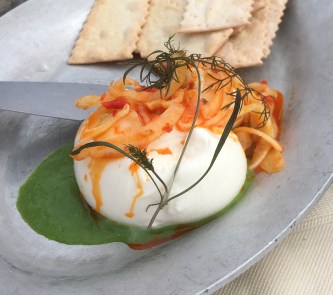
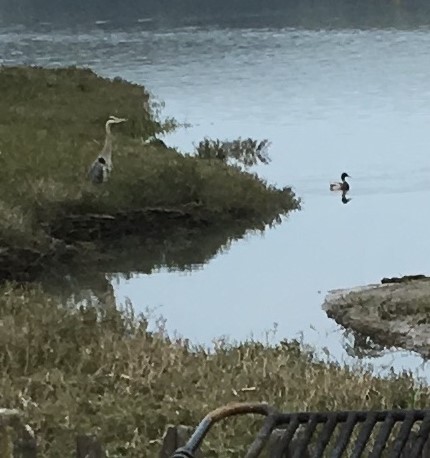
The little café has barbecue grills where you can cook Hog Island’s oysters in your own way if you want, while looking out at Tomales Bay and the birds. We didn’t use those, but we did eat raw oysters with lemon and Hogwash — this establishment’s version of Mignonette sauce; barbecued oysters, burrata cheese, and trout with roe. Our guide’s son preferred to put the Hogwash on his bread or to drink it straight up. Truly, it’s good to have bread with a meal like this, for sopping up the juices of everything.
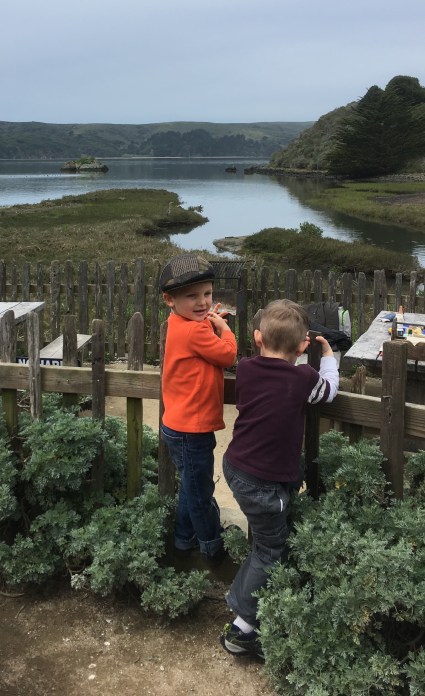
Pippin and I couldn’t stop taking pictures of the wildlife and the child-life,
and the multicolored buildings of this historic town of Marshall.
After all that fun I said good-bye to everyone and drove home by myself. Sprinkles of rain accompanied me all along my leisurely drive, but not so much that I couldn’t take take pictures. Right across the road from the oyster company were bushes that looked sort of like broom to me… but not quite.
When I got home I found out it is gorse, of all things, like in the English stories. This cousin of broom is not native, it’s terribly invasive and undesirable, and a fire hazard to boot. Broom has leaves, and gorse has prickles! If you want to know more, this article about Gorse the Invader is very informative.
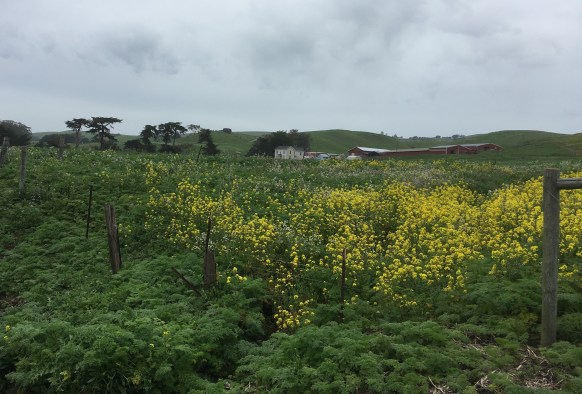
I feasted my eyes on Tomales Bay, cattle, mustard and more mustard, and clumps of calla lilies like you only see on the coast. Often next to a driveway to a dairy farm, a few bulbs were planted long ago and still thrive and expand on benign neglect under the foggy skies, growing into an irregular and wide swath that contrasts in the loveliest way with the green grass. These patches never will appear where I am able to pull over and snap their picture. Pacific Coast iris dot the fields on such narrow stretches of road that it would be dangerous for me to walk back from a turnout in an effort to frame them with my camera.
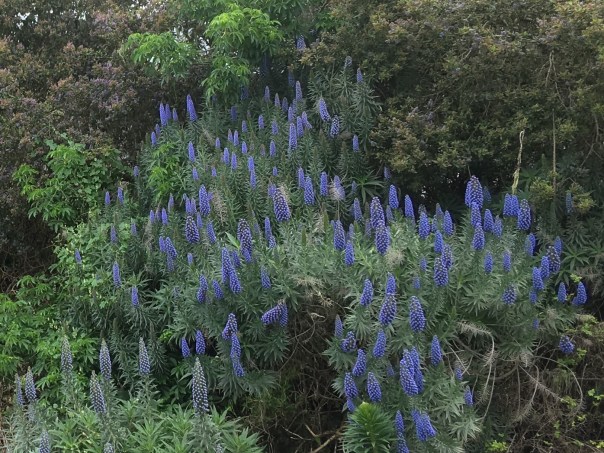
My favorite Pride of Madeira (echium) is in bloom, too!
As you can see, I did eventually get home, filled with knowledge and images — and oysters!




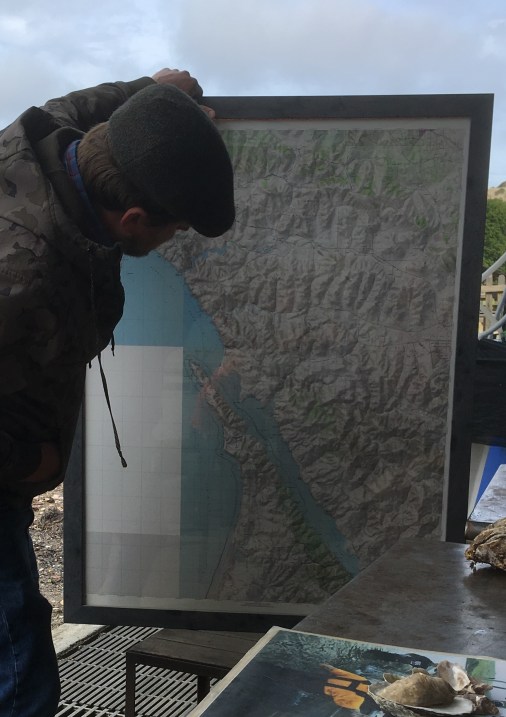
 Isn’t that an interesting crack-like body of water? It can’t be a fjord, because this is California. The San Andreas Fault, which is “a transform fault–where plates pass one another like cars on a two way street,” runs in a line down the middle of the bay. This classic photo (at left) of a displaced fence shows what happened as a result of the San Francisco Earthquake of 1906, and why rock formations on the east and west sides of the bay are so very different.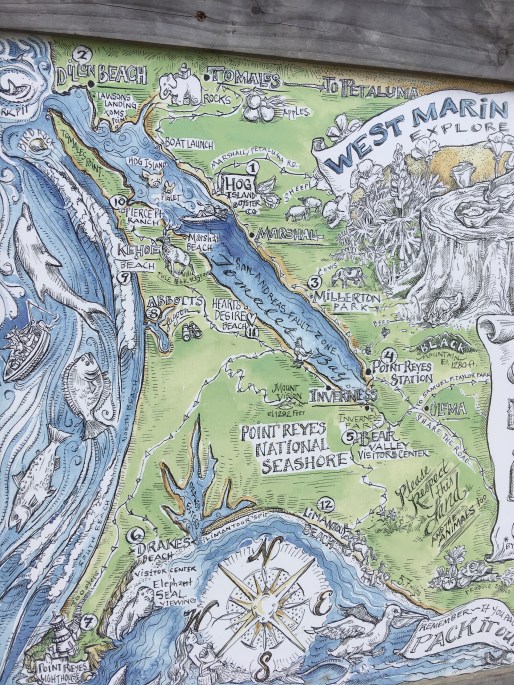






 Gladsome Lights