 When I got home from church this afternoon I baked a cheese tart from Trader Joe’s and ate it outdoors, and as the sun did not go behind a cloud, I read the Heritage Farm Companion and did some Spanish lessons. The Companion is a little magazine for members of the Seed Savers Exchange, an organization that I’ve loved for more than 25 years, though I’ve never participated by contributing seeds that I save.
Today I learned two interesting things from that issue: 1) People are growing rice in Vermont, and 2) Hoverflies/syrphid flies are attracted to the flowers of sweet alyssum; they also eat aphids, so planting alyssum as a companion to whatever you want to protect from aphids — in my case that would be milkweed, and several other plants — can be very helpful. This photo showing how that might look I found online, from the Regenstein Fruit and Vegetable Garden at the Chicago Botanic Garden. Before my garden makeover, I had alyssum everywhere, but I haven’t let it grow since I re-landscaped. Alyssum used to sprout up everywhere, but now I see  that situation as benign, whereas the aphids are a plague. Maybe there is a connection?
Three different people had been watching over my garden while I was in DC greeting the new grandson. Plus I have automatic irrigation, and drought-tolerant plants. So I should not have been surprised that it looked great, even better, when I got back — all the plants were bigger, and various things were in bloom, like the coreopsis that I had only set out the day before I departed.

 Several times in the last week I’ve been able to sit in the warm garden, usually in the early afternoon. The morning is often overcast and around 55°; dinner times a cool marine breeze often drives us indoors. Today after I finished my tart I glanced behind me and saw that the toadflax is finally in full bloom. It looks pretty weedy most of the year, and even now 🙂 but the flowers are so cheery… I’d say it never looks better than today.
And what do you know – I just found a photo in my files of a hoverfly on toadflax. I also have a shot of one sipping at lavender, and lately they are really busy with the lamb’s ears; that actually seems to be  their favorite flower around here. Come to think of it, there are blooming lamb’s ears right next to the aphid-infested milkweed… ? …but the hoverflies are mostly in the front yard… ? I need to think about this some more.
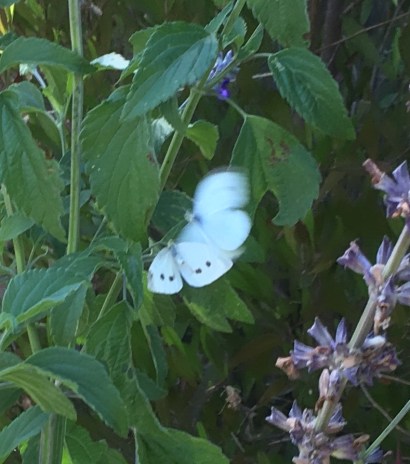
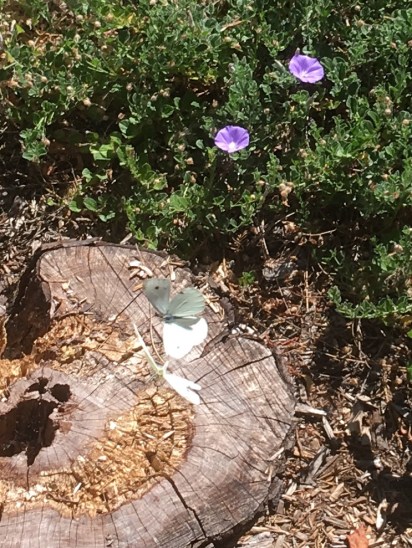
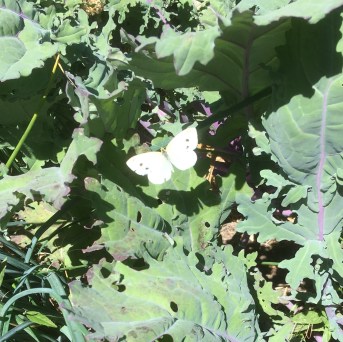
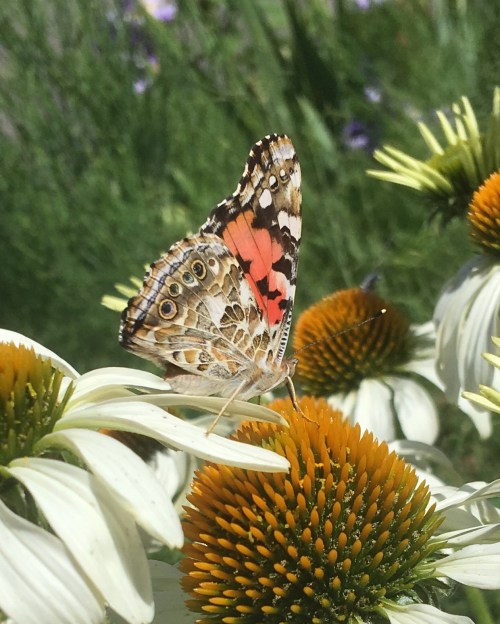
Cabbage white butterflies were dancing all over the garden the whole time I was out there. I assumed it was a kind of mating dance. I tried taking still shots, and even a video of their choreography. Against the blue sky, where one loses all perspective, they look like some crazy white birds. I read that “A male finds another butterfly of the same species by sight, then determines its sex by flying close to detect chemical pheromones—a process that often makes them look like they’re dancing around each other in the air.”


I could never get close enough to get any good pictures, still or moving, but here is a video I found of cabbage whites mating. Butterflies are so delicate and fairy-like, they make me feel that I am a character in a folk-tale where anything magical might happen. Even the name butterfly is charming, yes? Did you ever read my post about the words for butterfly in different languages? In French it is papillon. And in Spanish, mariposa. Those are beautiful, too! The Germans call them the fantastic schmetterling, which gives me almost as much joy to say, as it does to see a butterfly schmettering from flower to flower.
 A year or so ago I decided to study Spanish. In much of California it’s kind of crazy not to know Spanish, but I chose French in high school, and several other languages since then. I’ve had close friends who were Spanish majors, and four of my children studied Spanish for two or more years. When I started doing 5-minute lessons on my phone using the Duolingo app I discovered that I already knew quite a lot. It’s been more like play than work, because there are no humans to see my work, no shame in goofing up. I get points for doing the lessons no matter how many times I get something wrong. For six months I managed to do at least one five-minute lesson per day.
 When I was at Kate’s for three weeks I didn’t have any gardening or housework or church work to do, and I was able to do so many Spanish lessons one day that my brain grew weary. It occurred to me that there would be no harm in checking out the French course, to brush up on my French; in my youth I studied it first and the longest, so it’s probably stuck deep in the recesses of my mind… While mom and babies were napping, I did quite a few French lessons, and they were even more fun than Spanish. On Duolingo the first lessons of a language are short so you whip right through them — especially if they are ones you did when you were 13!
 So the next day what did I do? Turkish! I’ve had very little Turkish instruction, but I did spend six months total in that country, living with Turks, and it has been pure delight to do Turkish lessons. You may ask, what about my work, now that I am home again? It is mostly not stuff that anyone else cares if I do or not. And I’m still in a kind of limbo about my remodeling project, which makes it hard for me to know just what thing is the Next Thing. So I behave as though the maid is going to show up soon, and I am a woman of leisure with nothing more important to do than to read about seeds and learn a useless language.
And it is Sunday afternoon!

 ,” who delights us into laughter. We have the same Father, we and Nature. Okay then, I’ll say it was my Little Sister who gave it to me: a tomato plant.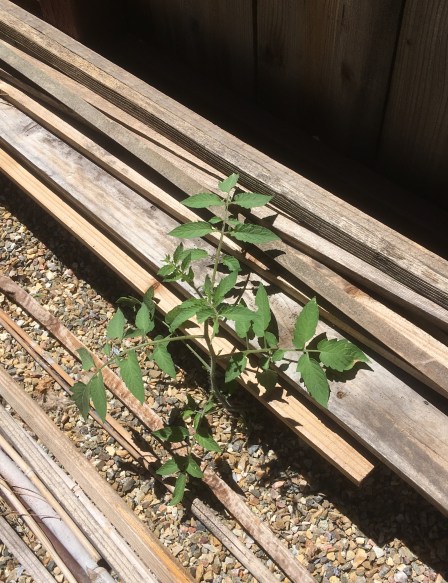
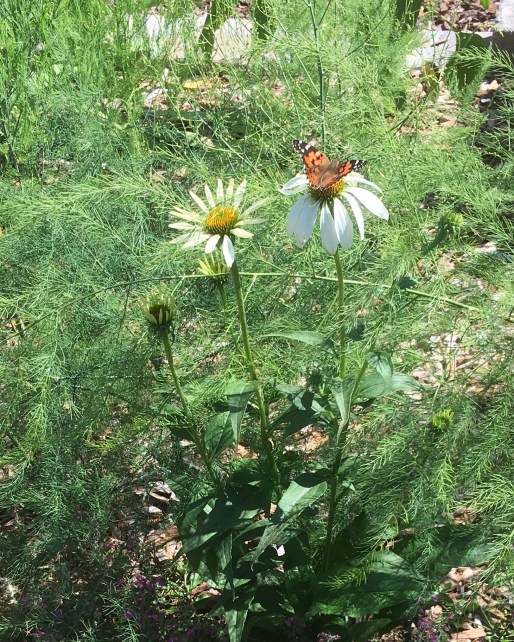



 o try that place again. It was a little later in the season that the Monarch events happened last year; maybe there’s time for me to get rid of the aphids somehow, and hope that they’ve left some nourishment in the leaves for caterpillars…
 Gladsome Lights