Monthly Archives: November 2019

Their great audacity.

Poet and critic Dana Gioia devotes a whole chapter of his recent book to Elizabeth Jennings, whose name I did not recognize. She is “not the average professor’s idea of a modern poet.” Jennings was one of the Movement poets (and no, I don’t know enough about poetry to have known about them) but the only woman of her group.

She was Catholic, which also set her up for mocking. Gioia writes:

“Catholic iconography portrays martyrs in their heavenly glory displaying the instruments by which they were tortured and killed…. By the same method, is it possible to understand Jennings’s achievement by considering her supposed liabilities as defining virtues? …
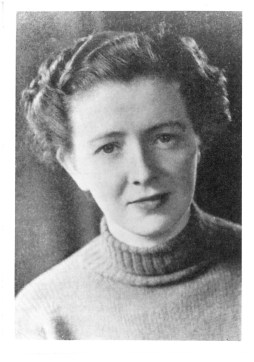
“Jennings was a lyric poet. She mastered short forms. She wrote from an educated woman’s perspective. Her work is personal but not blatantly confessional. In a literary era obsessed with style, she focused on content. Her poems cluster around a set of recurring themes — love, religion, art, and relationships. Her poetry reflects her Christian worldview. Her stylistic approach was not to innovate but to perfect. When free verse represented the vanguard, she crafted her signature poems in rhyme and meter. She wrote prolifically.”

I haven’t read all of the title essay in the book yet, but that chapter is available here on First Things if you would like to read it online. It’s worth reading if only for his understanding of what characterizes a Catholic world view.

After reading about Jennings I wondered how I had completely missed her — but I hadn’t, only forgotten her name. Somewhere I’d run across “Friendship” and posted it on my blog. My library doesn’t have a single hard copy of any of her books, which is not surprising. This one below I found online.

ANSWERS

I keep my answers small and keep them near;
Big questions bruised my mind but still I let
Small answers be a bulwark to my fear.

The huge abstractions I keep from the light;
Small things I handled and caressed and loved.
I let the stars assume the whole of night.

But the big answers clamoured to be moved
Into my life. Their great audacity
Shouted to be acknowledged and believed.

Even when all small answers build up to
Protection of my spirit, I still hear
Big answers striving for their overthrow

And all the great conclusions coming near.

-Elizabeth Jennings

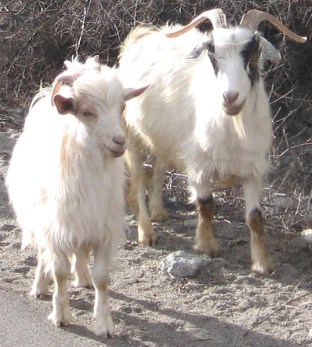
Bishop Latour meets the elegant goats.

I’ve read Death Comes for the Archbishop by Willa Cather three times, including an audio recording narrated by David Ackroyd which I only recently completed. These three readings were so far apart that each time seemed a fresh introduction to the characters and the setting. And yet, I do think that the first two readings helped to form a love in my soul for the Southwest territories of the United States, so that this third time I found it there waiting for me, like the warm sand beneath a red rock butte, a place where I might bed down for the night under the stars and feel whole.

Ackroyd’s voice and narrative style seem perfect for the story. There is a steadiness and a lack of hurry that aligns with the faithful dailiness of the lives of the two missionary priests as they try to meet the spiritual needs of a vast diocese that had just enlarged by nearly 30,000 square miles with the Gadsden Purchase.

They are based in Santa Fe, New Mexico, but make frequent trips by horse or mule of hundreds and thousands of miles, even into Old Mexico, to take care of ecclesiastical affairs, to baptize babies and perform marriages, and to serve Mass. Their characters are sympathetic and rich; the story of their friendship over the decades is a thread woven through the novel, made up of small stories scattered through the years.

I’m using this audio book now the way I have two or three others in the last years since I sleep alone, for the times when I don’t sleep. I put a well-known story to play on my phone, set the timer for 30 minutes, and let David or another nice person read me to sleep. This only works with voices that do not draw attention to themselves in various ways, usually by being overly dramatic.
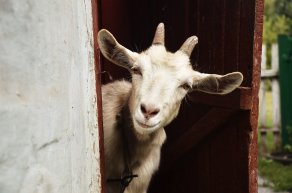
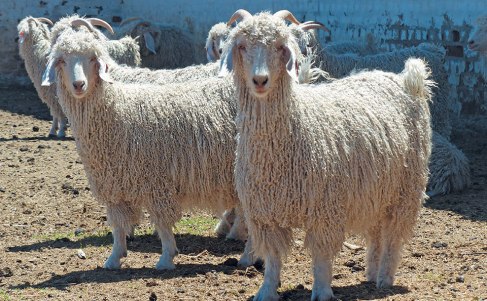

That means I am reading/listening to the book, based on a true story by the way, a fourth time. Because every anecdote and scene seems more luminous and meaningful than ever when it is told or described by a warm human voice, I may post here some passages that appear plain and dry to you poor people who may never have breathed the air of New Mexico or seen the Arizona desert in bloom. But today, it’s only goats we will consider, and I imagine that they are goat-ish the world over.

“After the feast the sleepy children were taken home, the men gathered in the plaza to smoke under the great cottonwood trees. The Bishop, feeling a need of solitude, had gone forth to walk, firmly refusing an escort. On his way he passed the earthen threshing-floor, where these people beat out their grain and winnowed it in the wind, like the Children of Israel.

“He heard a frantic bleating behind him, and was overtaken by Pedro with the great flock of goats, indignant at their day’s confinement, and wild to be in the fringe of pasture along the hills. They leaped the stream like arrows speeding from the bow, and regarded the Bishop as they passed him with their mocking, humanly intelligent smile. The young bucks were light and elegant in figure, with their pointed chins and polished tilted horns. There was great variety in their faces, but in nearly all something supercilious and sardonic. The angoras had long silky hair of a dazzling whiteness.

“As they leaped through the sunlight they brought to mind the chapter in the Apocalypse, about the whiteness of them that were washed in the blood of the Lamb. The young Bishop smiled at his mixed theology. But though the goat had always been the symbol of pagan lewdness, he told himself that their fleece had warmed many a good Christian, and their rich milk nourished sickly children.”

-Willa Cather in Death Comes for the Archbishop

St. Michael the Chief Commander


Today we commemorate St. Michael and all the Bodiless Powers. This feast day was established at the beginning of the fourth century, even before the First Ecumenical Council. This page on the Orthodox Church in America website explains the nine ranks of angels and much about St. Michael, the Chief Commander of angels.


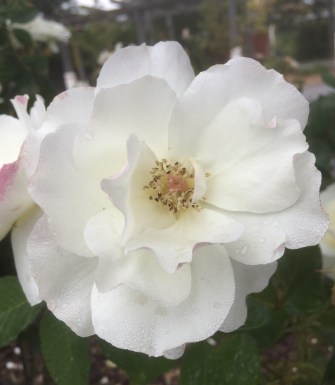
When I arrived at church I saw a rose gracing the damp and grey day,
so I memorialized it, too.

Father Stephen reminded us of a prayer that came from his son at about four years old:

Dear St. Michael,
Guard my room.

Don’t let anything
eat me or kill me.

Kill it with your sword.
Amen.

He shared other stories on his blog about children especially, who have seen their guardian angels. Our rector in his homily noted that many of us have our physical senses finely tuned so that we can know, when we taste wine, where the grapes were grown; and when we hear music we often know if it’s off-key, or even who composed it. But our spiritual senses are usually so dull that we not only can’t see our angels, but we mostly ignore them. In any case, they are there, guiding and protecting us! Let’s try to pay more attention.

How to love a strawberry tree.

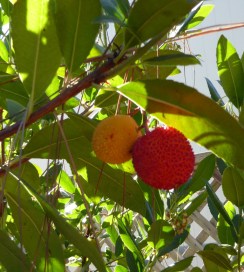
This summer my strawberry tree got my attention as never before, for a couple of reasons. First, there was lots of fruit. This is probably because of the wet spring we had, and because the tree is bigger than ever, and has been pruned twice in the last few years.
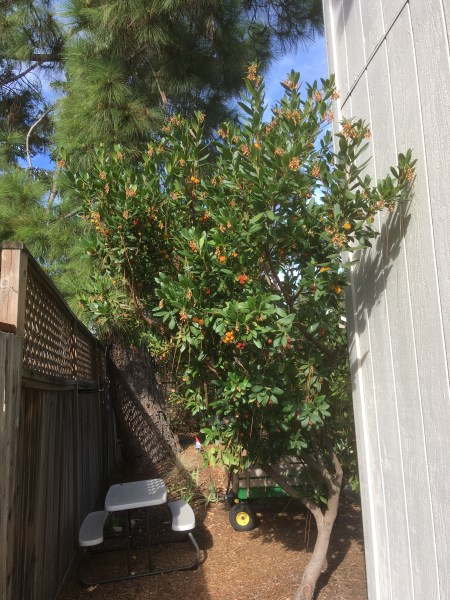
When I was popping the “berries” into my mouth I noticed that some of them were damaged, or that they were inhabited by other hungry creatures. That began my months-long more intensive engagement with my tree.

Let me tell you why I love this tree so much:

1) My husband and I planted our Arbutus unedo together, perhaps 15 years ago, so it’s got history with me.

2) It grows and grows without demanding any attention; it’s drought-tolerant, shade-tolerant and frost-resistant.

3) Even without its fruit it’s a handsome tree, but its blossoms and fruit add to that beauty over a long period.

4) The fruit is yummy and bears over a long period in late summer and fall, and the birds don’t seem to eat it.

Below, those are pine needles from the tree above, hanging like tinsel all over my tree.

The Strawberry Tree is native to the Mediterranean region, and also western Europe and southern Ireland. Here in California it’s grown a lot as an ornamental and usually the people who are familiar with it as a good landscape tree are surprised that I like to actually eat the fruit. Even the volunteers at the nearest Master Gardener help desk were surprised. I regretted that when I took in a few inedible fruits for their scrutiny I hadn’t brought a bunch of prime examples for snacks as well.

The Master Gardeners thought that the dark mottling of some fruit, which fruit also never ripens but remains hard as it dries up, was likely caused by a watering issue. That seems strange to me, because we had such a wet winter, and late rains, you’d think the tree would still have its roots down deep in the moist earth. But I had given it a long drink even so, before I asked.

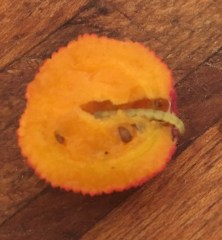
They studied and studied my pictures of the worms that were not around anymore for me to bring in as live specimens, but they could not identify them, though a couple of the staff consulted at length their University of California entomology databases. That didn’t surprise me, because if you look online, no one ever mentions one problem with the fruit – all the pests and diseases mentioned affect the leaves or the bark.

We are hoping that these worms will not come back in greater numbers next summer, but if they do, I’ll bring in a live worm for our research. They are icky. I can tell you, they get very excited when you slice their food-house in half, and their writhing about makes them more unlikable.

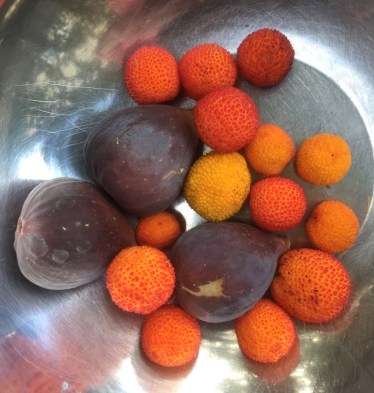
Let’s switch back to a photo of robust and radiant, healthy fruits. Yum. I think they are best when they are just turning orange, because they are plenty sweet, but still slightly firm. Their flavor then is also brighter than when they turn red and are starting to get soft.

I saw a picture of a crumble cake made with the fruit, in one of the many countries that appreciates them as a food crop, so when I baked a fig and almond cake recently, I added some cut-up fruits. Either they disappeared, or turned blue as did the figs, because there was nothing remotely red or yellow in that cake when we ate it, except the dried apricots.  😦

We haven’t had a frost yet, and I have a feeling I’ll have “berries” to enjoy until we do.