
Last night I attended the service of The Royal Hours of Nativity. It was not even an hour long, but the amount of Scripture in it — and theology in word, song, incense and candlelight — filled me to the brim. Here are a few excerpts:
Brethren, God, Who at various times and in different ways spoke in  time past unto the fathers by the Prophets, has in these last days spoken unto us by His Son, whom He has appointed heir of all things, through Whom also He made the worlds; Who being the brightness of His glory and the express image of His person, and upholding all things by the word of His power, when He had by Himself purged our sins, sat down at the right hand of the Majesty on high, being made so much better than the Angels, as He has by inheritance obtained a more excellent name than they.
For unto which of the Angels did He ever say: “Thou art My Son, this day have I begotten Thee”? Or again: “I will be to Him a Father, and He shall be to Me a Son?”
And again, when He brings the firstborn into the world, He saith: “Let all the Angels of God worship Him.” And of the Angels He saith: “Who makes His Angels spirits, and His ministers a flaming fire.”
But unto the Son He saith: “Thy throne, O God, is for ever and ever; a scepter of righteousness is the scepter of Thy Kingdom. Thou hast loved righteousness, and hated iniquity; therefore God, even Thy God, hath anointed Thee with the oil of gladness more than Thy companions…”
And: “Thou, Lord, in the beginning hast laid the foundation of the earth, and the heavens are the works of Thine hands; they shall perish, but Thou shalt remain; and they shall all grow old like a garment; like a cloak shalt Thou fold them up, and they shall be changed. But Thou art the same, and Thy years shall not fail…” (Hebrews 1:1-12)
Make ready, O Bethlehem.
Let the manger be prepared.
Let the cave show its welcome.
The Truth comes and the shadow flees.
God is born of a virgin and revealed to men.
He is clothed in our flesh, and makes it divine.
Therefore Adam is renewed, and cries out with Eve,
“Thy favor has appeared on earth, O Lord,
For the salvation of the human race.”
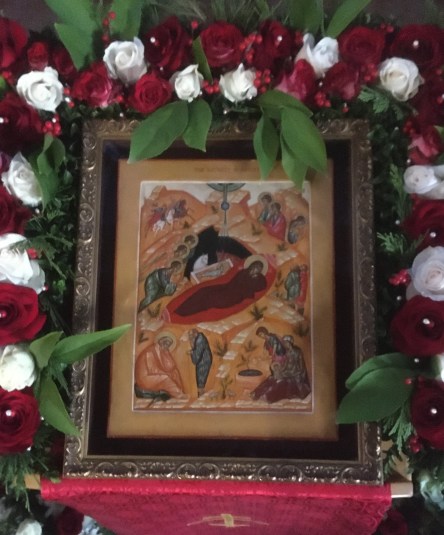
Psalm 86
His foundations are in the holy mountains;
the Lord loveth the gates of Sion
more than all the dwellings of Jacob.
Glorious things are spoken of thee, O city of God.
I will make mention of Raab and Babylon
to them that know me.
And lo, the foreigners and Tyre
and the people of the Ethiopians,
these were born there.
A man will say: Mother Sion;
and: That man was born in her;
and: The Most High Himself hath founded her.
The Lord shall tell it in the writ of the peoples and the princes,
even these that were born in her.
How joyous are all they
that have their habitation in Thee.
I wish you all a blessed, full Twelve Days of Christmas,
and a new year full of the experience of God’s favor and salvation.
Christ is born!

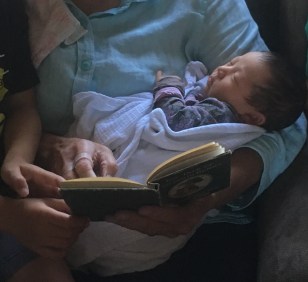 Ever since the King of Glory was born into this world of death, His people have suffered under and among the kingdoms of this world. We talk a lot about how He was weak and helpless, being a baby. But any of us mothers might remember the vulnerability of women in pregnancy, in the very season when one wants to be most in control, so as to nurture and protect.
 Babies are cute and adorable and fill us with love, but they also remind us that we are vulnerable. Strangely enough that is actually the most comforting thing about them. Their very perfection forces us to realize we will not be able to save and protect them in the way we wish. We mothers cannot guarantee that our babies will be safe and happy in this world.


