
During a 20-minute phone call with a friend last week, I mentioned all of the books pictured above, only one of which I have read, long ago. After he asked me about a couple of them, “Did you finish ____ ?” I blurted, “I don’t read books, I only buy them!”
It’s partly true; three of the books pictured I am in the middle of reading. I think I will take The Cross of Loneliness with me on my travels this week, because it is little and is likely to be encouraging to my spirit, without demanding too much of my analytical abilities. It sets down the correspondence of Saint Sophrony and Archpriest George Florovsky from 1954 to 1963. These illustrations from the book of their kind faces make me eager to peek in on their friendship.

I’ll be flying to Colorado to visit my son Soldier’s family, and from there to Idaho to see friends Jacob and Rosemary, before heading back to California. Both of these families are in new towns since I last visited them! The excitement of navigating airports, riding in airplanes, being in strange places and beds; playing with grandchildren and chatting with everyone will keep my mind plenty busy. It’s already buzzing with the challenges of getting myself ready for the big day, and incrementally taking leave, in my heart, of my home, and my garden with all the plants I have been nursing along; like the first golden zucchinis that will ripen while I am far away. I will say farewell to my stack of To-Read books, which if it actually were just one stack would be higher than my house.

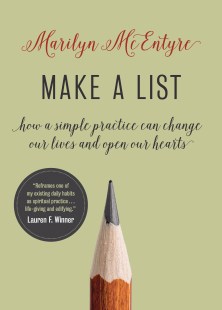 But I know that I will like to read on the plane, and read in my room before going to sleep at night, so I must choose what to take along. This book that I discovered in my Kindle, Make a List, looks appealing for a few summery reasons.
(List of) Reasons why it’s a good book for this summer:
1 – Only a couple hundred pages.
2 – Not demanding content:
2a – No long list of fictional characters to keep straight.
2b – No complex-thinking philosophers to follow.
3 – It will help me keep engaged with my philosophical self and my life back home by simply jotting down a list here and there.
4 – It will prompt me to keep writing without my always having to make quality whole sentences, which are a lot of work. I might even compose travelogues entirely of short lists!
 It occurs to me that my attempt at Bullet Journaling was kind of list-y. Unfortunately I always felt the need to elaborate and my bullet points swelled into paragraphs. It will be necessary to keep these lists in a different category from journaling altogether. I haven’t written one thing in my journal for a month or two, which feels scary. Maybe I’ve already made the break?
My college roommate Ann has been an inspiring list-maker all her life. She makes lists of the lists she needs to make. You might say that is the idea that Marilyn Chandler McEntyre has elaborated on; you can hear her talking for three minutes on the subject here.
Now I need to get back to the lists I have recently been working from, like:
1 – To-Do Before I Depart, and
2 – Carry With Me On the Plane.
Once I add “Kindle Reader” and “Notebook for Writing Lists” to that second list, I’ll be good to go! …. or will I…? One more very important list must be completed, before I shut the door on my tottering stacks:
Books I Really Want to Read Soon But Must Sadly Leave at Home.
But I’ll come back, Dear Friends!

 No man, when he hath lighted a candle, putteth it in a secret place, neither under a bushel, but on a candlestick, that they which come in may see the light. The light of the body is the eye: therefore when thine eye is single, thy whole body also is full of light; but when thine eye is evil, thy body also is full of darkness. Take heed therefore that the light which is in thee be not darkness. If thy whole body therefore be full of light, having no part dark, the whole shall be full of light, as when the bright shining of a candle doth give thee light.
 But though spiritual sight must be part of what Christ is talking about, twice He uses the words, “whole body full of light.” Pause and think on that! What can it even mean? We can theorize about it, but Christ, Who called Himself “The light of the world,” is not an idea or a theory or a spiritual practice. He will have to teach us what this means by experience. Our yearly Lenten effort is our effort to return again and again to that lifelong process. And He has many ways of opening our eyes and bringing us to Himself, customized to each person’s unique situation.
 is losing some of his youthful goodness. If our lives are like mirrors that are meant to reflect the glory of our Creator, his mirror is not doing that very well; it has gotten dirty by slow degrees and not even his parents understand why their son does not bring them joy as he used to.
 “It was indeed a lovely being, and Curdie thought how happy it must
 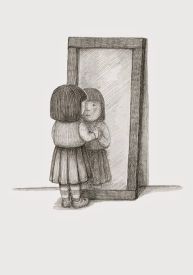 after an indefinable time out of time, which may be less than a minute, our boy comes through the storm with clarity, and proceeds with his repentance.
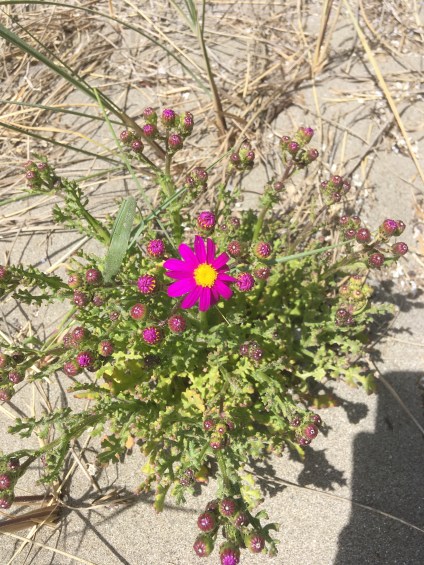
 Today’s beach trip kept getting put off, until by the time I got out to the coast it was already afternoon. These flowers had opened sometime in the last week; I don’t remember ever seeing them on the California coast before. The daisy flower looks like something that might have escaped a back yard, but the plant as a whole definitely does not.


 I saw this new sign, “Sensitive Wildlife Area: Do Not Enter,” one of many posted along the rope that surrounds an area not twice as large as what you can see in this picture. The dunes are of course always in flux from the changing winds. It seems odd to guard a relatively tiny spot, and also not to say what agency is forbidding the children to play there. [See more about this in the comments.]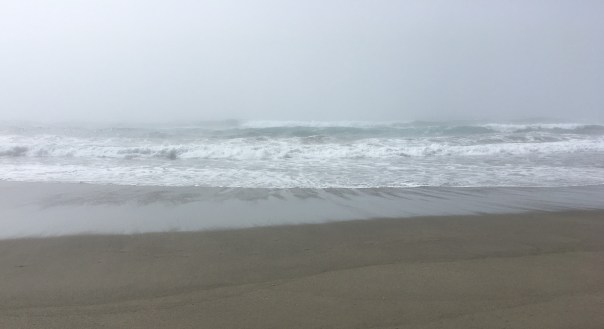

 The fourth book I had borrowed because I noticed this week that two Orthodox priests I follow on Goodreads had given it five stars, and it was a book I wasn’t familiar with. I began to read it and didn’t stop, just sat there behind the wheel for the next hour being charmed, by The 13 Clocks. I have over my life enjoyed many things James Thurber has written, so I’m not surprised. It was really fun, and I’d have liked to read it through again right then.


