In the evening of this humid day I was cooking, and waiting for my computer guy, who never came… Rain began to fall about 5:00, but the air is mild, so I opened the windows wider so as to smell the indescribable and rare scents of these early rains. When you live where the whole summer is dry, often for five months, the first showers of fall are especially delicious.
I was peeling and cutting up the smallest quinces I’ve ever seen, and surely they are the most rock-like. For years I’ve been on the lookout for neglected quince trees, which I know used to be common, when I didn’t have time to experiment with them. Last month I was invited to go with my new neighbor Kim up in the hills to pick fruit at her friend’s estate. The word was, the fig trees were loaded.
When we arrived, we found that the figs were mostly not ripe. Passing over the monster zucchini, we picked kumquats that turned out to be more sour than lemons, a few apples and pears, and these dwarf quinces. Note to self: tiny quinces are not a good deal.
I interrupted my tedious quince prep to make tomato soup for dinner, using roasted cherry tomatoes of every color, preserved in the freezer from a distant summer, and other hoarded tomato treasures. Then I decided not to eat my garlicky soup after all, because I am going to the dentist tomorrow. I munched on a few handfuls of sunflower seeds.
Then it was back to the quinces: At this point they have been poaching for a good hour, and did get soft, but they are more sour than the kumquats, reminiscent of rhubarb, in spite of me adding extra extra sugar. Now I’m wondering if the tree they came from was some kind of sport — but no, there was more than one tree….
So many of my thrifty cooking projects lately have ended up terribly time consuming, but at least today I was able to feel appropriate to the fallish weather, in my efforts to use the garden harvest. The fresh and damp air was such a tonic that only laughing, not grousing, seemed natural. When I took this picture, a light rain was watering the earth.
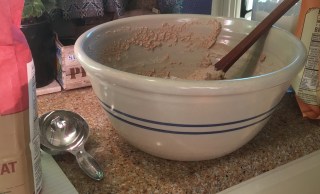
Over the weekend I got another batch of sourdough going. This particular make-it-up-as-you-go recipe included rye, whole wheat and unbleached flours, and potato flakes. I started what I call the sourdough sponge on Friday afternoon, and took the bread out of the oven Monday afternoon.
Most of the three days the sponge sat in a bowl on my kitchen table getting more and more sour. It was essentially a big batch of starter itself by Monday. After I added the last ingredients it took a few hours for the final proofing, shaping, and baking.
I watched a couple of videos of how to shape “high hydration dough.” Before its final rising you don’t want to add flour if you can help it, because that will spoil the lovely “custard” crumb you are aiming for. It’s a challenge to keep the fairly runny dough from just flattening out on the baking sheet. I liked the YouTube videos “Bake with Jack,” because Jack’s attitude and accent are entertaining; he does talk a little too much about the Why but eventually he gets to demonstrating the How, which is, after all, what I watch a video for. As in “How to stop your dough from spreading out flat!”
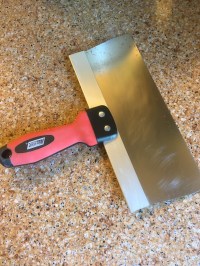
Another baker man on YouTube — they seem to be 80% men — poured his white and incredibly wet, stretchy dough out on a board and used a wide putty knife to cut it and and scoop it around, tucking the sides under in a series of rotating sweeps to get the lump shaped into a beautiful ball (boule) with a tight “skin.”
I went into the garage to dig around and found an almost identical putty knife, and it was even stainless steel, so I scrubbed it up and tried it out, but it seemed that the structure of my dough was heavy with ingredients low or lacking in gluten. It would not tighten up. I put the half I had tried to shape on a pizza stone anyway, and poured the rest into a large loaf pan. It was a total of about five pounds of dough.
How pleased I was to see that the free-form loaf got some height soon after it went into the oven at 450°. It must have held more tension than was obvious. My slashes in the top were so timid and shallow as to nearly disappear in baking, but that loaf has a nice shape and didn’t crack along the sides.
The pan loaf, on the other hand, had needed me to use the razor blade with a fearless will. Next time I will try to envision one of the Three Musketeers with his sword, and be brave. Swoosh! But right now, I have a loaf with a horizontal fault line along which the slices break, not quite halfway down. This makes the bread annoyingly inconvenient for toast or sandwiches. Enter the Brick Trick.
The section on “How to Slice a Brick” in Laurel’s Kitchen Bread Book is written for those times when your loaf of bread for some reason does not get height, yet you want to get more useful and normal-looking slices out of it. I thought this technique would work for at least the bottom half of my loaf, so I wrapped it in foil overnight to allow the crust to soften a bit, and in the morning I went at it.
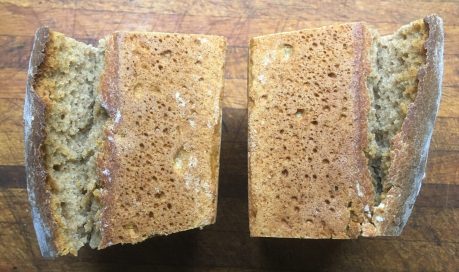
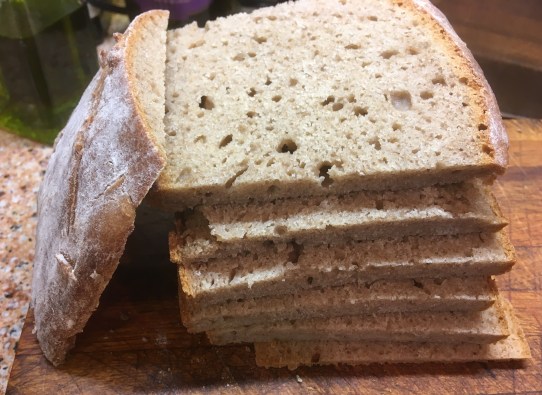
I didn’t know what would happen when I got to the upper part of the loaf, but I was able to slice along the “fault line” so that I ended up with 10 large square slices with only two crusty edges each, and five “heel” slices, two of which started out as the bottom of the loaf, and two of which are from the top. (Plus the heel I ate fresh from the oven.) I can see eating all those crusty edges myself, as well, so it looks like there will not be more than a few crumbs wasted. 🙂
I ate one of the thick Super Heels this morning, and I’d say I’ve never tasted better toast. Yesterday I had been feeling silly for giving “so much” effort to my Sourdough Project, even though the time commitment is not that great; bread spends a lot of time on its own in and out of the oven, giving the baker plenty of freedom to work on other tasks. This whole episode has only made me want to keep experimenting and having fun in the kitchen. Not to mention I need more opportunity to work on my sword skills!
Since my husband’s death three years ago I’ve had three long-term housemates. Two of them have moved on, so that Susan and I are the only ones here, just two of us using the cupboards and large freezer space. This situation dovetails with my own less-burdened mind, which now is able to grasp:
Yes! The obvious thing is to clean out the larder, use up the food, and start planning and cooking interesting meals with all the bits of this and that squirreled away. Facing up to what is unusable is part of the process; the soup that got lost in the back of the freezer for too long is one of the hidden costs associated with huge life changes, and is not a cause for guilt.
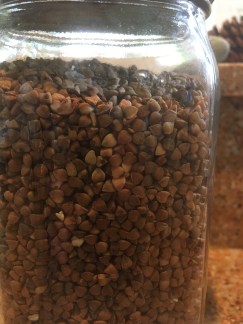
kasha (buckwheat)
Chesterton’s wisdom on creativity always helps me: Thrift is the really romantic thing; economy is more romantic than extravagance… economy, properly understood, is the more poetic. Thrift is poetic because it is creative; waste is unpoetic because it is waste. It is prosaic to throw money away, because it is prosaic to throw anything away; it is negative; it is a confession of indifference, that is, it is a confession of failure.
The most prosaic thing about the house is the dustbin, and the one great objection to the new fastidious and aesthetic homestead is simply that in such a moral menage the dustbin must be bigger than the house. If a man could undertake to make use of all things in his dustbin he would be a broader genius than Shakespeare.
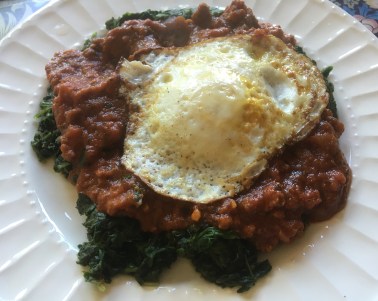
Another development since I returned from India is that I can’t go back to the weird eating habits I had fallen into as soon as I no longer had anyone to cook for routinely. Eating normally and very tastily for eight weeks cured me forever, I think, of my go-to frozen chopped spinach that I had been eating as the main part of every meal. Yesterday I used the last of it with a little container of likewise defrosted meaty red sauce and a (fresh) egg, to make a perfect breakfast:
These limitations I have placed on myself made me remember other things Chesterton said about art and painting and limits, and that led me on an interesting path through fields of quotes on the topic. Talk about limits and people will argue that they only exist in your mind, and must be “dropped,” if you are “to go beyond them into the impossible.” Even Winston Churchill is reported to have said, “The vistas of possibility are only limited by the shortness of life.” But he wasn’t trying to get dinner on the table in an hour.
Modern man seems especially prone to this delusion, but there are many sage exceptions, like Robert Browning: “So free we seem, so fettered fast we are!”
In matters of food and cooking, even if you had unlimited money you have limited time, and limits on whom you might find to prepare the ingredients, the choice of which is always limited to some degree, and on and on. I know you all know these things; this is my philosophical rambling you’re reading.
“Untitled” by Richard Diebenkorn
I am not advocating for an unhealthy fear of trying something new, but actually the opposite. As George Braque said, “It is the limitation of means that determines style, gives rise to new forms and makes creativity possible.”
And though Richard Diebenkorn was talking about painting, this word from him is empowering when considered at the beginning of any creative work: “My freedom will be so much the greater and more meaningful, the more narrowly I limit my field of action and the more I surround myself with obstacles.”
Yesterday I found several very ripe bananas in the freezer, and I did not want to waste them, even if their monetary value at purchase was minimal. You can imagine what they looked like after being there for a while; I’m sure I couldn’t have found a neighbor who wanted them. Anyway, part of my “style” is to stay home. I avoid going shopping, and knocking on doors for any reason. If only I had got my hoped-for worm bins set up, I would have given them to the worms!
But various baking supplies were sitting in the refrigerator begging to be used, so I put everything together into an unusual banana bread. It started from a “paleo” recipe with almond flour, but when I substituted egg replacer for the eggs I created a Grain-Free Vegan Chocolate Chip Banana Bread.
I was a gardener long before I had a blog — still, it’s surprising I didn’t tell my magic bean story here before. [Hmm… well, I did tell it, as the “related article” boxes below just revealed to me!] It started with friend Elsie… A Long Long Time Ago she and I used to share garden lore and harvest, and mysteries. The biggest mystery was how the special bean ever came to be growing in her vegetable plot.
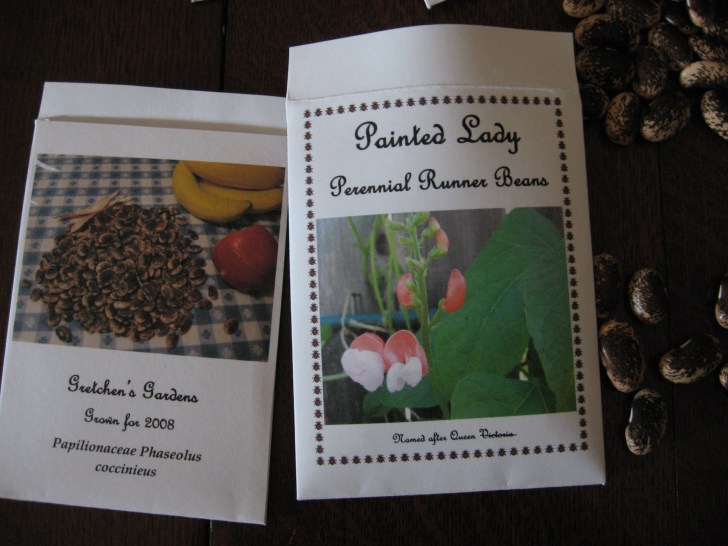
It must have been in 2006 at her house that she led me to a bed of earth next to a fence, to show me runner beans with big pods and pretty flowers. “Maybe you can tell me what this bean is,” she hoped. She always thought I might have the answers to any garden question. She hadn’t planted it, and her neighbors had no garden. I was clueless, but I went home and tried to find its picture online. It didn’t take long, even though at the time you could not easily find the seeds to buy. I read that only one runner bean has a bicolor flower, and this definitely matched the pictures of that variety called “Painted Lady.” Baker Creek Seeds in 2018 has this to say about it:
Traditional English bi-color grown since 1596! The name had mention to Queen Elizabeth I, ‘who was heavily made up with rouge and white chalk.’ The gorgeous flowers of red and white are among the most beautiful of flowering beans. The large beans are also good as snaps, freshly shelled or as dry beans, which are chocolate and tan mottled in color.
Just today I read on Wikipedia that this is a cultivar of the plain old Scarlet Runner Bean. They are all perennial, which is a great boon for someone like me who takes forever to get around to planting in the spring. The beans are pretty large, not the sort of seed you would imagine a bird dropping into the soil… Its appearance in our neighborhood and these other special features of the plant made it seem magic indeed, admittedly in a different way from those in the story “Jack and the Beanstalk;” but Elsie gave me seeds that fall, I planted them the following spring, and in a few months I had lots to give to friends in these packets I made, with an error in the name of the associated queen. Oops.
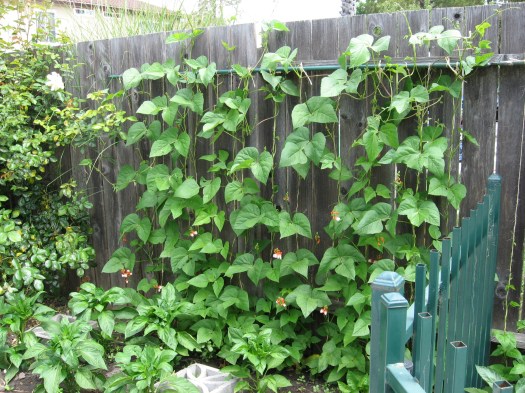
2007butternut,basil, and pole beans right now2018
It’s been many years since these beans have been given a spot in my garden, but I found a handful of seeds of uncertain age to try training along with the butternut squash on my sturdy trellis — and they sprouted!
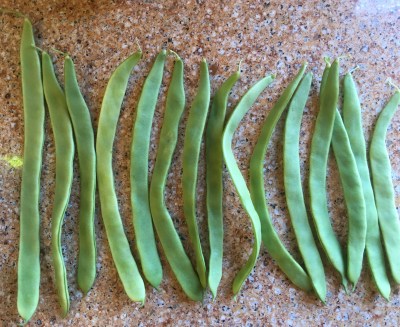
Nearby, the green beans named Blue Lake and Spanish Musica are reaching for the sky. I was lying in bed last night letting the poetry of bean names evoke images of Spanish ladies swimming in blue lakes, and composing a blog post about my wealth of beans. I had already made three pickings of the Spanish Musica, and Soldier came by to eat them with me — after I’d taken a picture of the last bunch, one of which was 11 inches long! They were very good eating, and their being stringless made them quick to prepare for the pot.
This morning at church the Gospel was the story of the Feeding of the Five Thousand. Father James’s homily ranged over the whole Bible and the goodness of God to feed us: The manna in the wilderness was a type of Christ, as He explained to His disciples at the Last Supper when they said,
Our fathers did eat manna in the desert; as it is written, He gave them bread from heaven to eat.
Then Jesus said unto them, Verily, verily, I say unto you, Moses gave you not that bread from heaven; but my Father gives you the true bread from heaven. For the bread of God is he which comes down from heaven, and gives life unto the world.
Then said they unto him, Lord, evermore give us this bread.
And Jesus said unto them, I am the bread of life: he that comes to me shall never hunger; and he that believes on me shall never thirst….Verily, verily, I say unto you, He that believes on me has everlasting life. I am that bread of life. Your fathers did eat manna in the wilderness, and are dead. This is the bread which comes down from heaven, that a man may eat thereof, and not die. I am the living bread which came down from heaven: if any man eat of this bread, he shall live for ever: and the bread that I will give is my flesh, which I will give for the life of the world.
Now we have the body and blood of Christ in the Eucharist week by week, imparting Christ the Bread of Life to us. Our homilist reminded us of the prayers that many people pray at meals, including those going back many millennia such as Jewish prayers like “Blessed art thou, O Lord our God, King of the universe, who bringest forth bread from the earth,” and “Blessed art Thou, O Lord, who feeds the world.”
When the theme of bread was added to the swirl in my head, a song popped up (naturally, because of Musica!) and joined in, one that our family used to sing as a grace before meals, part of Johnny Appleseed’s song adapted to the theme of dinner:
The Lord is good to me
and so I thank the Lord
for giving me the things I need:
the bread and the milk
and the bowl of beans;
the Lord is good to me!
It just so happens that I made bread last week, too, part of my ongoing project of combining “artisan no-knead” technique with my sourdough starter and experience. This latest effort was very satisfying, and makes me want to get another batch going tomorrow.
I assembled the ingredients for the Swedish Sourdough Rye on Tuesday…
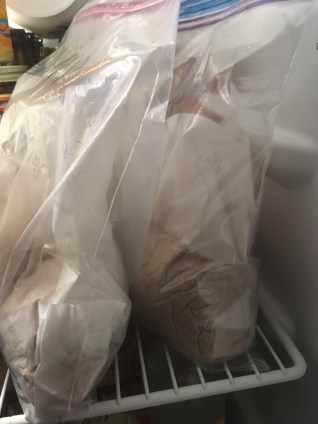
…and put two lumps of wet dough in the fridge in plastic bags.
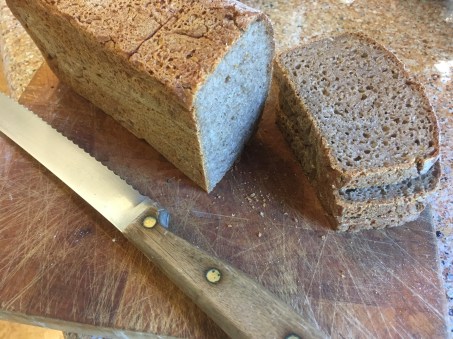
On Friday I baked one as a boule in the Dutch oven, and Saturday I baked the other in a bread pan, resulting in this 2-pound loaf:
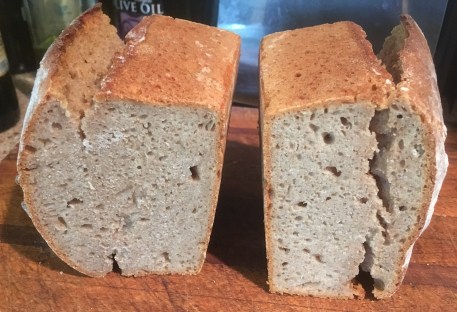
It is incredibly moist, what they call a custardy crumb, and nice and sour, with the anise and caraway and orange peel I got the idea for from Mabel last fall in Tucson. I sort of forgot to put any white flour in this batch, though it has whole wheat flour with the rye, and it is therefore dense, but it’s not doughy or heavy.
I bought the book at right but have read only a couple of pages. Before it arrived I had perused many recipes online but was too intimidated by all the details to follow any of them. After you’ve baked bread in a rather relaxed (a.k.a. sloppy) fashion for 40+ years the idea of completely starting over step-by-step was paralyzing. So I picked up some general principles and hoped that I might learn by experimentation; I’ve been keeping notes on my own trials and results. But I don’t know if I will ever have a real recipe to share with you all. I do know what is working for me currently:
1) Keep the dough wet and loose, more runny than biscuit dough.
2) Let it spend a good amount of time in the refrigerator.
3) When you take a lump out to bake it, handle it gently and don’t knead.
4) Bake it hot, at 450° or 500°F, and for longer than seems reasonable.
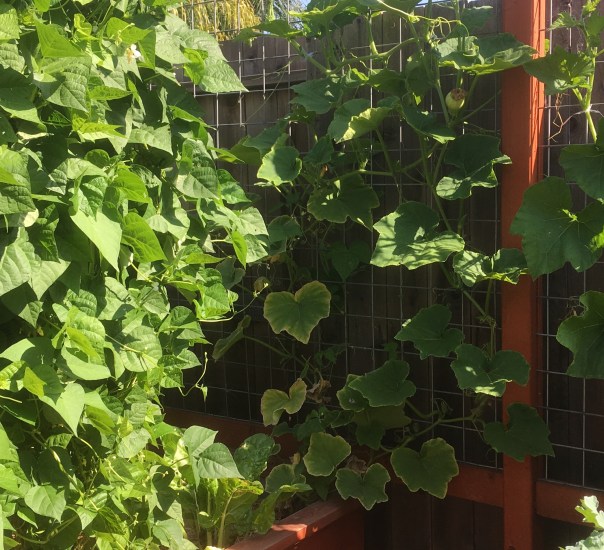
It’s not easy to see, but in the center of the photo below the Spanish Musicas are reaching across the space to hold hands with the trellis climbers. The poem that is being played out in my garden is too elaborate a ballad for me to follow easily (though Albert will likely jump at the chance to translate it), but tomorrow I’ll go out in the garden and try to soak up a few more lines.

 When we arrived, we found that the figs were mostly not ripe. Passing over the monster zucchini, we picked kumquats that turned out to be more sour than lemons, a few apples and pears, and these dwarf quinces. Note to self: tiny quinces are not a good deal.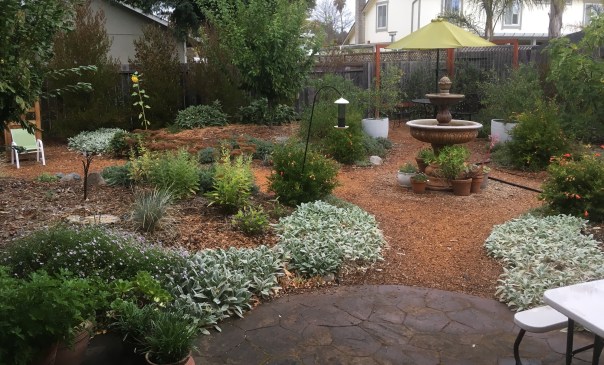
 Over the weekend I got another batch of sourdough going. This particular make-it-up-as-you-go recipe included rye, whole wheat and unbleached flours, and potato flakes. I started what I call the sourdough sponge on Friday afternoon, and took the bread out of the oven Monday afternoon.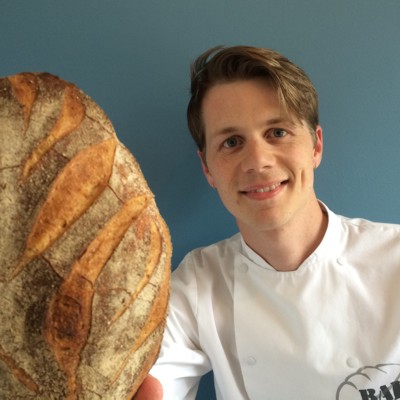
 How pleased I was to see that the free-form loaf got some height soon after it went into the oven at 450°. It must have held more tension than was obvious. My slashes in the top were so timid and shallow as to nearly disappear in baking, but that loaf has a nice shape and didn’t crack along the sides.
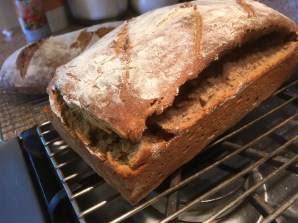 The pan loaf, on the other hand, had needed me to use the razor blade with a fearless will. Next time I will try to envision one of the Three Musketeers with his sword, and be brave. Swoosh! But right now, I have a loaf with a horizontal fault line along which the slices break, not quite halfway down. This makes the bread annoyingly inconvenient for toast or sandwiches. Enter the Brick Trick.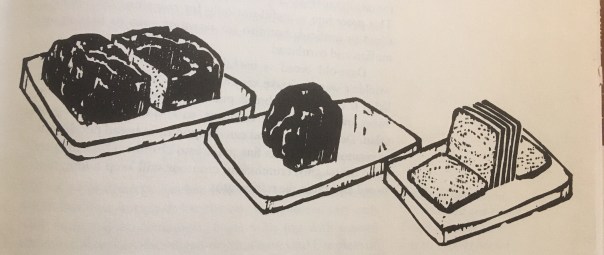





 d to have said, “The vistas of possibility are only limited by the shortness of life.” But he wasn’t trying to get dinner on the table in an hour.
 n if their monetary value at purchase was minimal. You can imagine what they looked like after being there for a while; I’m sure I couldn’t have found a neighbor who wanted them. Anyway, part of my “style” is to stay home. I avoid going shopping, and knocking on doors for any reason. If only I had got my hoped-for worm bins set up, I would have given them to the worms!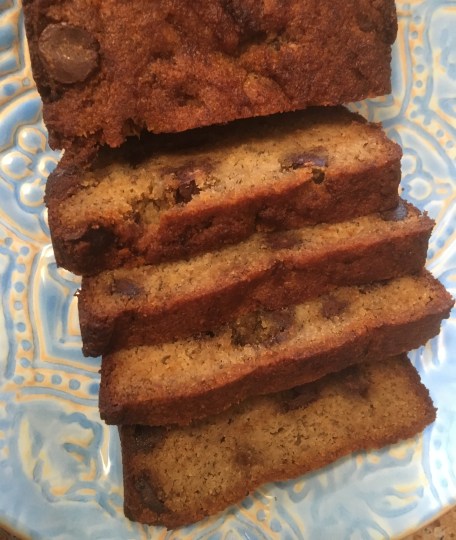


 The Lord is good to me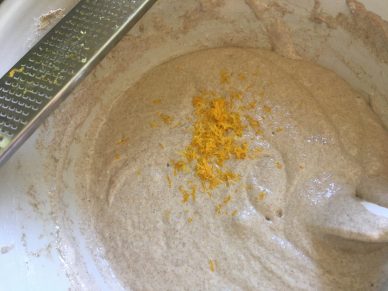
 Gladsome Lights