When Daughter Kate and her family arrived, we soon established a tradition of drinking smoothies in the afternoon, on the sunny patio. Raj especially liked the thick one I made with mango, ice, rice protein and pineapple juice concentrate. Then there was chocolate banana. And strawberry.
He hadn’t seen the playhouse in six months, and was quite pleased.
Rigo celebrated his first birthday, and he was pleased, too.
Raj sings pretty much all through the day, and he carries a tune awfully well for a two-year-old. I love having Raffi and every children’s folk song wafting through the house and garden.
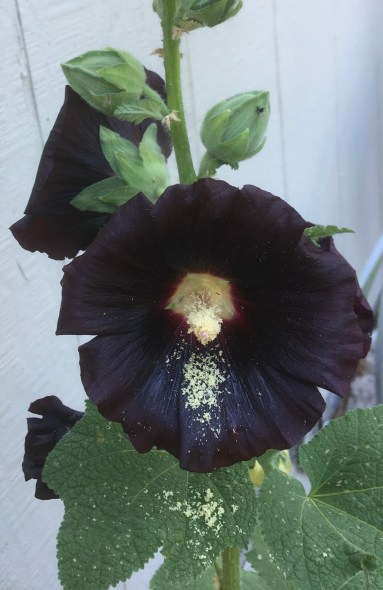
By the way, out there, a hollyhock whose seeds I planted several years ago is blooming for the first time. [It’s Black Currant Whirl from Baker Creek seeds.] It’s in a very out-of-the way spot behind the mock orange, and grew giant buds before I ever noticed. Then today, this!
I went to church today for the feast of Saints Peter and Paul. Blessed Feast! Our parish is not open yet on Sunday mornings; that is, we aren’t able to be in the building except for a short time when we file through to receive the sacrament. But because this was a weekday Liturgy, not a large crowd was expected, and we could stand through the service at an appropriate distance from one another. I was an hour late because I’ve been busy with other things than keeping track of the service schedule that’s been changing a lot lately. It was still quite a blessing.
I visited the icon of Saint Isadora, whose message I know that I always need, but never more than these days and months we’ve had lately. And what a gorgeous flower surround for the icon of the saints of the day.
The song of a Bewick’s Wren came through my bedroom window as I was waking to the morning. I’ve never heard one of these birds carrying on so long.
If you are not familiar with it you can listen here: Bewick’s Wren
What busyness in my life all at once. June warmth makes my blood to move faster, and days fill up and empty themselves, as the thermometer on my patio rises and falls. A few of the many things:
**Half the plants in the garden need trimming already! I severely pruned the plum trees, trying to keep them small, as per Grow a Little Fruit Tree. Santa Barbara daisies, wallflower, helianthemum, gazanias, bush lupine and salvias, all needed a midsummer shearing. Then there were all those one-gallon salvias and such for which spots must be found in the ever more crowded landscape. I’ve been gardening for hours every day.
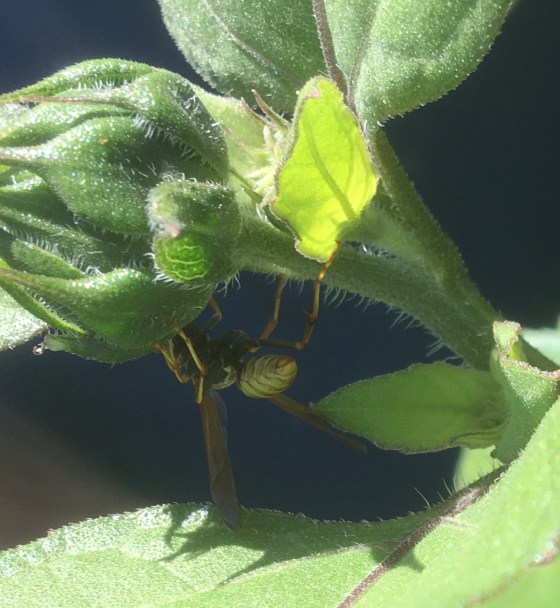
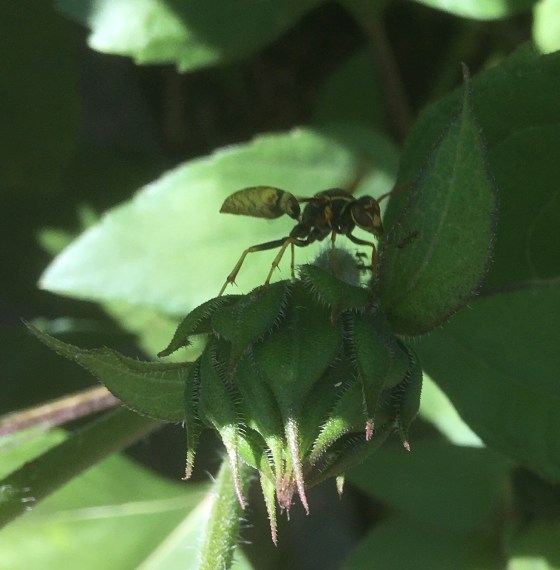
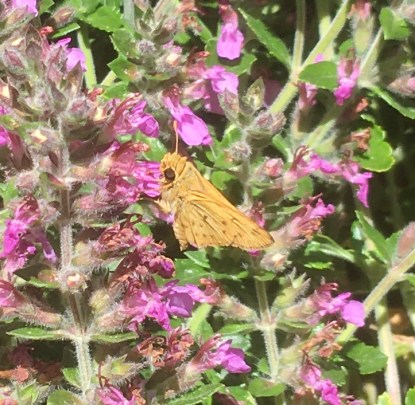
**Still seeing butterflies and wasps that I don’t know, and which I can sometimes identify. These wasps that my Seek app says are paper wasps ignore the sunflowers that are open, and hang out on the fat buds. I wonder what they are doing…
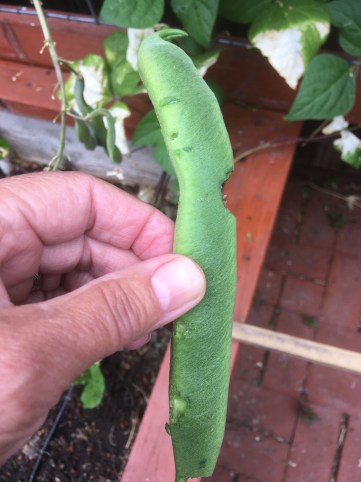
**Rats seem to be eating my garden as they did in 2016. Then it was tomatoes. This time it was the single collard plant that came up from some old seeds. After it grew back for a few days they ate it again. Then they tried the unripe Painted Lady runner beans but evidently didn’t like them. I’ve planted fresher collard seeds and am trying to figure out how to protect them when they sprout. Rats spurn Swiss chard, and all the other current offerings, though they did nibble on snow peas back in April.
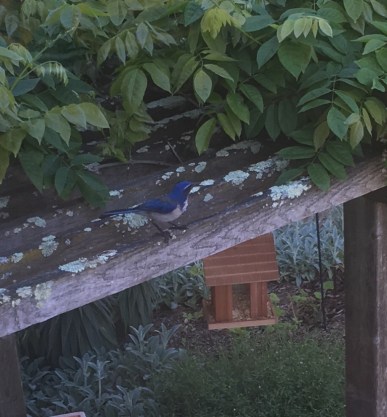
So as not to attract rodents unnecessarily, I’ve been bringing the bird feeders into the garage at night. At first light finches and mourning doves and even crows are waiting for the sunflower seeds to reappear.
View from my bedroom window.
This morning, as I often do, I pulled on my robe and went out to hang their “chapel” feeder on its hook above the patio, and then I looked up into the redwood tree, because I could tell that the wren was broadcasting from there at that moment. But I couldn’t see him. A junco and titmice and a hummingbird flew back and forth from that tree, to and fro across the yard from tree to rooftop to tree; but the wren followed his routine of staying out of sight while visiting in turn every tall tree in the neighborhood, making sure he communicated to each household, insisting on joy.
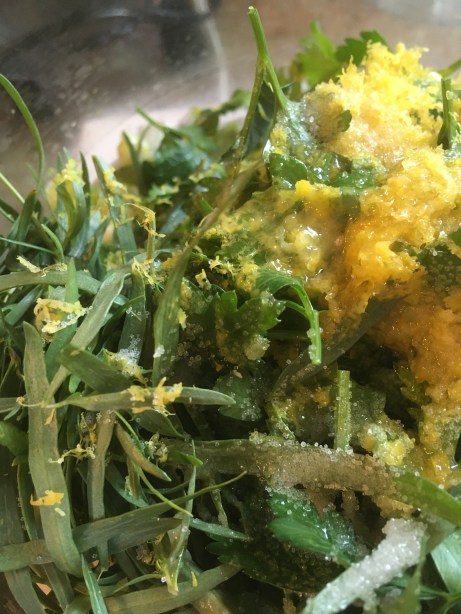
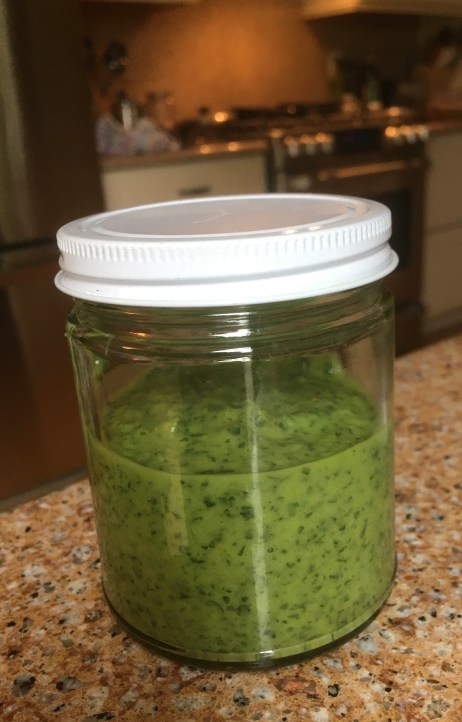
**I’ve been cooking a lot. I love having fresh tarragon with which to make the Tarragon-Parsley Salsa Verde. This time I used walnut oil instead of olive oil and it’s great. The yellow in the picture above is lemon zest.
I took all the remaining Painted Lady beans I’d stored and soaked them together. The older they get, the more they turn dark and red and shiny. The older beans took longer to soak, and longer to cook to tender.
**My computer comes and goes with my Computer Guy, and while he’s always interesting to talk to on almost any topic, the other day when he came merely to pick up the PC he wanted to talk for an hour before he even unplugged it. He has lots of ideas for how to improve the state of the nation. I told him he’d need to be king so he could make unilateral decisions.
new shower curtain
**The construction workers came back! The new bathroom is perfectly usable now, though it has a couple of details unfinished. I soaked in its tub the night after my most strenuous day of pruning. Lovely. My master bedroom walk-in closet is almost done — maybe tomorrow I will be able to start moving into it, after more than a year of shifting my belongings from one room to another. This was the closet that I basically wanted to get unextravagantly spiffed up before the major remodeling was begun. And it has been the biggest inconvenience. That is sometimes most aggravating to think about, but on days like today, the wren makes me laugh aloud.
**I pulled this weed out of the germander and was impressed by the little black seeds. I think it is Black Medick.
**Yesterday morning I was surprised by daughter Pippin appearing in my front garden and calling “Mama!” up to me where I sat by a sunny open window. Such a familiar voice and word… ❤ How she happened to be here is too long a story, but we enjoyed the best hug ever — well, at least since I saw them in March. And then we sat in the garden and chatted and it was so good for our mother-daughter hearts. She and I are not phone-talkers at all; we really need to be together in person to be fully satisfied.
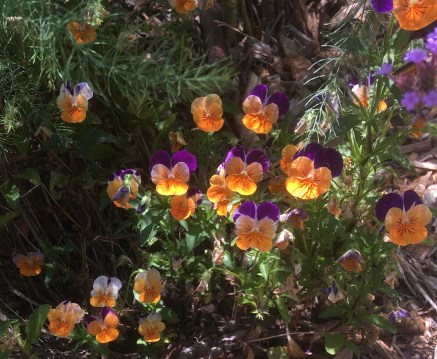
Violas surviving in the shade of asparagus.
**I don’t like to write much here about things that are expected to happen in the future, because they aren’t real yet. But the excitement I feel is terribly real, over the imminent arrival of Kate and her family; they will stay with me for several weeks! She is my youngest, whom I went to India to see, and whose two babies I was blessed to see come into the world, one in India and one in DC last summer. Her family actually contracted the coronavirus and got over it while cooped up in their DC apartment; otherwise they would have been leery of coming to California to see all the grandparents before they go abroad again.
We’ll see what kind of blogging communications I will be able to accomplish in the next while — maybe it will be the little boy voices that wake me morning by morning to the important realities of this particular summer season. That will also be music to my ears.
“Their voice has gone out into all the earth, and their words to the end of the universe.” -Psalm 19:4
This is a post about bees. If you find them icky or boring and don’t care which bee is a robber, I understand! I put a pretty flower at the bottom for you to look at before you leave.
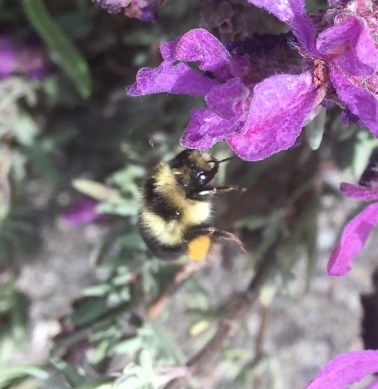
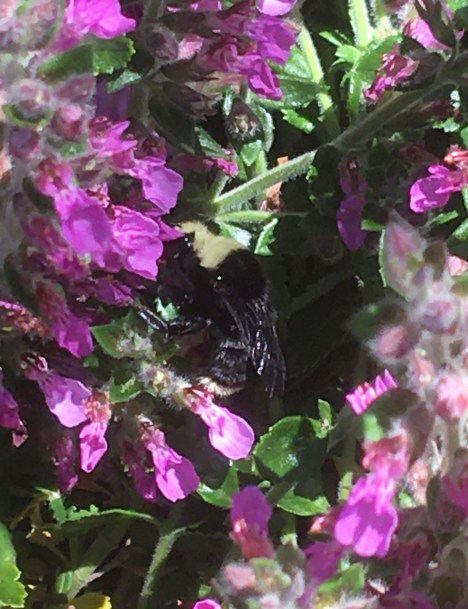
One morning this week I went back and forth along the front walk, for fifteen minutes or so, stooping over the germander hedges to watch a bumblebee. It caught my eye because of its yellow markings that were not what I’m used to seeing, and also because of its nectar-gathering style.
Was it because of its size and weight, that it couldn’t manage the flowers near the tops of the germander stems? It seemed to get lost in the understory of that purple forest, but would eventually resurface, tempting me to try again and again with my camera to fix his image (I can’t help switching male pronouns so I will just give in to my inclinations and be unscientific, because of course I have no idea of “his” sex.) so as to be able to see his markings better.
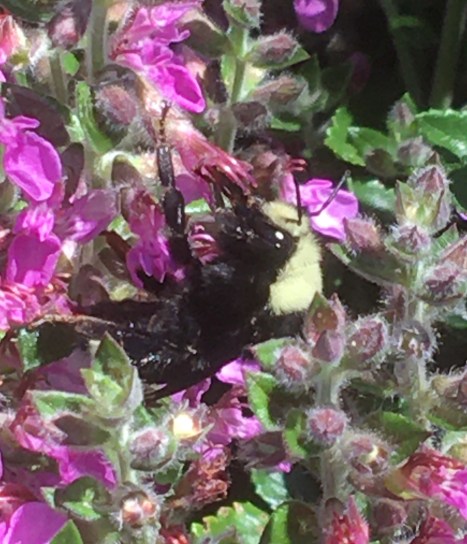
Here are the best pictures I got. Bees are buzzy and usually vibrating!
My Yellow-Faced Bumblebee is funny-looking! In that middle picture sprawled on his back like a suckling child, his yellow face is more like a yellow toupee. Here is a clearer, more classic image of the bee:
It is from the page Bumblebees of California, which is where I realized that what I thought for years was the primary bumblebee enjoying my pollinator garden is not a bumblebee at all.
It wasn’t until that same evening that I was set straight. As the sun was about to go down, I was snipping spent penstemon blooms in the back garden when I saw one of these “bumblebees” visiting the non-spent ones. He was not trying to go in at the door, so to speak, but was busy at the top. Did he have a short cut to the nectar? Was he making a short cut?
Back inside, when it began to dawn on me that he was not a bumblebee, I searched for “black bees that look like bumblebees,” and soon realized that he is a carpenter bee. And on the first site I found they described what I had seen a few minutes before: “On flowers such as salvias, penstemons, and other long, tubular flowers the carpenter bee, due to its large size, is unable to enter the flower opening. Instead they become nectar robbers. Using their mouthparts they cut a slit at the base of corolla and steal away with the nectar without having pollinated the flower.”
I learned that there are 500 species of carpenter bees! Most of them are all black and hard to tell one from another. The easiest way to tell them apart from bumblebees is by their abdomens: The bumblebees’ abdomens are covered with dense hair, while the carpenters’ are shiny. This last fact I was well aware of, because it has been the biggest hindrance to me getting a picture of these bees that usually show up as shiny black blobs. But now that I have identified two bees in one day, and have blurry pictures to refer to when I forget, I will relax and move on.
But — early this morning I went out looking for Yellow Face. I didn’t see him, but I did see the carpenter bees, and what were they doing? Stealing nectar from the tubular white salvia flowers!
I wasn’t shocked, but pleased. And I don’t see why this should be called “stealing.” Is there a law of nature that says a bee has a right to nectar only if he pollinates the flower at the same time? Have the tubular flowers filed a complaint about the theft?
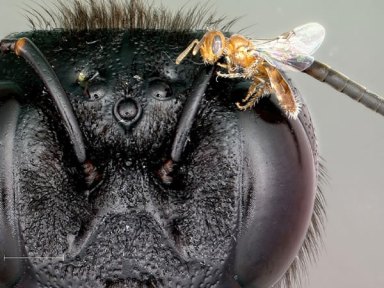
Last year I was trying to identify a strange-looking wasp, and I browsed entomology sites to no avail. Entomologists can’t even keep the thousands of species straight, and we common people who deal with insects our whole lives have strong and conflicting beliefs about their names and identities. I realized back then that wasps were a low priority for me; I’m sorry to say that I even hate some of them. But I feel otherwise about bees. Here is a photo from the U.S. Forest Service showing the smallest bee with the largest bee:
It is the Perdita minima on the head of a female carpenter bee. Wasps and bees, along with ants, are among the members of the Order Hymenoptera, but wasps are not bees any more than ants are bees. The first very readable paragraphs on this site I found helpful in refreshing my own memory on these creatures: Bees, Wasps, and Ants.
The tribe to which the 250 species of bumblebees belong is called Bombini. Isn’t that cute?
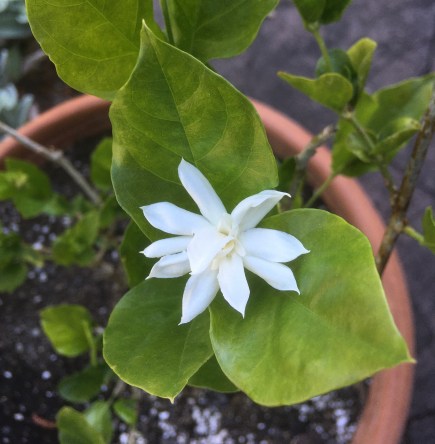
Okay, enough entomology for today. Here is that flower I promised you. It is my Belle of India jasmine that Soldier and Joy gave me for Christmas one year. It’s taken me a while to figure out how to make it happy, but now it is healthy and blooming and so sweet! I wonder if any Bombini will come by for a taste?


 not open yet on Sunday mornings; that is, we aren’t able to be in the building except for a short time when we file through to receive the sacrament. But because this was a weekday Liturgy, not a large crowd was expected, and we could stand through the service at an appropriate distance from one another. I was an hour late because I’ve been busy with other things than keeping track of the service schedule that’s been changing a lot lately. It was still quite a blessing.