Category Archives: Nativity

Waking with the living pains.

Three years ago I first posted this poem, which Malcolm Guite had introduced me to in his collection, Waiting on the Word. I looked at it again today on his website where as usual you can listen to him read it if you like. By means of the earthiest concrete images Anne Ridler offers a vision and understanding that is so broad and deep, it’s providing me with fresh appreciation for all the ways that God’s grace infuses our every moment, and how His life pulls us,and prods us awake.

“The whole self must waken; you cannot predict the way.”

CHRISTMAS AND COMMON BIRTH

Christmas declares the glory of the flesh:
And therefore a European might wish
To celebrate it not at midwinter but in spring,
When physical life is strong,
When the consent to live is forced even on the young,
Juice is in the soil, the leaf, the vein,
Sugar flows to movement in limbs and brain.
Also before a birth, nourishing the child
We turn again to the earth
With unusual longing—to what is rich, wild,
Substantial: scents that have been stored and strengthened
In apple lofts, the underwash of woods, and in barns;
Drawn through the lengthened root; pungent in cones
(While the fir wood stands waiting; the beech wood aspiring,
Each in a different silence), and breaking out in spring
With scent sight sound indivisible in song.

Yet if you think again
It is good that Christmas comes at the dark dream of the year
That might wish to sleep ever.
For birth is awaking, birth is effort and pain;
And now at midwinter are the hints, inklings
(Sodden primrose, honeysuckle greening)
That sleep must be broken.
To bear new life or learn to live is an exacting joy:
The whole self must waken; you cannot predict the way
It will happen, or master the responses beforehand.
For any birth makes an inconvenient demand;
Like all holy things
It is frequently a nuisance, and its needs never end;
Freedom it brings: We should welcome release
From its long merciless rehearsal of peace.

So Christ comes
At the iron senseless time, comes
To force the glory into frozen veins:
His warmth wakes
Green life glazed in the pool, wakes
All calm and crystal trance with the living pains.

And each year
In seasonal growth is good — year
That lacking love is a stale story at best
By God’s birth
Our common birth is holy; birth
Is all at Christmas time and wholly blest.

-Anne Ridler

Sun temples don’t celebrate in winter.

Why is Christmas on December 25? Did Christians make use of a pagan festival date when they decided to celebrate Christ’s birth? Very unlikely, as you will understand if you read William J. Tighe’s  “Calculating Christmas.”

“In the Julian calendar, created in 45 B.C. under Julius Caesar, the winter solstice fell on December 25th, and it therefore seemed obvious [to some] that the day must have had a pagan significance before it had a Christian one. But in fact, the date had no religious significance in the Roman pagan festal calendar before Aurelian’s time, nor did the cult of the sun play a prominent role in Rome before him.

“There were two temples of the sun in Rome, one of which (maintained by the clan into which Aurelian was born or adopted) celebrated its dedication festival on August 9th, the other of which celebrated its dedication festival on August 28th. But both of these cults fell into neglect in the second century, when eastern cults of the sun, such as Mithraism, began to win a following in Rome. And in any case, none of these cults, old or new, had festivals associated with solstices or equinoxes.”

Tighe explains that “…the pagan festival of the ‘Birth of the Unconquered Sun’ instituted by the Roman Emperor Aurelian on 25 December 274, was almost certainly an attempt to create a pagan alternative to a date that was already of some significance to Roman Christians. Thus the ‘pagan origins of Christmas’ is a myth without historical substance.”
If they didn’t choose December 25 for that reason, why did they? For reasons we never would have thought of in modern times. Read the whole brief article to find out.

We came to the setting of the sun…

The Second Day of Nativity was splendid.

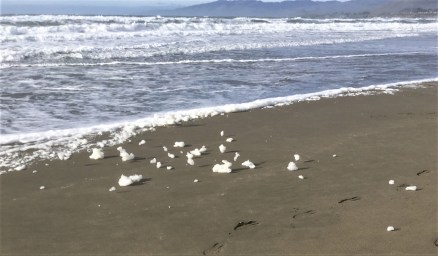
After Liturgy friend Margaret and I went to breakfast and then out to the coast to walk on the beach. The sun was shining but it was wintry with wind beating against us from every direction and tearing the sea foam into chunks of confetti which then ran away across the sand.

We walked and talked and talked and walked, and kind of got lost. We had pushed a long way to the south without realizing it, and then when we came back, we couldn’t recognize the path by which we had come down through the dunes at the start. So, up we walked on a different path, me thinking we might have gone too far and were at the northern access to the beach. Nope. After looking at a map that a couple of newbies were kind enough to show us (we who named this our favorite beach!) we realized that we had crossed an invisible boundary to the next beach south, and were still not back to the beach we’d started out on. We had a long way to go yet back to the car.

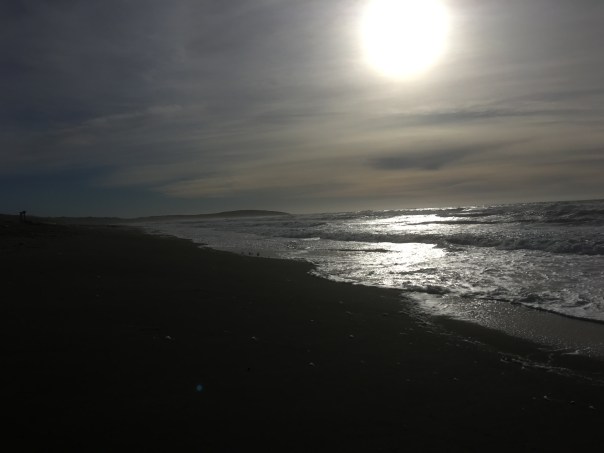
So we kept on, till we got to the proper exit, and then turned around to face the sea once more as the sun was going down, for a good-bye. We said a couple of prayers together, ending with “the earliest known Christian hymn recorded outside of the Bible that is still in use today,” Phos Hilaron, which we know as “O Gladsome Light.”

O Gladsome Light of the holy glory
of the immortal, heavenly, holy, blessed Father:
O Jesus Christ.

Now that we have come to the setting of the sun,
and behold the light of evening, we praise God:
Father, Son and Holy Spirit.

For meet it is at all times to worship Thee with voices of praise,
O Son of God and Giver of life;
therefore all the world doth glorify Thee.

Matters of heart and flesh.


Today we celebrate the second of three days considered the “Winter Pascha.”
We are still singing these hymns of Nativity:

Thy Nativity, O Christ our God,
Has shone to the world the Light of wisdom!
For by it, those who worshiped the stars
Were taught by a Star to worship Thee
The Sun of Righteousness,
And to know Thee, the Dayspring from on High.
O Lord, glory to Thee!

and

Today the Virgin gives birth to the Transcendent One
And the earth offers a cave to the Unapproachable One!
Angels with shepherds glorify Him!
The wise men journey with a star!
Since for our sake the Eternal God was born as a Little Child!

On Christmas Eve, the sky dark with clouds at midday, we celebrated a Vesperal Liturgy, and the church glowed in a special way with the combination of candlelight and muted daylight.

Then Christmas Eve proper, when it became the next day liturgically, the Festal Matins of Nativity. How joyous! In the cathedral was the darkness of winter night, but with more candles and more festivity, because Christmas Day had begun! Our hearts were soaring. The children were drooping….

When I woke on Christmas Day I also was bushed. I had baked a few cookies between the previous day’s services, which meant I’d been on my feet most of that day. I chose different shoes Christmas morning, and before the service even began I had retrieved my joy. I was introduced to a woman who was visiting out of curiosity, had been raised Christian Scientist, and considered herself “more of a Buddhist.” But her friend of Ukrainian descent, who also had not been to our parish before, had invited and brought her.
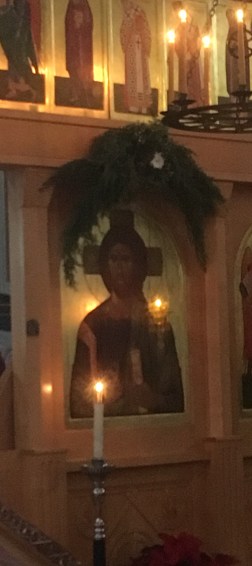
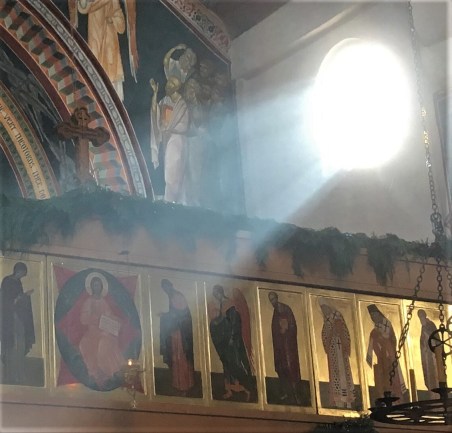
As I began to explain why the icons, the incense and candles…  to tell her about the materiality of our worship, how this very feast was a celebration of God Who has no flesh taking on human flesh for our sakes… well, it was thrilling to be able to give a little background to what was so vividly being expressed in fullness right there.

I pointed to the pillar with a fresco of St. John of Damascus painted on the side, and part of this quote on the scroll he is holding: I do not venerate matter, I venerate the fashioner of matter, who became matter for my sake and accepted to dwell in matter and through matter worked my salvation, and I will not cease from reverencing matter, through which my salvation was worked.

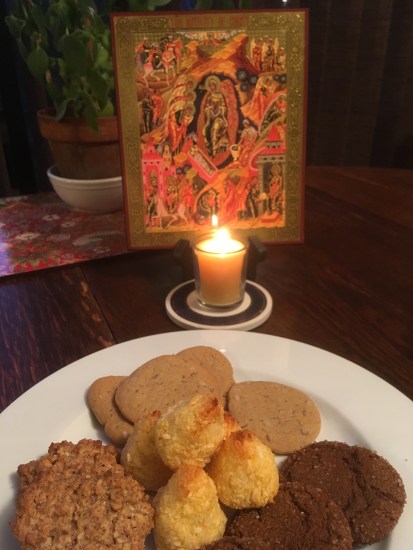
On the home front, concerning the matter that is our earthly food, I feel that I am way behind in my cookie-baking.  I have made four kinds now… and no chocolate yet! I guess I never do have much chocolate in the Christmas cookies. But so far my collection leans heavily toward the nut-brown tones, partly because Trader Joe’s was out of their cranberry-orange relish that I use to make my jellies. I am out of energy to create an alternative recipe from scratch. I did one of those already last week.

The cookies above are the Apricot-Coconut Macaroons, which ended up low on the apricot element this time; I don’t know how that happened. I hope to make cookies for several more days, and during the next couple of weeks to invite friends to eat them with me!

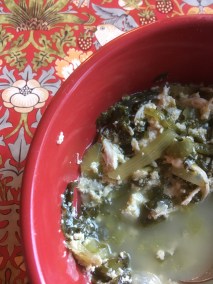
Today after church I visited two friends on opposite sides of town. I have no family with me this year, meaning more options than usual; I’m almost forgetting that I need to go to bed early and provide for some down time. At first I thought I could make four stops on Christmas afternoon, but that doesn’t sound very likely, does it? As it turned out, I got home in time for a bowl of Greek Wedding Soup that my housemate had made, and which tasted perfectly delicious and also seemed the perfect delicious holiday food to balance out cookies. She also had a fire burning in the stove, and Christmas movies playing on the TV.

I have plans for today, too, so I had to draft this post last night. I’m still trying to write every day in December — but maybe that was intended to be only till Christmas? I’ll check with Pom Pom. I think it’s been good for me to have this gentle pressure to write every day, because it’s a kind of work that satisfies something in me and helps keep me on an even keel in the midst of such a busy season. And it’s given me more chances to warm up to this:

Christ is born! Glorify Him!