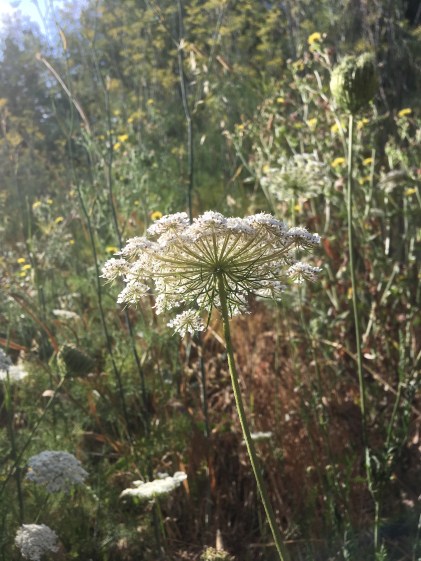
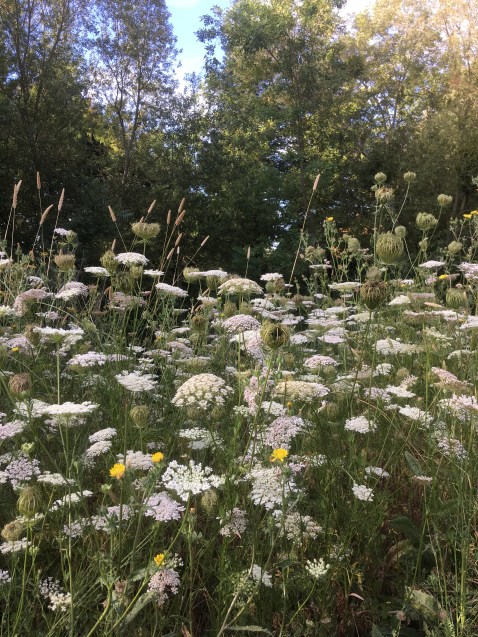
 The Queen Anne’s Lace, or Daucus carota, one of the “wildflowers of the carrot family,” is in full glory this month along the creek near my house. It was a mild winter and a wet spring; though we are now well into the dry season, their plantation is lush.
Once before I posted a gallery of images of them, various angles and perspectives. This week my walk along the path was greatly extended and I explored the current neighborhood that has grown up, full of a unique assortment of plants and animals developing from this year’s natural and man-provoked conditions. That means a completely new gallery!

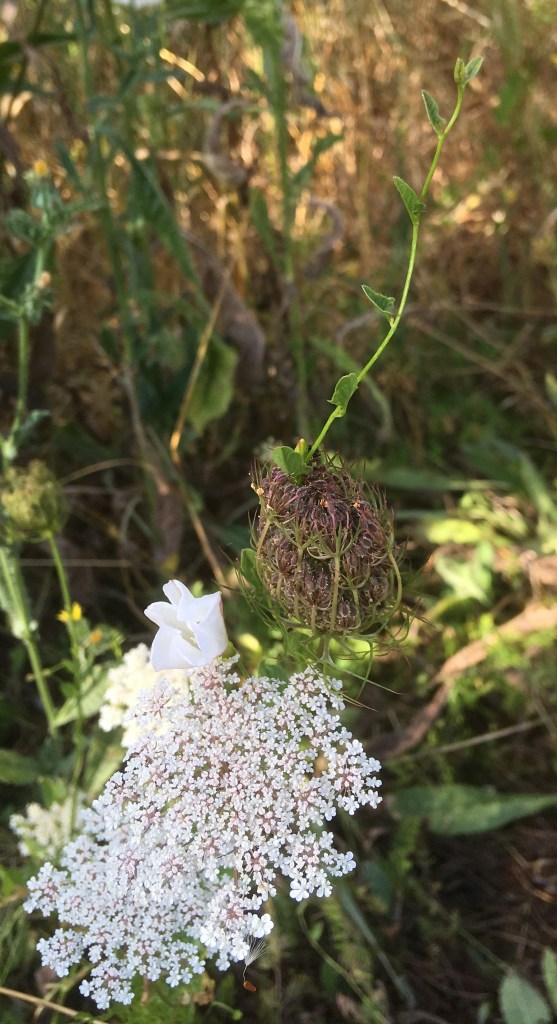
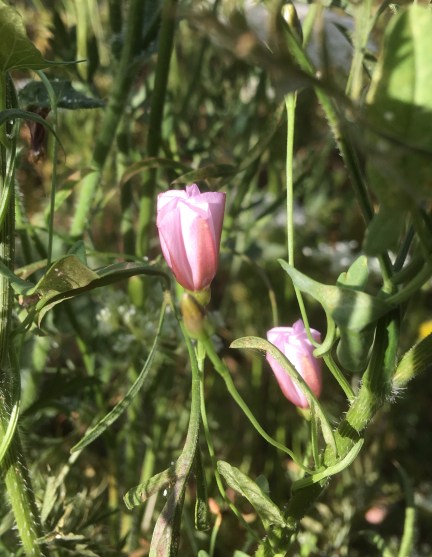
The picture just above shows a morning glory weed or bindweed (Convolvulus), which has twined around the stem of an opened flower, grown on through a bud, and is now reaching out into space. It has an opened flower just above the lower Queen Anne’s Lace bloom. And I just noticed a little seed of something, close to the bottom of the photo, and about to drop down, down… and make a contribution to next spring’s neighborhood.
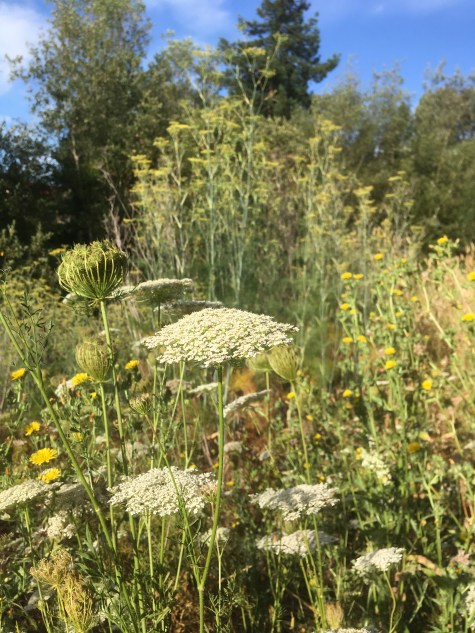
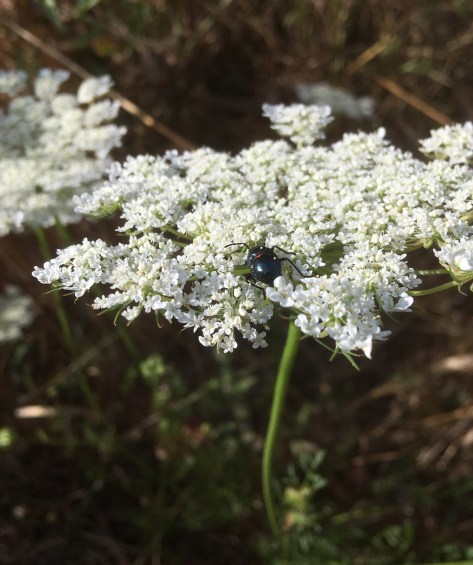
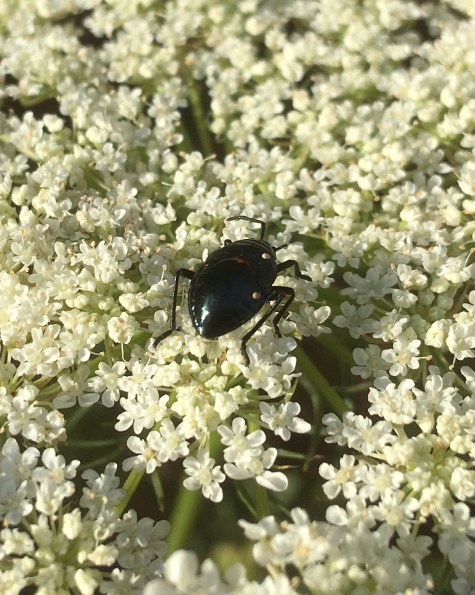
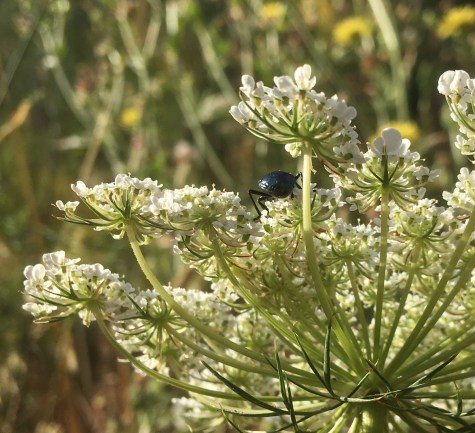
In my last gallery of Queen Anne’s Lace, I featured the red spots that are found in the center of many of the blooms. This year what were more eyecatching were insects and the other umbellifers.
I learned that word almost a year ago when Pippin and I were exploring wetlands together. As I walked along my nearby creek path I began to think about the flower form that Queen Anne’s Lace shares with the wild fennel nearby, and the word was struggling along my mind’s synapses for several minutes… and finally arrived where I could grab it. Today I researched its meaning again; it comes from the old name for the plant Family Apiaceae, which was Umbelliferae.

I found several helpful webpages besides the Wikipedia information. One has a timeline of North American invasive species: “We came on the Mayflower, too!“, where I learned that our wild fennel likely did come with those first pilgrims in 1620, and it spread all over the continent. That site also has lots of recipes for using wild plants, and I would be interested to try using the tender green fronds of fennel, or even the stems. But on the fennel page they were a little sloppy with their botany, telling me that fennel and anise are the same thing, which they are not.
Let’s start with fennel, which is my neighbor: its botanical name is Foeniculum vulgare. Anise is Pimpinella anisum. They are both in the Apiaceae family but different genera. The fleshy bulb that is eaten as a vegetable is a fennel bulb. Anise looks very similar in the field, but I don’t ever see reference to eating the bulb.
On the Spiceography page I read a paragraph-long comparison of the seeds, which both contain the essential oil anethole. I found its guidelines confusing, and concluded that I will just try to use whichever seed a recipe calls for. By the way, two other plants with this flavor but completely unrelated and different in form are star anise and liquorice.
Anise is an ingredient in many alcoholic beverages traditional to the Mediterranean and Asia. At least one of them, absinthe, includes fennel as well. I was pleased to see a map showing the locales and the names of the drinks.

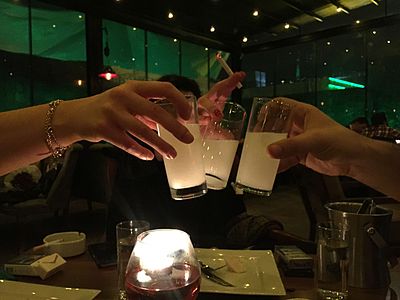
When I was in Turkey I did enjoy rakı. (Yes, that is an i without a dot. It designates a schwa or ə sound.) Usually it was served with water; you would pour a little rakı in your glass and then add water. It turned all milky then, as in this picture. No one ever tried to explain to me why this happened, and I doubt they could have if they knew, because when I read the explanation for it now it’s very complicated to my unscientific mind: The Ouzo Effect.


I seem to have drifted from flowers to food and drink (passing quickly over insects). Truly this earth is full of enough animal, vegetable and mineral to keep us forever occupied examining, experimenting, cooking and brewing — and thanking our Father for putting us in a world so packed with beauty and life.


 ,”
,”
 When I got home from church this afternoon I baked a cheese tart from Trader Joe’s and ate it outdoors, and as the sun did not go behind a cloud, I read the Heritage Farm Companion and did some Spanish lessons. The Companion is a little magazine for members of the
  that situation as benign, whereas the aphids are a plague. Maybe there is a connection?
 Several times in the last week I’ve been able to sit in the warm garden, usually in the early afternoon. The morning is often overcast and around 55°; dinner times a cool marine breeze often drives us indoors. Today after I finished my tart I glanced behind me and saw that the toadflax is finally in full bloom. It looks pretty weedy most of the year, and even now 🙂 but the flowers are so cheery… I’d say it never looks better than today.
 their favorite flower around here. Come to think of it, there are blooming lamb’s ears right next to the aphid-infested milkweed… ? …but the hoverflies are mostly in the front yard… ? I need to think about this some more.

 A year or so ago I decided to study Spanish. In much of California it’s kind of crazy not to know Spanish, but I chose French in high school, and several other languages since then. I’ve had close friends who were Spanish majors, and four of my children studied Spanish for two or more years. When I started doing 5-minute lessons on my phone using the Duolingo app I discovered that I already knew quite a lot. It’s been more like play than work, because there are no humans to see my work, no shame in goofing up. I get points for doing the lessons no matter how many times I get something wrong. For six months I managed to do at least one five-minute lesson per day.
 When I was at Kate’s for three weeks I didn’t have any gardening or housework or church work to do, and I was able to do so many Spanish lessons one day that my brain grew weary. It occurred to me that there would be no harm in checking out the French course, to brush up on my French; in my youth I studied it first and the longest, so it’s probably stuck deep in the recesses of my mind… While mom and babies were napping, I did quite a few French lessons, and they were even more fun than Spanish. On Duolingo the first lessons of a language are short so you whip right through them — especially if they are ones you did when you were 13!
 So the next day what did I do? Turkish! I’ve had very little Turkish instruction, but I did spend six months total in that country, living with Turks, and it has been pure delight to do Turkish lessons. You may ask, what about my work, now that I am home again? It is mostly not stuff that anyone else cares if I do or not. And I’m still in a kind of limbo about my remodeling project, which makes it hard for me to know just what thing is the Next Thing. So I behave as though the maid is going to show up soon, and I am a woman of leisure with nothing more important to do than to read about seeds and learn a useless language.



 o try that place again. It was a little later in the season that the Monarch events happened last year; maybe there’s time for me to get rid of the aphids somehow, and hope that they’ve left some nourishment in the leaves for caterpillars…
 Gladsome Lights