It was from watching a movie about Sophie Scholl (I think it must have been “Sophie 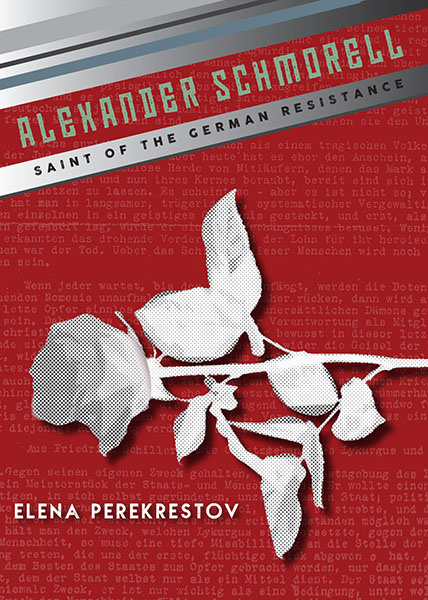 Scholl: The Final Days”) that I first heard of The White Rose, a non-violent youth resistance group formed in Munich in 1942. Britannica says of its members:
Coupling youthful idealism with an impressive knowledge of German literature and Christian religious teachings, the students published their beliefs in a series of leaflets under the name “the White Rose” (and later as “Leaflets of the Resistance”).
In the movie we meet not only Sophie and her brother Hans, but also friends and other members of The White Rose, one of whom is named “Alex.” A couple of years ago I learned that this was Alexander Schmorell, an Orthodox Christian and co-founder of the group.

There is a very memorable scene — one of only two that I can bring to mind from that film — in which Hans and Sophie are throwing leaflets from the upper story of a university building. They were seen by a Nazi Party member and arrested, on February 18, 1943.
The leaflets were like nothing the Gestapo had ever seen—not rigid ideological tracts aimed at the working classes, but passionate, erudite manifestos that quoted Friedrich Schiller, Plato and Laozi. “The guilt of Hitler and his accomplices goes beyond all measure,” read the group’s fifth leaflet. “Tear up the cloak of indifference you have wrapped around your hearts. Make your decision before it is too late!” –Smithsonian
Hans and Sophie were beheaded four days later, along with medical student Christoph Probst. In succeeding months, many other people were arrested in relation to The White Rose, and among them was Alexander Schmorell, who was executed on July 13, 1943. In 2012 he was glorified in the Orthodox Church as a saint and passion-bearer.

Memory eternal!
 Liturgy. Usually on Sundays there are two changeable parts of those readings called troparia, always one for the Resurrection, and often another for the feast or saint of the day. There was another sort of hymn, a kontakion, for the Blind Man, but there was not a troparian hymn in the lectionary for that event.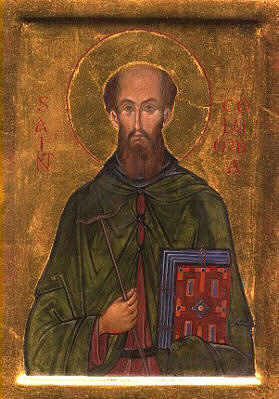
 “One evening, St. John’s Eve it was, right at the end of my journey, I came round a headland at sunset into a beautiful little bay and inlet on the west coast in Donegal, just as the fires were being lit around the headlands for St. John’s Eve, and there was drinking and fiddle playing and dancing round the fires that evening. And I asked where I was, and they said Glencolmcille, and I felt a sudden quickening and sense of connection, as though a memory stirred. And they asked me my name and I said ‘Malcolm’, and they said, ‘Ah that is why you have come, because he has called you’, and I said ‘who?’ and they said ‘Colm has called you, Malcolm, for this is the place he fought his battle and gathered his disciples and from here he left for the white martyrdom and Scotland.”