I Make a place to sit down. Sit down. Be quiet. You must depend upon affection, reading, knowledge, skill—more of each than you have—inspiration, work, growing older, patience, for patience joins time to eternity. Any readers who like your poems, doubt their judgment.
II Breathe with unconditional breath the unconditioned air. Shun electric wire. Communicate slowly. Live a three-dimensioned life; stay away from screens. Stay away from anything that obscures the place it is in. There are no unsacred places; there are only sacred places and desecrated places.
III Accept what comes from silence. Make the best you can of it. Of the little words that come out of the silence, like prayers prayed back to the one who prays, make a poem that does not disturb the silence from which it came.
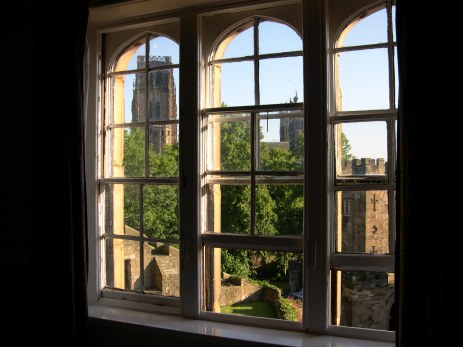
The birds are in their trees, the toast is in the toaster, and the poets are at their windows.
They are at their windows in every section of the tangerine of earth– the Chinese poets looking up at the moon, the American poets gazing out at the pink and blue ribbons of sunrise.
The clerks are at their desks, the miners are down in their mines, and the poets are looking out their windows maybe with a cigarette, a cup of tea, and maybe a flannel shirt or bathrobe is involved.
The proofreaders are playing the ping-pong game of proofreading, glancing back and forth from page to page, the chefs are dicing celery and potatoes, and the poets are at their windows because it is their job for which they are paid nothing every Friday afternoon.
Which window it hardly seems to matter though many have a favorite, for there is always something to see– a bird grasping a thin branch, the headlight of a taxi rounding a corner, those two boys in wool caps angling across the street.
The fishermen bob in their boats, the linemen climb their round poles, the barbers wait by their mirrors and chairs, and the poets continue to stare at the cracked birdbath or a limb knocked down by the wind.
By now, it should go without saying that what the oven is to the baker and the berry-stained blouse to the dry cleaner, so the window is to the poet.
Just think– before the invention of the window, the poets would have had to put on a jacket and a winter hat to go outside or remain indoors with only a wall to stare at.
And when I say a wall, I do not mean a wall with striped wallpaper and a sketch of a cow in a frame.
I mean a cold wall of fieldstones, the wall of the medieval sonnet, the original woman’s heart of stone, the stone caught in the throat of her poet-lover.
Following on the theme of language, I’m re-posting this poem from Dana Gioia. As my situation is different from seven years ago when I first put it up here, so is my response to the poem. Then, I was often with my late husband, and we would tell each other the names of things, and amplify our knowledge and appreciation of the world together. Or, we would simply be together in silence, in those moments of happy existence in the world that does not need words.
Nowadays, I still have the impulse to tell all these things, or attempt to bring my readers into the wordless experiences I have — by means of words! Of course, I can’t even attempt to describe more than a fraction of the moments, the stones and sunlight and shadows. So I am learning — a little — to just sit with the things, “no less real for lying uncatalogued and uncounted.” There is Someone with me, after all, who doesn’t tell me the names of things, but Who is the Reality from which they came into being. He also needs no praise, so we praise Him always.
WORDS
The world does not need words. It articulates itself in sunlight, leaves, and shadows. The stones on the path are no less real for lying uncatalogued and uncounted. The fluent leaves speak only the dialect of pure being. The kiss is still fully itself though no words were spoken.
And one word transforms it into something less or other – illicit, chaste, perfunctory, conjugal, covert. Even calling it a kiss betrays the fluster of hands glancing the skin or gripping a shoulder, the slow arching of neck or knee, the silent touching of tongues.
Yet the stones remain less real to those who cannot name them, or read the mute syllables graven in silica. To see a red stone is less than seeing it as jasper – metamorphic quartz, cousin to the flint the Kiowa carved as arrowheads. To name is to know and remember.
The sunlight needs no praise piercing the rainclouds, painting the rocks and leaves with light, then dissolving each lucent droplet back into the clouds that engendered it. The daylight needs no praise, and so we praise it always – greater than ourselves and all the airy words we summon.
I am no more than a secretary of the invisible thing
That is dictated to me and a few others.
Secretaries, mutually unknown, we walk the earth
Without much comprehension. Beginning a phrase in the middle
Or ending it with a comma. And how it looks when completed
Is not up to us to inquire, we won’t read it anyway.
-Czeslaw Milosz
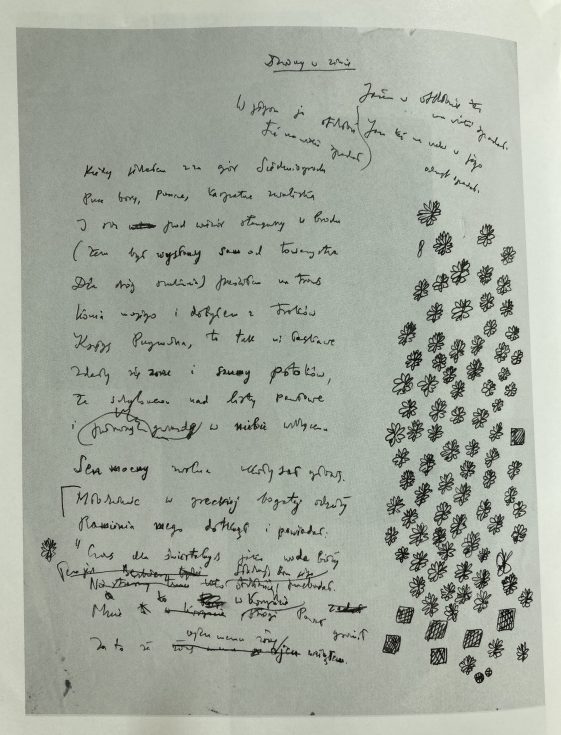
A Milosz poem in the original Polish. I like the doodlings that resemble my own “secretarial” scribblings, though I feel I am not as good at taking dictation.
 Gladsome Lights