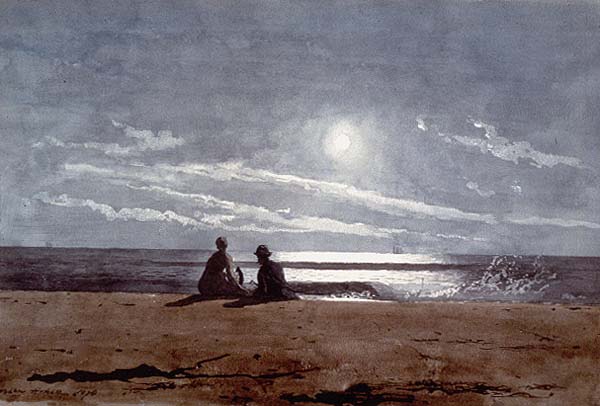
The last lines of this poem rescue it for me, out of a feeling of chaos and loss. The moon is a real thing, unlike the many insubstantial facts that we might forget. In this case it’s also an experience in the moment, of heartfelt beauty, good for centering the soul.
FORGETFULNESS
The name of the author is the first to go followed obediently by the title, the plot, the heartbreaking conclusion, the entire novel which suddenly becomes one you have never read, never even heard of,
as if, one by one, the memories you used to harbor decided to retire to the southern hemisphere of the brain, to a little fishing village where there are no phones.
Long ago you kissed the names of the nine muses goodbye and watched the quadratic equation pack its bag, and even now as you memorize the order of the planets,
something else is slipping away, a state flower perhaps, the address of an uncle, the capital of Paraguay.
Whatever it is you are struggling to remember, it is not poised on the tip of your tongue or even lurking in some obscure corner of your spleen.
It has floated away down a dark mythological river whose name begins with an L as far as you can recall
well on your own way to oblivion where you will join those who have even forgotten how to swim and how to ride a bicycle.
No wonder you rise in the middle of the night to look up the date of a famous battle in a book on war. No wonder the moon in the window seems to have drifted out of a love poem that you used to know by heart.
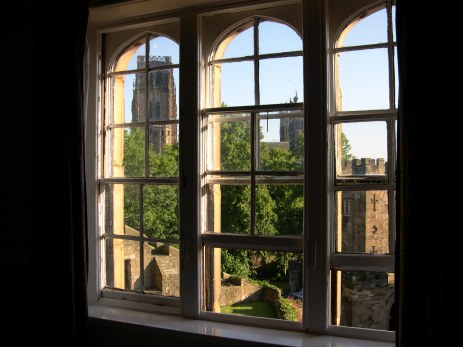
The birds are in their trees, the toast is in the toaster, and the poets are at their windows.
They are at their windows in every section of the tangerine of earth– the Chinese poets looking up at the moon, the American poets gazing out at the pink and blue ribbons of sunrise.
The clerks are at their desks, the miners are down in their mines, and the poets are looking out their windows maybe with a cigarette, a cup of tea, and maybe a flannel shirt or bathrobe is involved.
The proofreaders are playing the ping-pong game of proofreading, glancing back and forth from page to page, the chefs are dicing celery and potatoes, and the poets are at their windows because it is their job for which they are paid nothing every Friday afternoon.
Which window it hardly seems to matter though many have a favorite, for there is always something to see– a bird grasping a thin branch, the headlight of a taxi rounding a corner, those two boys in wool caps angling across the street.
The fishermen bob in their boats, the linemen climb their round poles, the barbers wait by their mirrors and chairs, and the poets continue to stare at the cracked birdbath or a limb knocked down by the wind.
By now, it should go without saying that what the oven is to the baker and the berry-stained blouse to the dry cleaner, so the window is to the poet.
Just think– before the invention of the window, the poets would have had to put on a jacket and a winter hat to go outside or remain indoors with only a wall to stare at.
And when I say a wall, I do not mean a wall with striped wallpaper and a sketch of a cow in a frame.
I mean a cold wall of fieldstones, the wall of the medieval sonnet, the original woman’s heart of stone, the stone caught in the throat of her poet-lover.
I turn around on the gravel
and go back to the house for a book,
something to read at the doctor’s office,
and while I am inside, running the finger
of inquisition along a shelf,
another me that did not bother
to go back to the house for a book
heads out on his own,
rolls down the driveway,
and swings left toward town,
a ghost in his ghost car,
another knot in the string of time,
a good three minutes ahead of me—
a spacing that will now continue
for the rest of my life.
Sometimes I think I see him
a few people in front of me on a line
or getting up from a table
to leave the restaurant just before I do,
slipping into his coat on the way out the door.
But there is no catching him,
no way to slow him down
and put us back in sync,
unless one day he decides to go back
to the house for something,
but I cannot imagine
for the life of me what that might be.
He is out there always before me,
blazing my trail, invisible scout,
hound that pulls me along,
shade I am doomed to follow,
my perfect double,
only bumped an inch into the future,
and not nearly as well-versed as I
in the love poems of Ovid—
I who went back to the house
that fateful winter morning and got the book.
From the heart of this dark, evacuated campus I can hear the library humming in the night; a choir of authors murmuring inside their books along the unlit, alphabetical shelves, Giovanni Pontano next to Pope, Dumas next to his son, each one stitched into his own private coat, together forming a low, gigantic chord of language.
I picture a figure in the act of reading, shoes on a desk, head tilted into the wind of a book, a man in two worlds, holding the rope of his tie as the suicide of lovers saturates a page, or lighting a cigarette in the middle of a theorem. He moves from paragraph to paragraph as if touring a house of endless, paneled rooms.
I hear the voice of my mother reading to me from a chair facing the bed, books about horses and dogs, and inside her voice lie other distant sounds, the horrors of a stable ablaze in the night, a bark that is moving toward the brink of speech.
I watch myself building bookshelves in college, walls within walls, as rain soaks New England, or standing in a bookstore in a trench coat.
I see all of us reading ourselves away from ourselves, straining in circles of light to find more light until the line of words becomes a trail of crumbs that we follow across a page of fresh snow; when evening is shadowing the forest and small birds flutter down to consume the crumbs, we have to listen hard to hear the voices of the boys and his sister receding into the words.
-Billy Collins
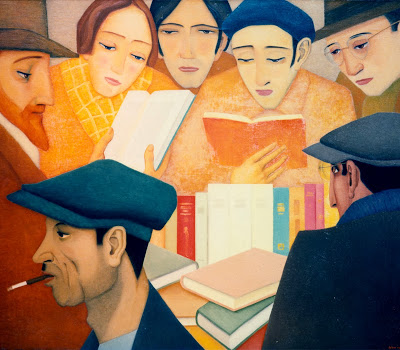
Johan van Hell – Boekenstalletje
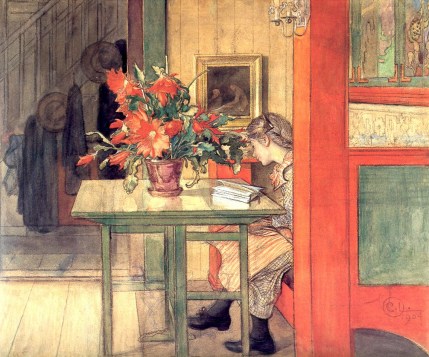
This poem was the perfect one for me to find right now, because I myself have been acting out all the verbs: following, straining, hearing and touring… and listening hard, to the humming of a choir. This choir of authors aren’t all consciously “singing” in harmony, or even intending to write about the same things, but their voices, the sounds, the crumbs I am following “across a page of fresh snow” all seem to be parts of a whole. The rooms I am touring are all in one house; it must be the place where the human soul lives.
My “circles of light” sometimes seem like a 60’s light show, beautiful and confusing, when I am waiting rather for illumination and clarity. So many authors have shined their little lights out into the world, but how many reveal the reality of things?
Over the last several months I have been reading a lot, with no resulting book reviews and few even small illuminations of the sort I might write about here. The Eucharist was very focused and wonderful and I do want to say some things about it eventually, but instead of stopping for that I kept working my way through Irrational Man, which is such a tour de force that it’s hard to know what to say about — everything. It mostly makes me want to read more books that William Barrett reminds me of.
Like Flight From Woman by Karl Stern, which I read some years ago and thought brilliant; but at the time I knew I needed to read it a second time to digest it. Barrett explains the duality of selves in Sartre’s philosophy, how he considers not the “fruitful, excessive, fruitful blooming nature” to be the true self, but only that of the radically free and active man who has projects. Now I want to go back and read Stern on this topic.
But I am determined to finish a couple more books first. The Rise and Triumph of the Modern Self is like another long chapter, maybe the closing chapter, of Western Philosophy, so it will be good if I can move right on to finishing it after Barrett.
On my recent road trip I listened to Come on Shore and We Will Kill and Eat You All: A New Zealand Story, by Christina Thompson, a title so embarrassing on several fronts that I considered leaving this accomplishment unrecorded. But even this book, which was about as deep as I could go on all that freeway driving, provided a few revealing glimpses of how ideas from the other books I mentioned play out in real life, especially the central one: What is the self?
About halfway through The Cross of Loneliness I began to have a difficult time knowing what these two men were talking about, but I will finish that book, too, before long. My really easy, small book to read under the covers right now is The Bookshop by Penelope Fitzgerald, which I found in the little free library up at the lake.
And then, the sweetest, which will be easy to finish, as it’s like swimming slowly through a small and refreshing pond to the other side: The Scent of Water, which our book club is reading together. It is coming to an end way too fast.
Oh, yes, there are a dozen more sitting nearby, that I plan to continue with eventually, but they are not at the moment as current as these, these rooms full of delicious crumbs that I trust are leading me always to brighter places.
In regard to my own life and reading, I don’t relate to the progression of Collins’s poem, in its hearkening back to the experiences of childhood and youth, and the mood of evening and shadow descending. I am just very thankful for all the good writers I have at my disposal, and for the lovely song that they are trying to learn and to sing.

 Like Flight From Woman by Karl Stern, which I read some years ago and thought brilliant; but at the time I knew I needed to read it a second time to digest it. Barrett explains the duality of selves in Sartre’s philosophy, how he considers not the “fruitful, excessive, fruitful blooming nature” to be the true self, but only that of the radically free and active man who has projects. Now I want to go back and read Stern on this topic.
 And then, the sweetest, which will be easy to finish, as it’s like swimming slowly through a small and refreshing pond to the other side: The Scent of Water, which our book club is reading together. It is coming to an end way too fast.
 Gladsome Lights