 Mr. Kierkegaard was very hard to take in the last two discourses of The Lily of the Field and the Bird of the Air. I was happy for the non-hearers of his non-sermons — you may remember, he was not ordained so he didn’t consider it appropriate to call them sermons — that they did not have to listen to him audibly, on and on repeating himself, and stretching the bird and lily metaphor into nonsense.
Or so it seemed to my small brain. I finished the book last evening, when my patience was already tried by my eyes that had been burning for two days, and for what reason? No one knows. By the late afternoon on Sunday I’d followed a doctor’s advice and used some very expensive eye drops that changed the burning to a sticky-scratchy feeling. The burning had made me want to keep my eyes shut, but with the latter condition open or shut didn’t matter, so I was able to distract myself with reading. (Today they are fine!)
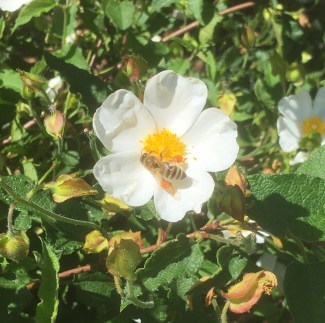 I sat in the garden, because it is so delicious, I want to be there as much as possible, with the bees humming and sparrows singing and flying back and forth, eating the sunflower seeds I give them. It is true, what Kierkegaard says, echoing our Savior, that we must learn from nature. And in some way we need to be like the birds and the lilies if we are going to fulfill our humanity. But we can’t learn about thinking from them. Thinking is something we humans specialize in, to such a degree that our minds dominate our fragmented selves. And that mind tells us, among other irrational things, to worry.
Our mind is what we use to accomplish our daily lives, to plan and execute our work. But it’s also where swirl the same unproductive thoughts over and over again, thoughts of regret over the past, or anxiety over the future. Complaining and blaming and angry thoughts. How can we plan without worrying at the same time? How can we bring every thought captive to Christ? Lord, have mercy!
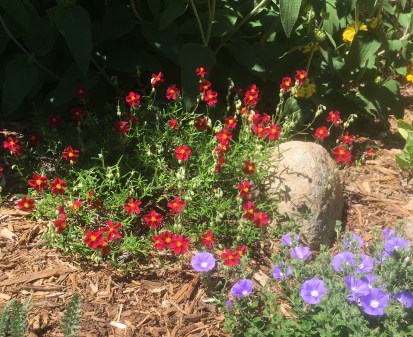
Kierkegaard says in the second discourse that the bird and the lily are unconditionally compliant with God’s will: “In nature everything is obedience, unconditional obedience.” Maybe he is trying to get at what I have heard from fathers of the Church, about how creatures other than humans act according to their God-given natures. Humans were made in the image of God, which means that our nature is to be of love, and unity. But we are typically at odds with ourselves, and with our Creator.
I haven’t been too successful myself of late, in thanking God for everything. For ten years now, I’ve found it helpful to use my writing to steer my mind in the right direction, but lately the load is too heavy to steer. Writing does not accomplish the task of “bringing the mind into the heart,” which is what Saint Theophan tells us we need to do. When my mind is burdened I can’t make sentences that would substitute for prayer, or other more receptive activities, say, watching a bee.
C.S. Lewis’s feeling, “Actually it seems to me that one can hardly say anything either bad enough or good enough about life,” comes to mind, but only weakly applies to my difficulty conveying a simple experience like picking peas this evening.
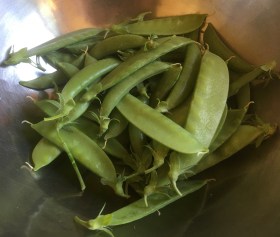 That Big Friendly Giant pea patch I’ve got is a wonder of my garden world. It just keeps growing and being green and lush, producing new baby pea pods every day. I wander around the edges of its kingdom and peer into the jungle of vines, trying not to miss any of the ripe ones, wondering if I should let this or that one grow one more day. I’m pretty sure that one day this week there are going to be about a hundred of the sugar snap peas all ready at once. Each pea pod is lovely and tender-crisp, and begs to be eaten the moment after being picked.
The day is filled with this kind of incomprehensibly good thing, which I would like to share. I think those are joys flowing out of my heart, so they are easier to express than sad things, though of course I can’t say anything “good enough.” I’ve tried taking pictures of the pea mass, but this is a case where you have to have your nose following your arm into the dim and cool interior, all the while the sun warms your hair. Pictures are worthless.

As to the other side of Lewis’s quote, saying anything “bad enough” about life — that’s not my calling. I think that line might have been from a personal letter that he wrote, expressing empathy with someone who was suffering. I know I have had experiences that seemed very bad. And my cry amounted to, “This is not what I want!” But at this time in my life, if I ever manage to “take them captive,” I try to put those thoughts in quarantine.
Kierkegaard finally admits that we do have difficulties that the bird and the lily escape, when he writes of an “…enormous danger — a danger in which a human being is indeed situated by virtue of being a human being, a danger that the lily and the bird are spared in their unconditional obedience, which is happy innocence, for neither God and the world nor good and evil are fighting over them…”

That makes me think that if the author were writing blog posts today, he might remind us that we do not war against flesh and blood, viruses, stupid humans, wicked empires, etc, but against “principalities and powers” in the spiritual realm. Every time I get distracted it’s a waste of time and a missed opportunity to use my mind to better purposes. The pandemic is showing me how prone I am to this.
I did have three more friends in my garden last week after my godmother’s visit. Everyone wore masks. They were on two different errands. My goddaughter Sophia had found some plum wood for my wood stove, which she and her new husband delivered. And my goddaughter Mary’s father and brother came to finish my garden icon project that I began five years ago. But you know what? — it’s past my bedtime, and this post is too long already. I’ll explain tomorrow about the elegant completion of my garden. ❤

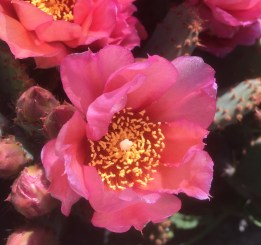
(The cactuses are not mine.)
 “The whole philosophy of Hell rests on recognizing the axiom that one thing is not another thing, and specially, that one self is not another self. My good is my good, and your good is yours. What one gains another loses. Even an inanimate object is what it is by excluding all other objects from the space it occupies; if it expands, it does so by thrusting other objects aside or by absorbing them. A self does the same. With beasts the absorption takes the form of eating; but for us, it means the sucking of will and freedom out of a weaker self into a stronger. ‘To be’ means ‘to be in competition.'”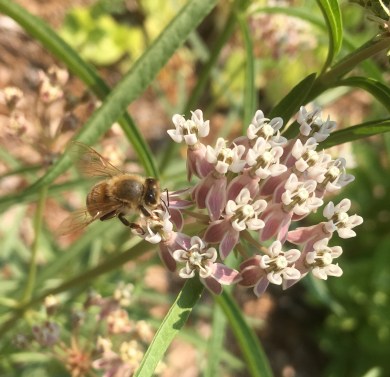
 is more in the heart than the brain, this place where the Maker shares His secrets. Both of my wonderings are based on my slight understanding of philosophy and theology; what I do feel more certain of is that angels are basically very different from humans. Christ took on human nature, because it was we humans who needed His solidarity with us, and His quickening of our dead spirits. But having been created “a little lower than the angels,” we were “crowned with honor and glory.”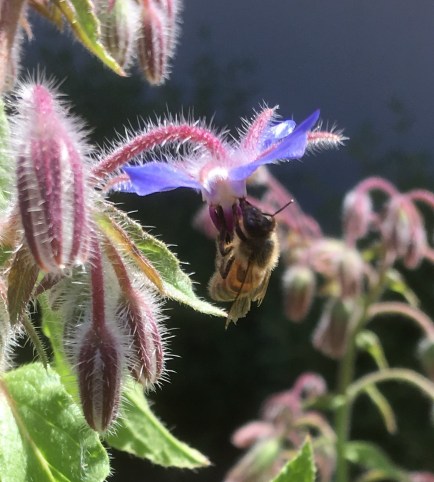
 Gladsome Lights