In this poem I recently encountered, the poet doesn’t say whether he himself believes in Platonic forms, only that “they” claim to know that this principle orders the minds of angels, and what the effects of its working is. It’s my understanding that Plato’s idea of forms is not in accord with Christian theology; one writer on the subject claims that “Maximus the Confessor remains to this day the single most important figure in Orthodox cosmological thought,” and that “his doctrine of the logoi of things can in no way be reduced to a static world of Platonic forms.” There is no Huge Principle, but there is Almighty God, the great “I am.”
Another thing I wonder about is the location of the “tiny interior” mentioned; I should think it is more in the heart than the brain, this place where the Maker shares His secrets. Both of my wonderings are based on my slight understanding of philosophy and theology; what I do feel more certain of is that angels are basically very different from humans. Christ took on human nature, because it was we humans who needed His solidarity with us, and His quickening of our dead spirits. But having been created “a little lower than the angels,” we were “crowned with honor and glory.”
Whatever all of the attributes of angel nature may be, it is given to us humans to enjoy the senses and their joys, which in the following poem by C.S. Lewis are seen as guards against the richer angel-type experiences that we could not in our earthiness bear. I see these sensory experiences as much more than that, and where the poet evokes the way they can fill our hearts to overflowing, such as when we “drink the whole summer down into the breast,” isn’t he describing more than a purely sensual experience? Quite possibly a thankful, prayerful heart can know mystical secrets of the trees and stones, as their secrets would be not other than whatever the Creator in kindness might reveal of Himself in and through them – and beyond.
ON BEING HUMAN
Angelic minds, they say, by simple intelligence
Behold the Forms of nature. They discern
Unerringly the Archtypes, all the verities
Which mortals lack or indirectly learn.
Transparent in primordial truth, unvarying,
Pure Earthness and right Stonehood from their clear,
High eminence are seen; unveiled, the seminal
Huge Principles appear.
The Tree-ness of the tree they know — the meaning of
Arboreal life, how from earth’s salty lap
The solar beam uplifts it; all the holiness
Enacted by leaves’ fall and rising sap;
But never an angel knows the knife-edged severance
Of sun from shadow where the trees begin,
The blessed cool at every pore caressing us
— An angel has no skin.
They see the Form of Air; but mortals breathing it
Drink the whole summer down into the breast.
The lavish pinks, the field new-mown, the ravishing
Sea-smells, the wood-fire smoke that whispers Rest.
The tremor on the rippled pool of memory
That from each smell in widening circles goes,
The pleasure and the pang — can angels measure it?
An angel has no nose.
The nourishing of life, and how it flourishes
On death, and why, they utterly know; but not
The hill-born, earthy spring, the dark cold bilberries.
The ripe peach from the southern wall still hot
Full-bellied tankards foamy-topped, the delicate
Half-lyric lamb, a new loaf’s billowy curves,
Nor porridge, nor the tingling taste of oranges.
— An angel has no nerves.
Far richer they! I know the senses’ witchery
Guards us like air, from heavens too big to see;
Imminent death to man that barb’d sublimity
And dazzling edge of beauty unsheathed would be.
Yet here, within this tiny, charmed interior,
This parlour of the brain, their Maker shares
With living men some secrets in a privacy
Forever ours, not theirs.
-C.S. Lewis
Thanks to Fr. Mark Kowalewski for introducing me to this poem.
(said Mr Homegrown)
 The library is a pleasant walk away from Kate’s apartment, but maybe not on a day when it’s over 90 degrees and the library didn’t open until 1:00. So Kate drove the two of us while Raj was napping, and that way we could completely focus on finding the titles we really wanted, most of which we had researched together online the night before.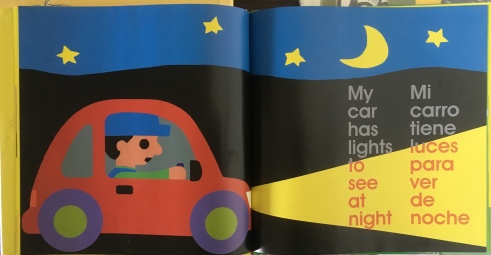
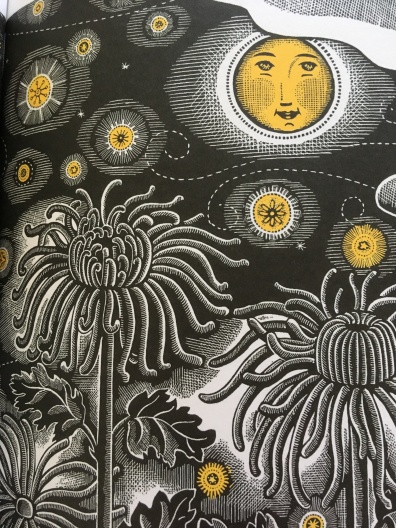
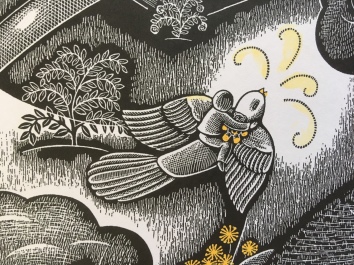
 One charming picture book with fold-out pages is Papa, please get the moon for me, by Eric Carle. It’s a whimsical tale in which the girl making the request does get her wish, and she even plays with the moon as soon as it gets small enough for her dad to bring it down the ladder. Raj seems to focus on the pictures of the moon in his story books, and I always love to return to the more poetic depictions of the moon when reading or singing to children.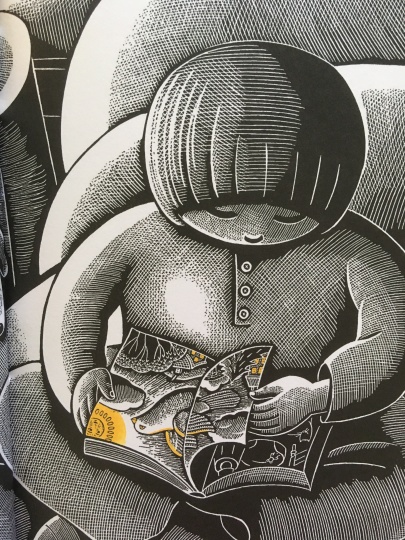
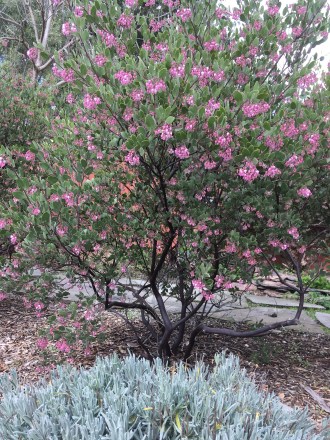 This was a Sunday extra-full of intellectual stimulation, so much so that I feel I must write in order to debrief and process the swirling thoughts. (The church property was also graced with thousands of manzanita blossoms, with which I am decorating my post.)
 what is going on.
 “I shouldn’t bother about that just at present if I were you,” says the blessed spirit, and goes on to explain, “When you painted on earth — at least in your earlier days — it was because you caught glimpses of Heaven in the earthly landscape. The success of your painting was that it enabled others to see the glimpses too. But here you are having the thing itself. It is from here that the messages came…. If you are interested in the country only for the sake of painting it, you’ll never learn to see the country.”
 We were discussing The House of the Spirits by Isabel Allende. A couple of the younger women had read it 20 years ago, and liked it then. But they have changed, and did not enjoy it much. None of us thought it was great, and I only read half, and won’t say more about it here. Next time we are reading Wounded by Love by Elder Porphyrios, picked from a half dozen suggestions of literary sustenance for our Lenten journey coming up in a few weeks.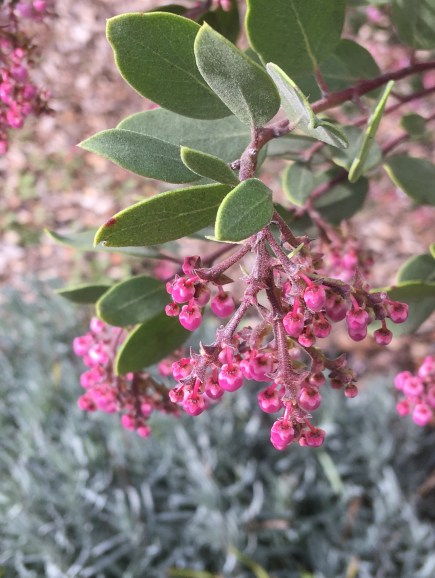
 my “book larder” almost as soon as I got home on Sunday, and have been taking that nourishment.
 Gladsome Lights