Tag Archives: Creation

The face of the earth ever renewed.

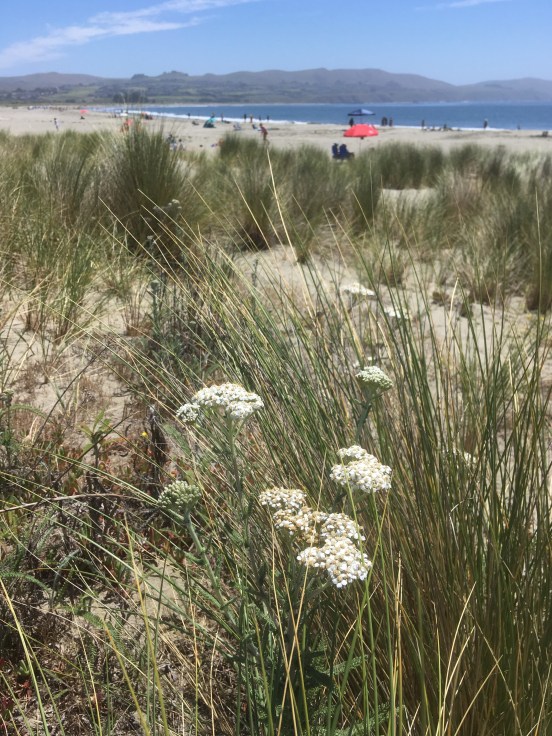
common yarrow

This sunny morning my neighbor Kim and I drove separately to the coast and met for a walk. On my winding way through the hills, I noticed Queen Anne’s Lace swaying in the breeze along the roadway. Trees, grasses and shrubs were painted in the gentlest pastel colors of lavender, green, and yellow-orange. The Psalter played through my speakers, and one of the Psalms I heard was 104, which is part of every Orthodox Saturday Vespers. It begins:

Bless the Lord, O my soul!

O Lord my God, You are very great:
You are clothed with honor and majesty,
Who cover Yourself with light as with a garment,
Who stretch out the heavens like a curtain.

He lays the beams of His upper chambers in the waters,
Who makes the clouds His chariot,
Who walks on the wings of the wind,
Who makes His angels spirits,
His ministers a flame of fire.

beach suncup

Once we set out at our brisk pace, I was distracted somewhat from my surroundings, except through my bare feet, which kept me tuned to the cool and firm sand under them, or the waves that splashed over. Though lots of people walked close to the surf, the beach in general wasn’t crowded. I had the feeling it must be the healthiest place around, with the quantities of sea air flowing freshly in and around us all.

I lost track of time. Eventually we parted in the parking lot, and then I wandered by myself in the dunes for a while looking at flowering plants known and unknown to me. I’ve managed to identify most of them — I think.

Ribwort Plantain
Silver Beachweed
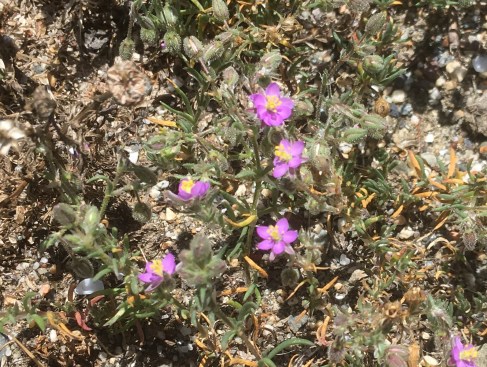
non-native sand spurry
what we call ice plant – native of South Africa
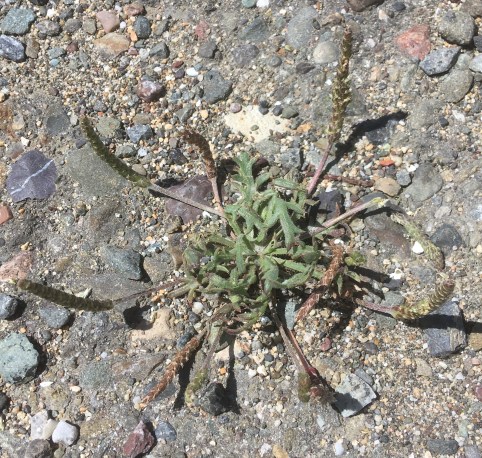
Buck’s-horn Plantain

O Lord, how manifold are Your works!
In wisdom You have made them all.
The earth is full of Your possessions—
This great and wide sea,
In which are innumerable teeming things,
Living things both small and great.
There the ships sail about;
There is that Leviathan
Which You have made to play there.

These all wait for You,
That You may give them their food in due season.
What You give them they gather in;
You open Your hand, they are filled with good.
You hide Your face, they are troubled;
You take away their breath, they die and return to their dust.
You send forth Your Spirit, they are created;
And You renew the face of the earth.

Yellow Bush Lupine

If I hadn’t had another obligation in the afternoon, I think I would have meandered up and down the coast till dusk. I’ve never been more thankful that I live close enough to be in the domain of the sand and the sea and the flowers, on a warm and sweet June day.
 

They lack nerves, and the tiny interior.

In this poem I recently encountered, the poet doesn’t say whether he himself believes in Platonic forms, only that “they” claim to know that this principle orders the minds of angels, and what the effects of its working is. It’s my understanding that Plato’s idea of forms is not in accord with Christian theology; one writer on the subject claims that “Maximus the Confessor remains to this day the single most important figure in Orthodox cosmological thought,” and that “his doctrine of the logoi of things can in no way be reduced to a static world of Platonic forms.” There is no Huge Principle, but there is Almighty God, the great “I am.”

Another thing I wonder about is the location of the “tiny interior” mentioned; I should think it is more in the heart than the brain, this place where the Maker shares His secrets. Both of my wonderings are based on my slight understanding of philosophy and theology; what I do feel more certain of is that angels are basically very different from humans. Christ took on human nature, because it was we humans who needed His solidarity with us, and His quickening of our dead spirits. But having been created “a little lower than the angels,” we were “crowned with honor and glory.”
Whatever all of the attributes of angel nature may be, it is given to us humans to enjoy the senses and their joys, which in the following poem by C.S. Lewis are seen as guards against the richer angel-type experiences that we could not in our earthiness bear. I see these sensory experiences as much more than that, and where the poet evokes the way they can fill our hearts to overflowing, such as when we “drink the whole summer down into the breast,” isn’t he describing more than a purely sensual experience? Quite possibly a thankful, prayerful heart can know mystical secrets of the trees and stones, as their secrets would be not other than whatever the Creator in kindness might reveal of Himself in and through them – and beyond.

ON BEING HUMAN

Angelic minds, they say, by simple intelligence
Behold the Forms of nature. They discern
Unerringly the Archtypes, all the verities
Which mortals lack or indirectly learn.
Transparent in primordial truth, unvarying,
Pure Earthness and right Stonehood from their clear,
High eminence are seen; unveiled, the seminal
Huge Principles appear.

The Tree-ness of the tree they know — the meaning of
Arboreal life, how from earth’s salty lap
The solar beam uplifts it; all the holiness
Enacted by leaves’ fall and rising sap;

But never an angel knows the knife-edged severance
Of sun from shadow where the trees begin,
The blessed cool at every pore caressing us
— An angel has no skin.

They see the Form of Air; but mortals breathing it
Drink the whole summer down into the breast.
The lavish pinks, the field new-mown, the ravishing
Sea-smells, the wood-fire smoke that whispers Rest.
The tremor on the rippled pool of memory
That from each smell in widening circles goes,
The pleasure and the pang — can angels measure it?
An angel has no nose.

The nourishing of life, and how it flourishes
On death, and why, they utterly know; but not
The hill-born, earthy spring, the dark cold bilberries.
The ripe peach from the southern wall still hot
Full-bellied tankards foamy-topped, the delicate
Half-lyric lamb, a new loaf’s billowy curves,
Nor porridge, nor the tingling taste of oranges.
— An angel has no nerves.

Far richer they! I know the senses’ witchery
Guards us like air, from heavens too big to see;
Imminent death to man that barb’d sublimity
And dazzling edge of beauty unsheathed would be.
Yet here, within this tiny, charmed interior,
This parlour of the brain, their Maker shares
With living men some secrets in a privacy
Forever ours, not theirs.

-C.S. Lewis


Thanks to Fr. Mark Kowalewski for introducing me to this poem.
(said Mr Homegrown)

Shy and Peruvian, black and beautiful.

gl-15-img_3268-peruvian-sage-sep-16
salvia discolor

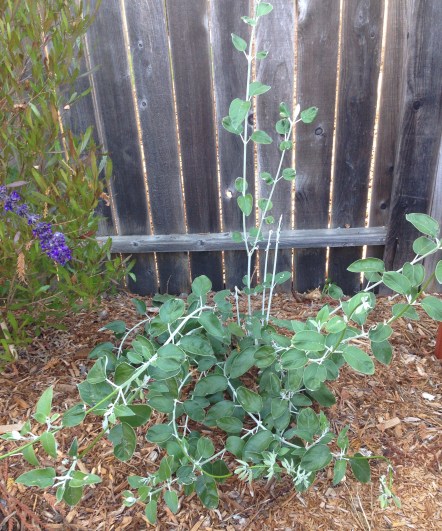
This unusual Peruvian or Andean Sage that I found at a nursery nearby has grown up and started blooming. I almost didn’t see the flowers, they are so shy and mostly hidden. I saw a website that said they were large and showy… if they become that I will be sure to take another picture.

Even without the blue-black flowers, the plant is very pretty, the way it drapes its graceful stems in the air. The stems and the backs of the leaves are silvery white, and the newer parts of the stems are very sticky.

gl-15-p1050493-crp-peruvian-sage

It makes me happy, the way it has quietly thrived and come into itself. I hope it will survive the winter and come again in the spring. It’s not listed in the Sunset Western Garden Book, but since it was propagated locally there’s a good chance it’s suited to our area.

I thought of it when I read this email from Salvo Magazine this morning. Beauty like this naturally makes us humans remember the Creator and Giver of beauty:

Is Planet Earth Trying to Tell Us Something?

You may know the standard line of evolutionary biologist-atheists like Richard Dawkins, which goes something like this:

Biology is the study of complicated things that give the appearance of having been designed for a purpose. (Dawkins, The Blind Watchmaker, 1996, p. 1)

Got that? “Have the appearance.” Don’t be fooled, warns Dawkins, for:

Natural selection is the blind watchmaker … does not see ahead, does not plan consequences, has no purpose in view. Yet the living results of natural selection overwhelmingly impress us with the illusion of design and planning. (Richard Dawkins, The Blind Watchmaker, 1996, p. 21)

It’s all an illusion of design. So ignore what your eyes and brain [and heart? -GJ] are telling you. They’re mistaken.

But apparently this habit of the mind that sees purposeful design in biology has spread beyond biology to the entire planet!

From the Daily Mail:

Sir David Attenborough and Brian Cox’s TV nature shows are ‘putting viewers off science’ because the beautiful scenes reaffirm belief in God.

* New study suggests nature programmes are putting viewers off science.
* Religious people often ‘have faith reaffirmed by the beauty on the screen.’

In the first bullet point, put “science” in quotes. They don’t mean science per se; they mean materialism or scientism.

There is no escaping it: The Planet Earth is stunningly beautiful. A wiser man wrote:

If the beatification of the world is not a work of nature but a work of art, then it involves an artist. -G. K. Chesterton

Draw your own conclusions, but don’t let someone tell you don’t see what you do see.

Some things about the Day and the Earth

In truth, I have never paid much attention to what is called Earth Day. But as someone just pointed out to me, every day is God’s day. That made me think of how “The earth is the Lord’s, and the fullness thereof.” And how He created the earth, to be a home for us people who are made in His image. He is so good to us. And in the beginning he looked over everything that He had made and called it Good.

Yes, we selfish people have done a lot to wreck things. We do damage even when we try to fix the situation, because our motives are not often pure and we are filled with pride that makes us stumble. It’s a very complicated and complex earth and task, too, like a lot of situations we or other people create. More often than not, tricky to repair. And is it possible to really love the earth if you despise its Creator? I could get more excited about Creation Day.

“This is the day that the Lord has made. Let us rejoice and be glad in it.” It was a good day for that here, and I thought about Earth Day more than usual because I walked around outside taking pictures of some things sprouting out of the ground, the earth. Dirt Day would get me excited, too, I bet.

This is our lonely — so far — foxglove. Notice how foxglove has love in it? They are the loveliest, I think. In many places in Northern California they self-sow, but not here. I planted three last fall, and snails ate at least one of the buds.

I neglected the foxgloves for weeks and when I finally noticed the flower stem it was curving around on the ground. I rescued it and propped it on the fence. Many people who keep Earth Day are trying to rescue the beautiful things God made.

We and the neighbor rescued the fence that divides our yards last week. I had to detach the Cécile Brunner rose from that fence and tie half of it to another fence temporarily. I think it will be o.k. Today I took this picture of one of the roses.

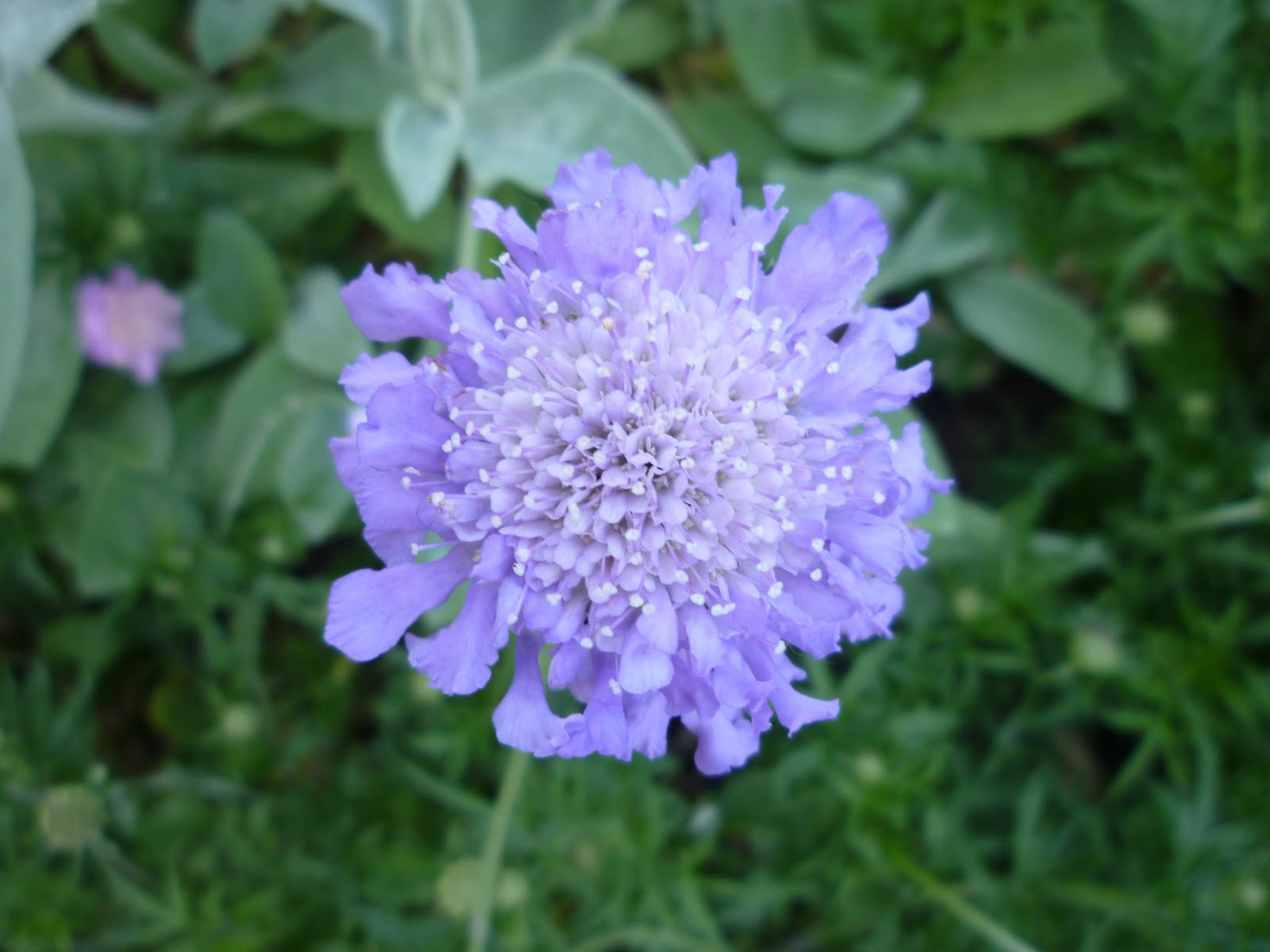
The first California Poppies of the season have come out! They are our state flower, blooming from perennial roots next to a salvia, across the sidewalk from the lavender pincushion flowers.

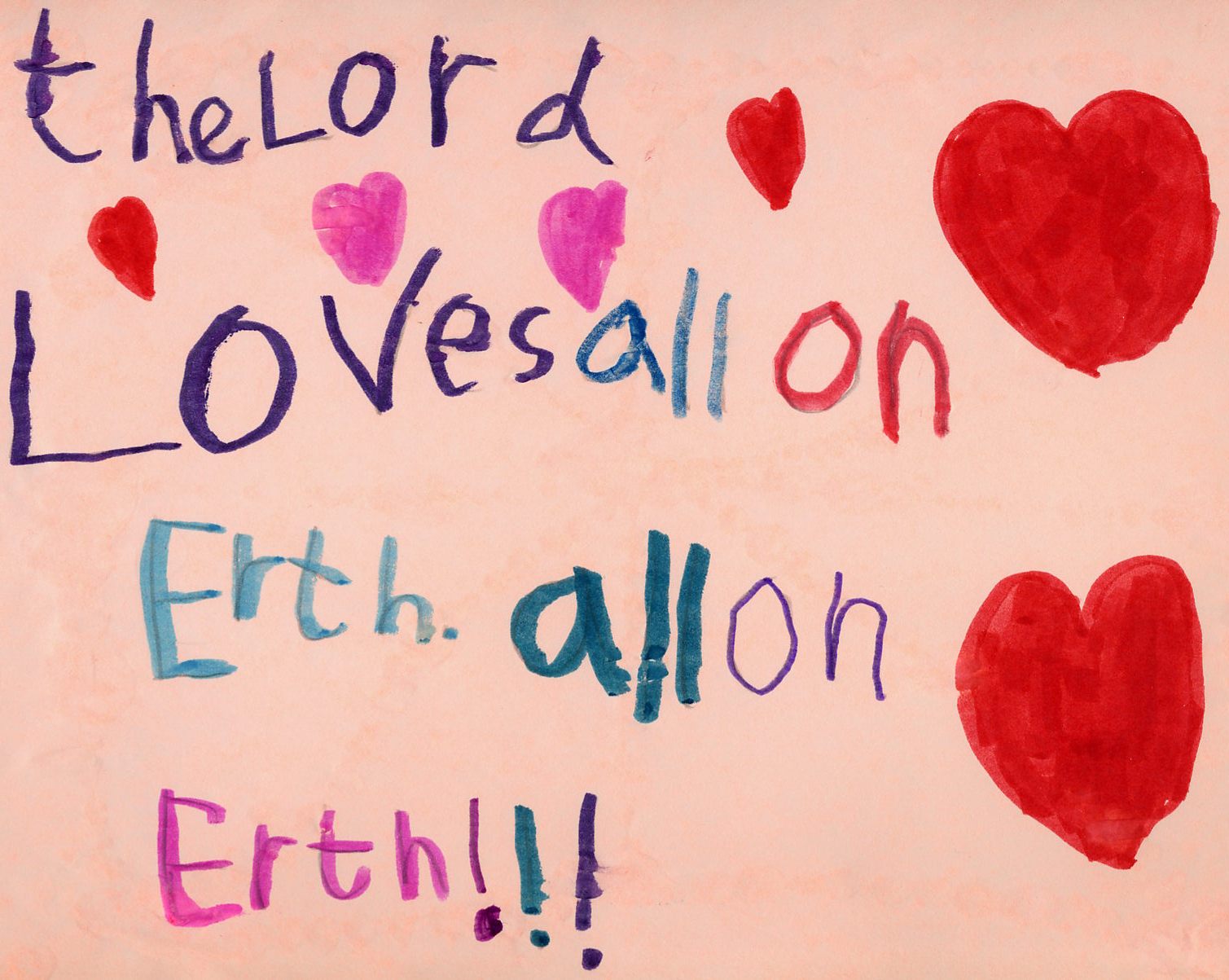
When I thought about Earth Day, now when it is already tomorrow for most of you, I also remembered this announcement (below) that Kate penned in her childhood. And it’s the most important thing I know on this subject. I hope you had a good (Earth) Day. It was a gift from the Creator.