In spite of my absence for various reasons, the garden continues to carry on valiantly its business of growing and changing by the hour. I love walking around and picking off a few dead flowers, or noticing seeds forming, even when I can’t give it the more thorough care it needs.
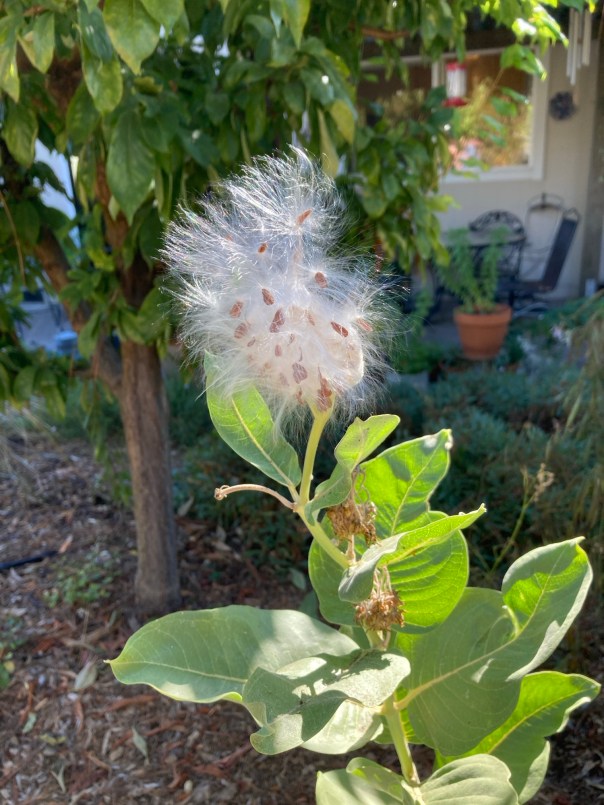
A couple of years ago I managed to transplant one of the vigorous Showy Milkweed plants (above) next to where the Narrow-Leaf Milkweeds grow. You can’t see the latter very well in the background, which is a good thing, because their leaves have mostly had the life sucked out of them by aphids and have turned black. But every spring, they come back stronger than ever.
Tatsoi greens and lobelia
The leafy green Tatsoi really took off in this pot where I stuck it in next to lobelia, and is begging to be thrown into a stir-fry a.s.a.p. Those I set out in the planter boxes are languishing; that soil must need amending.
The dwarf pomegrantes are mostly a fun member of the garden in that for most of the year have flowers, often with hummingbirds drinking from them; or foliage bright and beautiful catching one’s attention in spring and fall; and their darling fruits, that don’t get very large, and in this climate don’t get enough heat for their seeds to develop sweetness. But they are so cute right about now. This one is about an inch and a half in diameter.
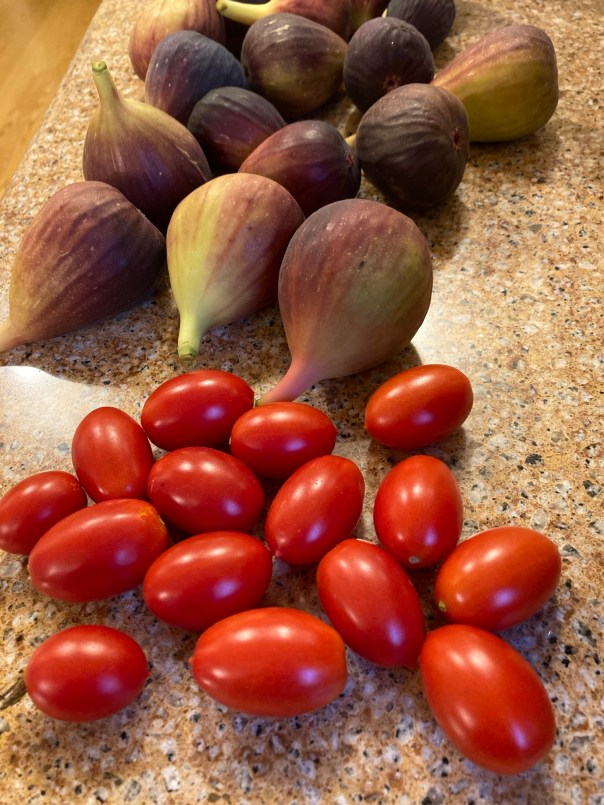
Every day I pick figs; the evening of my return from the mountains I gathered two dozen, and yesterday nineteen. Soon I hope to make that Autumn Fig Cake I told you about one time. And the Juliet grape tomato plant is prolific. I eat the tomatoes in the garden and in the kitchen, and took enough with me to the cabin that I could eat a few every day for ten days, and they were always sweet.
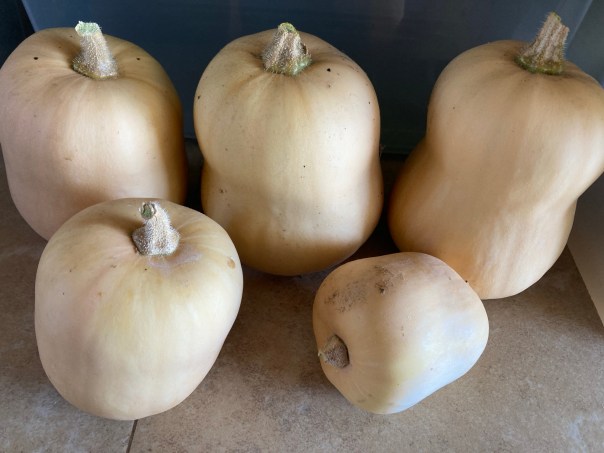
I harvested all but one of the little butternut squashes I grew this year, and planted some Sugar Ann snap peas in their place. Ideally those will start bearing about February, if the winter isn’t too cold and if I can keep the snails from devouring the plants between now and then.
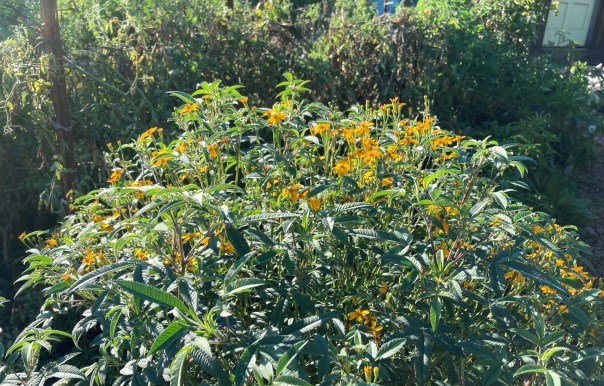
My native sneezeweed is of the less showy sort, but it welcomed me when I returned from my mountain retreat with a particularly lovely array of blooms, not plain at all.
No doubt about it, my garden loves me, and forgives my neglect.
It makes me want to do better in the future.
It was hard to keep up with myself last week, and with all the friends, projects and tasks that fill my life to overflowing. I guess I was somewhat playing catch-up after my mountain retreat the previous week. The garden got gently rained on three times that last week of September, which is unusual. Combined with fog on other days, the dampness caused mildew in the planter boxes, but mostly the lower leaves of the tall zinnias have been affected.
When I noticed the Japanese anemones looking better than ever, it occurred to me to plant a few more this fall, maybe some pale pink ones — but I corrected my impulsivity in time, and won’t be taking on one more project, what with so many others unfinished. A more reasonable goal would be to try to take better care of the anemones I have, and see if they can be encouraged to be taller and more robust. It’s a sign of their middling health, that they do not ever spread and multiply, and their flowers are few and small.
The sneezeweed I grow in a pot looks as well as it ever has. I bought it a few years ago at a native plant nursery, because I love the mountain versions of the flower. I put it in a pot so I could be sure to water it enough; the irrigation settings for most of my garden are set for drought-tolerant plants, and sneezeweed is not one of those. My type is pretty plain, or at least monochromatic, compared to the mountain ones.
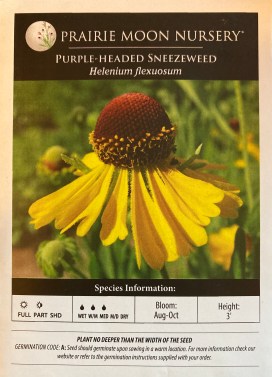
In search of fancier kinds, a few months ago I browsed sneezeweeds online for quite a while, and ordered seeds for this one, Purple-Headed. When I am looking at seed catalogs or even plants in nurseries, all the options seem so do-able and desirable. But once the time comes to get on with the actual work of planting… well, I literally drag my feet. So who knows what will happen with these seeds…
I used my sourdough starter twice last week, first to make a large pan loaf of seeded wheat-and-spelt bread. This is the recipe I have been trying to perfect, but perfection hasn’t happened yet. I may have to pause the sourdough project while I branch out and reach back, to other breads I have made or have wanted to try, like chocolate bread, Indian flatbreads, and applesauce rye.
Buttery Sourdough Crackers was a satisfying recipe that used a bit of starter. This picture shows the dough as it was resting overnight, along with leaves of the lemon verbena that I am drying, after pruning my plant for the first time ever.
I used this recipe for: Rustic Sourdough Butter Crackers as my jumping off place, substituting half dark rye flour, and adding sesame seeds to one half, and poppy seeds to the other. I baked them a lot longer than the recipe called for. The resulting crackers are nice and crispy and easy to eat. The butter ingredient plus the sourdough tang is a great combination.
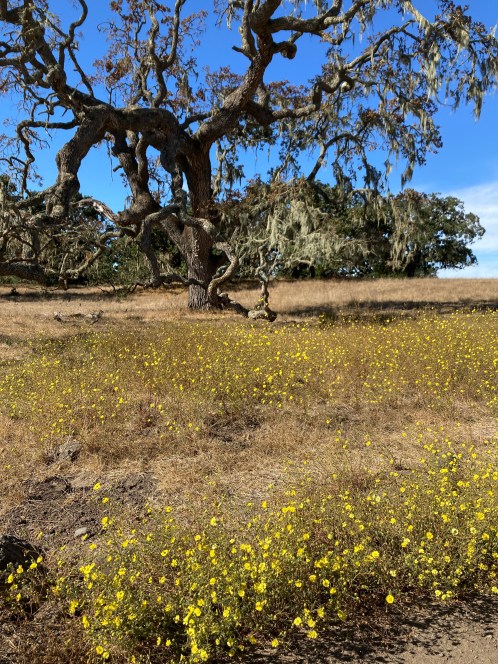
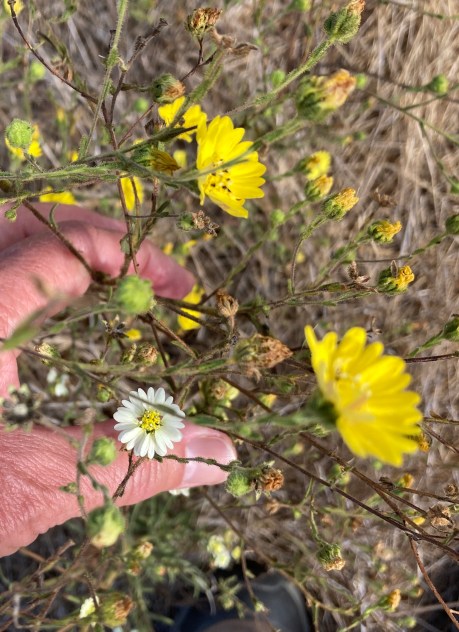
My friend Lucy and I took another one of our monthly walks, up in the hills again but to a park she hadn’t been to before. It’s mostly very brown up there now, but the poison oak is making red splashes in the landscape. And my old friend tarweed!
The Seek app tells me this is not either of the species I saw on my way up the mountain last month, but Hayfield Tarweed. And it seems to come in white or yellow versions, in one case growing side by side:
The third online Beowulf class was this week, and I spent more than two happy hours in the company of the most delightful teachers, Richard Rohlin and Jonathan Pageau. They both love the subject, and Richard is definitely a Beowulf scholar from way back. I will have to at least quote a couple of lines from the poem here eventually, though it seems that unlike me, most people I’ve talked to got an introduction to Beowulf in school. So you may already be more familiar with the story than I.
Apple orchard where I go.
At the end of the week, I remembered: apples! It’s time to make a trip my favorite apple ranch, and see which of their 30+ varieties is available now. I squeezed it in on Saturday afternoon, and added a stop at a nursery out that way, hoping they would have starts of some kind of leafy greens I could tuck into spaces in the planter boxes after I take out zucchini and tomatoes and eggplant. They did!
So here in the back of my car is a mix of apples Empire, Jonathan and Macintosh; and six packs of Swiss chard and collards. I do have chard growing right now, but I think I need more. And I wasn’t able to get collards started from seed in August.
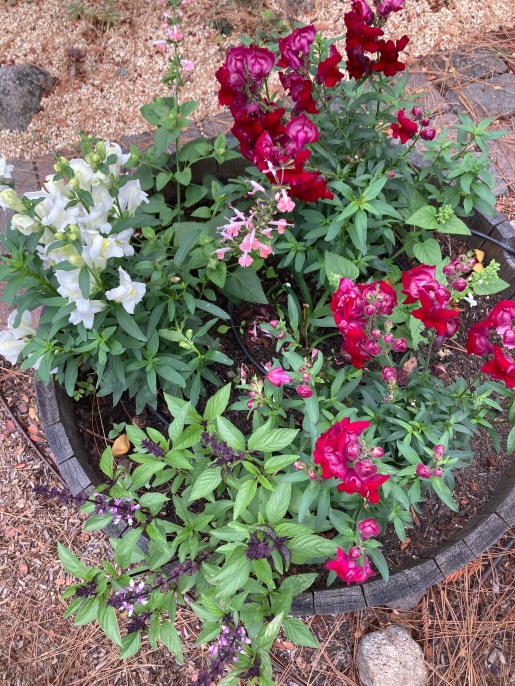
One more glad sighting of late summer I want to share, is this half wine barrel that was unplanted through last winter:
When I put in some snapdragon plants in late spring, I noticed a couple of tiny mystery plants that didn’t look like weeds, so I left them undisturbed. Now everything has filled out and I find that I have beautiful Thai basil and tropical sage complementing the snaps. Gardens are ever surprising.
From my planter boxes I pulled up and cleaned out parsley, zucchini, chives and Love-in-a-Mist; butternut and pumpkin vines, and a volunteer zinnia. When I went after the sea of overgrown chamomile, its warm and bittersweet aroma comforted me in the midst of that violent afternoon’s work. I don’t think I used one leaf of basil this summer; I just wasn’t home enough to take care of the garden in general, or to use half of its produce.
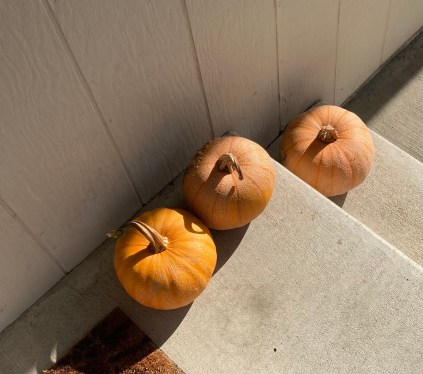
My pumpkins, grown from seed and nurtured in the greenhouse, were a complete flop! But one plant I gave to my neighbors produced 22 pumpkins, so one morning I found these on my doorstep:
Now I’ve sealed the boxes against winter, and added several inches of good soil. Still to do: organize and plant all those beautiful succulents that my friends gave me in the last few months, and put seeds into the dirt.
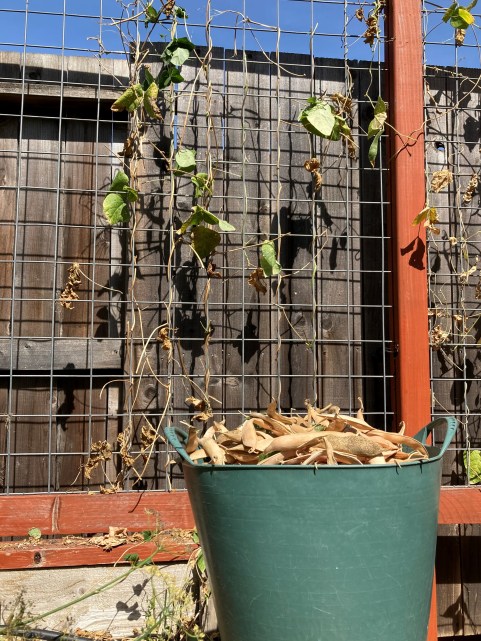
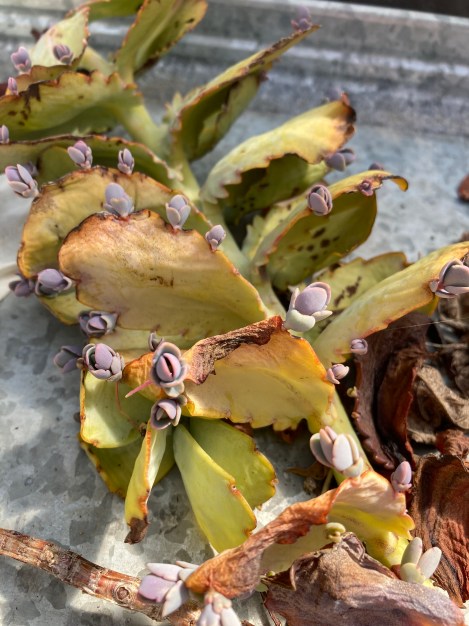
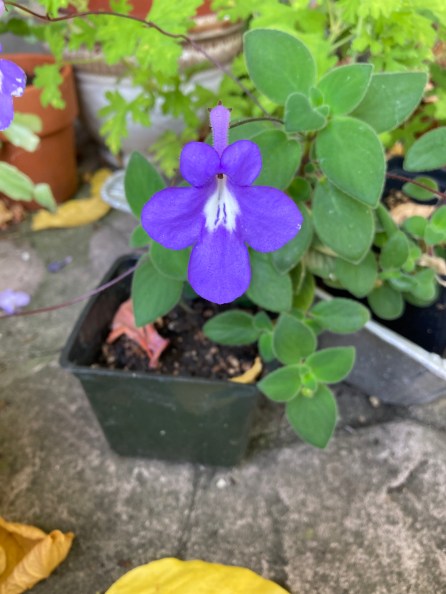
Trug full of Painted Lady runner beans.Succulent stem abandoned and unwatered — and undaunted.My first spider plant ever!Nodding Violet I propagated. If you want it, come and get it!
I had fun with Bella the other day at the community garden where she tends a plot. We always like to look around at what the other gardeners are doing, and to forage along the edges where people plant offerings to the whole community who farm there; you might find raspberries, or cutting flowers, or kale ready to harvest and take home.
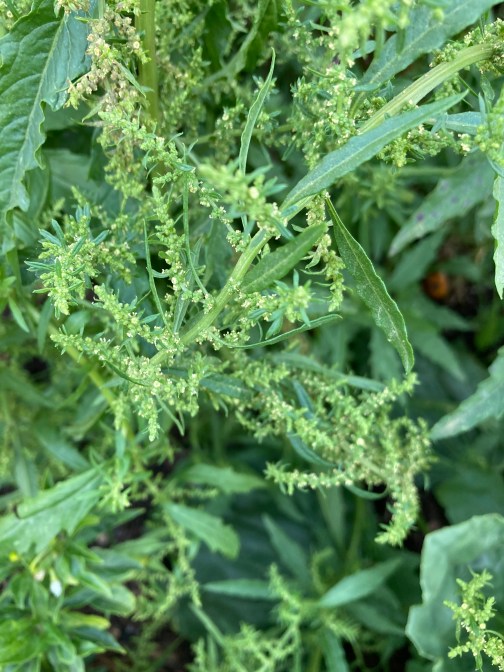
Some kind of amaranth…
Some kind of 10-ft glorious amaranth.
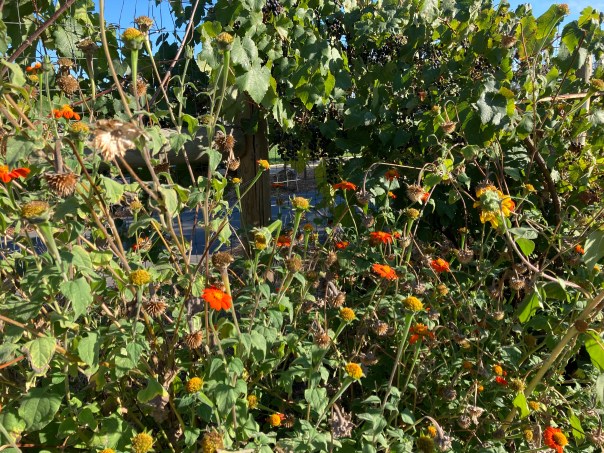
I brought home seeds from that community garden, too, of tithonia, in a handkerchief I happened to have in my purse:
These mild days with soft air are a balm to the soul. They always surprise me with their kindness, especially when they turn up between others that are by turn sunless and drizzly, then scorching. For two weeks I’ve had my bedroom and morning room windows wide open to the weather all day and night. A cross breeze rolls over me as I sleep.
Sometimes there’s been a bit of smoke, sometimes heat at midday. At night I often have to burrow under the blankets; I hear the traffic early in the morning, and occasionally the neighbors’ loud voices late at night. But it’s the best way I know to feel alive to the earth. Simply by being open to the weather and the air, I can be In Nature. It’s the most convenient month for that, here where I dwell. September is where it’s easy to feel at home….
But — September is leaving this very week, that change is in the air. I admit to being a little broken-hearted; essentially, I’m being evicted, and that’s harsh. There is nothing for it but to take inspiration from that budding succulent stem above, that will draw on its stored resources, and make the most of whatever sunlight burns through the fog. Those three little pumpkins will likely come in handy, too, because it’s time to start cozying up to October.
My sister joined me at the cabin on Saturday afternoon (This was almost two weeks ago now – I have been writing these reports from home); it was the first time just the two of us had spent any time together as long as we can remember – maybe since our younger sister was born! We didn’t have any real adventures, but we had a lovely time.
Unless you count losing our power as an adventure, but we are used to that. The cabin is off the power grid, but we have a solar collector and batteries that usually provide enough electricity for lights.
We were brushing our teeth, getting ready for bed, when the lights went out on Saturday night, and we never got the system going again. We think the batteries may need replacing. So we used lanterns and flashlights, and two dim gas wall lamps. The refrigerator runs on gas.
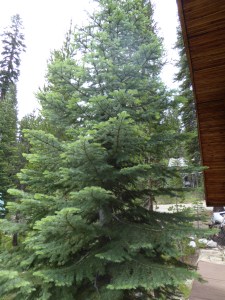
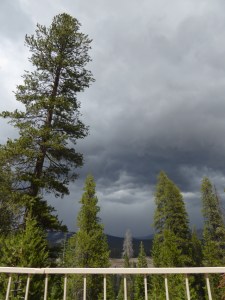
We read on the deck, until we got too hot, or too cold, or too sleepy. We cooked lots of vegetables, and Sister barbequed enough steak to make me happy for days to come. We talked about our favorite trees around the cabin, two of which I show here.
Storm clouds gathered all day Sunday, and we watched them eagerly, hoping some moisture would fall out, and in the late afternoon it finally did. Immediately the fragrance of the conifers and the duffy earth rose up and all around us and we felt better about everything. The trees were happy and able to exhale and share their essence again.
Monday I spent the whole day combing through the Sunset Western Garden Book and some books from the library, picking out the most flowery drought-tolerant plants that would attract bees, birds and butterflies, and making lists to prepare myself for an upcoming meeting with a landscape designer. She will help me with my garden at home, once the pool is gone and I am left with a vast dirt canvas on which to paint my garden art.
I know, that was a little odd — you’d think I should have been focused instead on nature’s glorious garden all around me. But it helped me greatly to invest some time in that landscaping project so that my mind would not feel as chaotic and overwhelmed as my yard looks right now. The mountains were a restful place where I would not be distracted by any environmental mess.
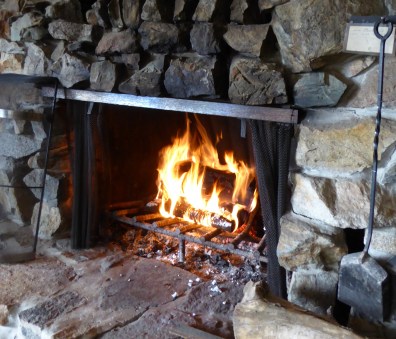
My sister and I collected firewood from the stash under the cabin deck, and pushed and pulled it up the hill in a cart, to build our magnificent fires. She built one, and I built the next.
We read, and talked about our reading, and planned our next sisters cabin retreat, which will include all three of us at a different cabin in October. This place will be closed down by then, to protect it from the snows, which we pray will be heavy this year. Sometimes the cabin is completely covered in snow, just a bump showing under the white blanket.
Penstemon heterodoxus – Sierra Penstemon
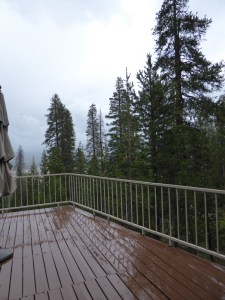
The storm clouds had gathered again that day, and serious rain began to fall in the early afternoon, and continued all day and night. We were gleeful, as if our own skins had been shriveled and were now plumping up again. We tried to take pictures of the wet skies. On our way to the firewood pile between showers I took a picture of the most common wildflower at the cabin right now, a tiny drenched penstemon.
Too soon it was the morning of our departure. It was certainly nice to have someone to work with, turning off the water valve and getting the cabin tidied up for the next family members who visit.
Once again, I departed late, but I didn’t expect to feel the need to take pictures on the way down, as I had done so much of that on the way up. I was really surprised therefore when the one-hour drive from 8,000 ft to 5,000 ft elevation took almost double that amount of time.
Meadow Goldenrod
Now that I’m back home, I’m very glad I did stop a lot on that curvy road flanked by layers of wildflowers. Using my several wildflower guides I have identified three new flowers that I didn’t know before, or that I had wrongly named in the past, just from that morning.
The Meadow Goldenrod was popular with the bees. I had seen it in the meadow with the cattle on the way up, but here it was growing along the roadside.
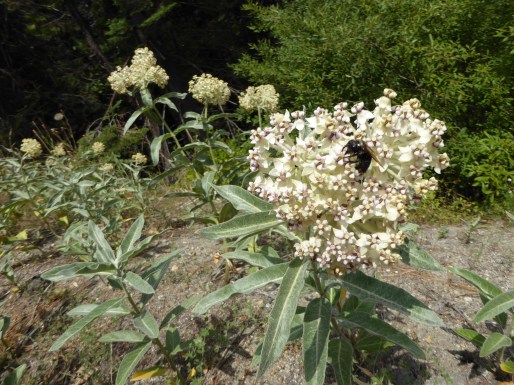
Another plentiful flower along my course was milkweed. Like the goldenrod, it has a hundred miniature flowers making up its clusters, and the insects were feasting on nectar there, too. I think this one is Indian Milkweed, asclepias eriocarpa.
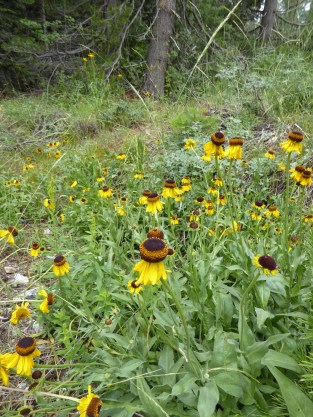
Indian MilkweedBigelow’s Sneezeweed
Years ago I had mistaken this next flower for something else. It is Bigelow’s Sneezeweed, which is an ominous name; one can imagine how it got that title. The blooms I saw were pretty far spent, but easily recognizable — and I actually was set straight on this one while perusing a guide from the cabin library.
So…the rain is blessing the forest, and the bees are blessing the flowers, and the flowers are blessing the insects with nectar.
It is comforting to remind myself of these things that were going on under my nose. At the time, I was hurrying down the mountain, to Pearl’s house, to get a granddaughter to take home with me. That will be the next chapter of my summer story collection.



 When I noticed the Japanese anemones looking better than ever, it occurred to me to plant a few more this fall, maybe some pale pink ones — but I corrected my impulsivity in time, and won’t be taking on one more project, what with so many others unfinished. A more reasonable goal would be to try to take better care of the anemones I have, and see if they can be encouraged to be taller and more robust. It’s a sign of their middling health, that they do not ever spread and multiply, and their flowers are few and small.
 seed catalogs or even plants in nurseries, all the options seem so do-able and desirable. But once the time comes to get on with the actual work of planting… well, I literally drag my feet. So who knows what will happen with these seeds…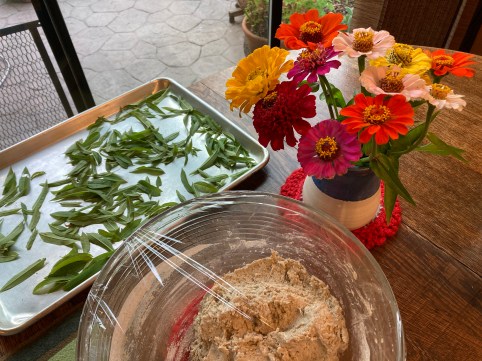









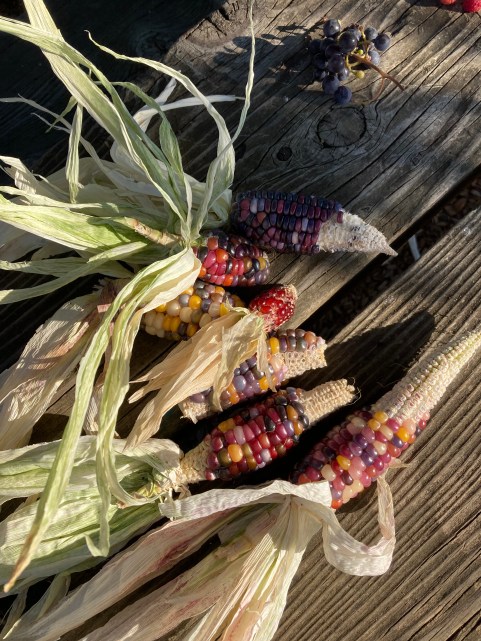



 Sometimes there’s been a bit of smoke, sometimes heat at midday. At night I often have to burrow under the blankets; I hear the traffic early in the morning, and occasionally the neighbors’ loud voices late at night. But it’s the best way I know to feel alive to the earth. Simply by being open to the weather and the air, I can be In Nature. It’s the most convenient month for that, here where I dwell. September is where it’s easy to feel at home….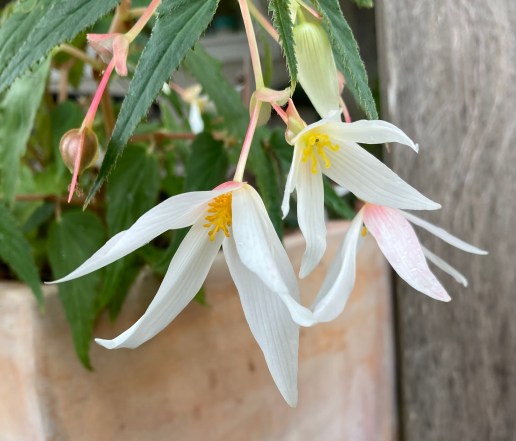
 st the two of us had spent any time together as long as we can remember – maybe since our younger sister was born! We didn’t have any real adventures, but we had a lovely time.
 k, until we got too hot, or too cold, or too sleepy. We cooked lots of vegetables, and Sister barbequed enough steak to make me happy for days to come. We talked about our favorite trees around the cabin, two of which I show here.

 d I collected firewood from the stash under the cabin deck, and pushed and pulled it up the hill in a cart, to build our magnificent fires. She built one, and I built the next.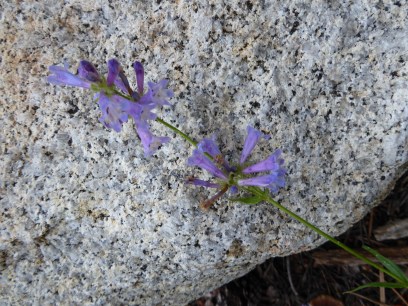
 d been shriveled and were now plumping up again. We tried to take pictures of the wet skies. On our way to the firewood pile between showers I took a picture of the most common wildflower at the cabin right now, a tiny drenched penstemon.
 Gladsome Lights