Tag Archives: trees

Apples and apples and a book.

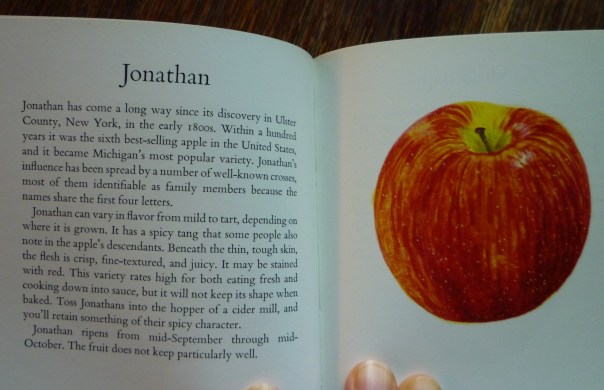
From the book Apples, by Roger Yepsen.

My kitchen and both refrigerators are overflowing with apples right now, as I recently made my annual visit to the apple farm I am so fond of. I’ve made jars and jars of applesauce to put in the freezer, at this point mostly from unpeeled Jonathans, which after it has cooked down and been put into pint jars, makes as pretty and pink a picture as I have ever had a hand in painting. It’s a good time to revisit as well this passage from a favorite novel, which I first shared ten years ago:

             – – – – – – – – – – – – – – – – – – – – – –

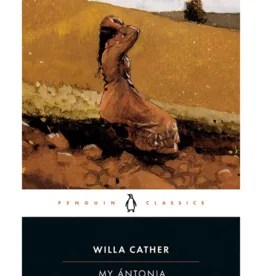
Willa Cather’s novel My Ántonia held a special place in the hearts of both my late husband and me, perhaps in our conjugal heart ? by reason of our sharing the story together more than once, and reading it on our own as well. When I’ve read it aloud it’s not uncommon for me to start sobbing at places in the narrative where the pathos hits home.

I was surprised to see recently a review in which the reader did not enjoy Cather’s writing, saying it was dry and lacking emotion. Those qualities might be why I appreciate her skill at capturing the story and drawing us in. Cather gives us the perspective of Jim, and we experience with him as narrator the various levels on which he is in love with our heroine and all that she represents, and he makes us fall in love with her, too.
Our differing response from the reviewer above probably has something to do with what we bring to the story. Though we haven’t lived in Nebraska or known any Bohemians, perhaps we are like Jim (and Willa Cather) in our grieving for the past, for the lifestyle of the pioneers and their farm life, for the good hardworking people we have lost; as I understand it, that was a theme that reappears in many of her works, but she accomplishes it without what might be called “emotional” prose. Mr. Glad and I both have farming in our roots, and our love for nature and the outdoors (and for people) is only encouraged and expanded by reading books like this.

I thought to transcribe some passages from the book on my blog, representative snatches for my own enjoyment and yours, as a way to savor again some moments from my reading experience, and perhaps introduce people who haven’t yet made friends with these characters and their world.

In the novel, there is no question but that Jim must leave the country life and go away to school and to city life. The passage below is from the last part of the book when he returns many years later for a visit, and I appreciate the way it conveys something of Ántonia’s character and also the mood of this season of the year.

At some distance behind the house were an ash grove and two orchards: a cherry orchard, with gooseberry and currant bushes between the rows, and an apple orchard, sheltered by a high hedge from the hot winds. The older children turned back when we reached the hedge, but Jan and Nina and Lucie crept through it by a hole known only to themselves and hid under the low-branching mulberry bushes.

“As we walked through the apple orchard, grown up in tall bluegrass, Ántonia kept stopping to tell me about one tree and another. ‘I love them as if they were people,’ she said, rubbing her hand over the bark. ‘There wasn’t a tree here when we first came. We planted every one, and used to carry water for them, too — after we’d been working in the fields all day. Anton, he was a city man, and he used to get discouraged. But I couldn’t feel so tired that I wouldn’t fret about these trees when there was a dry time. They were on my mind like children. Many a night after he was asleep I’ve got up and come out and carried water to the poor things. And now, you see, we have the good of them. My man worked in the orange groves in Florida, and he knows all about grafting. There ain’t one of our neighbors has an orchard that bears like ours.’

“…The afternoon sun poured down on us through the drying grape leaves. The orchard seemed full of sun, like a cup, and we could smell the ripe apples on the trees. The crabs hung on the branches as thick as beads on a string, purple-red, with a thin silvery glaze over them. Some hens and ducks had crept through the hedge and were pecking at the fallen apples.”

–Willa Cather
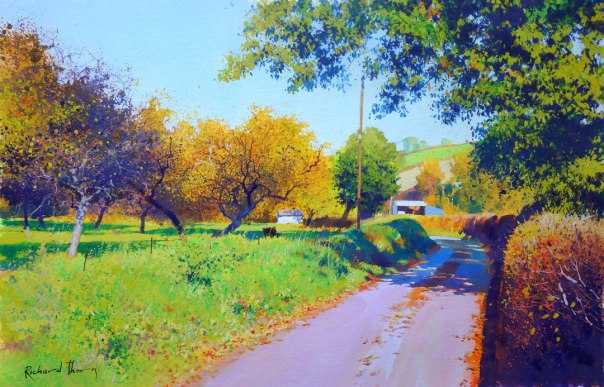
Orchardside by Richard Thorn

As large as alone.

Mountains are giant, restful, absorbent. You can heave your spirit into a mountain, and the mountain will keep it, folded, and not throw it back as creeks will. The creeks are all the world with all its stimulus and beauty; I live there. But the mountains are home.

– Annie Dillard

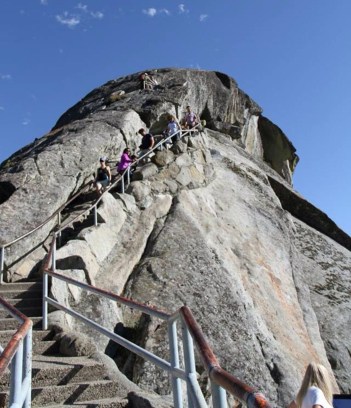
Moro Rock in Sequoia National Park – web photo

A granite dome was the focus of my mother’s most memorable hiking experience. She told me many times the story of how, at the urging of my father, she climbed Moro Rock when she was great with child (me). That is, so far, my only experience of it.

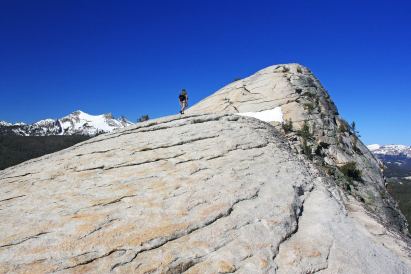
On our yearly camping trips decades later, my own children’s father would hike to the summits of other domes of rock with them, and a few of those times I was along. Lembert Dome was long my favorite, looming over Tuolumne Meadows on the Tioga Pass, in Yosemite National Park. Even at three years old Pippin could get to the top of it, with someone to hold her hand on the gradual ascent up the back slope.
Lembert Dome in Yosemite – web photo

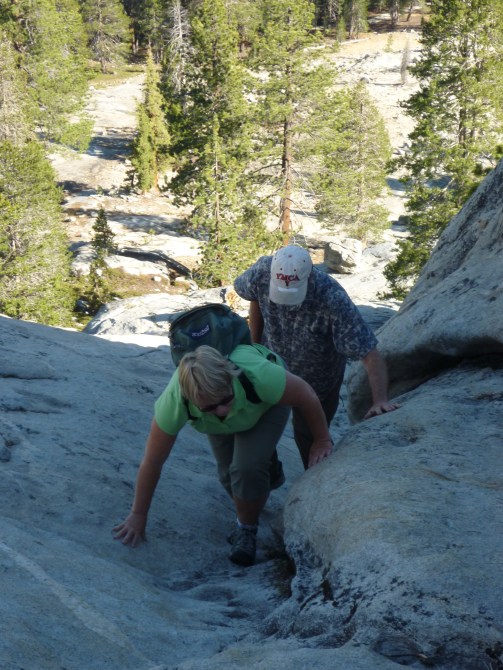
In the latter half of my life, my favorite dome is the one behind our mountain cabin. Several features of it make it accessible to me, the most important one being that I can walk to its base in a few minutes. I read recently that one summer, a small group of us climbed to the summit of this dome in the morning and again in the evening of the same day. My late husband took the picture below of our companions coming up behind him, about eight years ago. You can see why I wouldn’t want to try it alone.
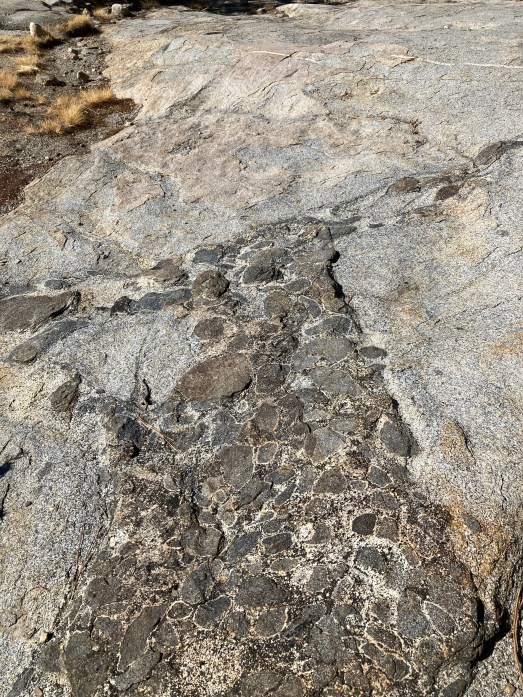
During my recent mountain retreat, I set out one morning before breakfast, thinking that I would just walk over that way to get a view of the lake from the other side of what we have nicknamed Gumdrop Dome. Within ten minutes I had changed course and decided to approach from a different direction and to do a new thing: walk all the way around the base. I came through the trees to the north side, and headed to my right, around the west side of the rock. That side is a steep wall, decorated by veins of different colored minerals, and by lichens.

I refreshed my memory just now about different types of clast, or broken rock. I think what lies there at the bottom of the wall would not be classified talus or scree, but is just plain clast. On this side you can clearly make out where the base of the dome is.

I walked along in the clast, it moved under me, and then — whoopsie! Down I went on my behind. While I sat, I thought I should take advantage of the camera angle:

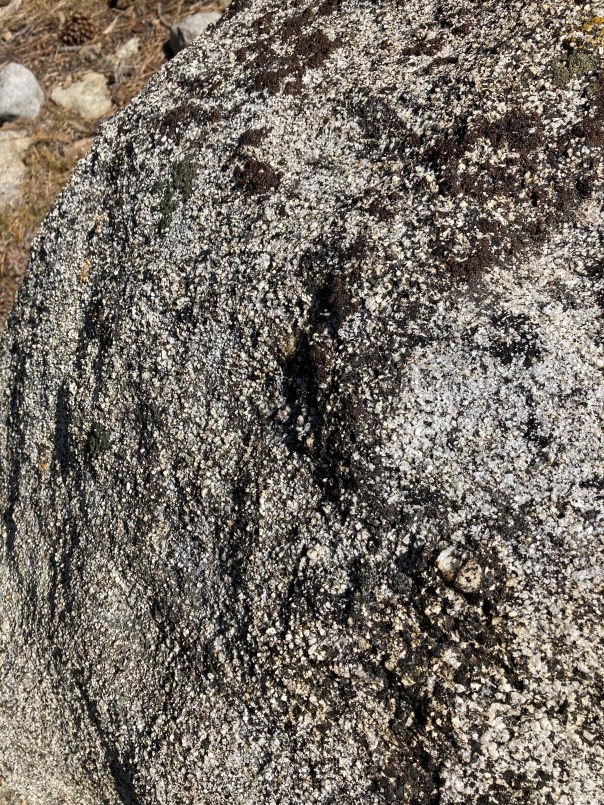
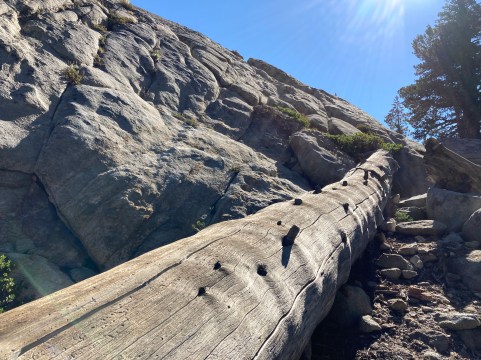
It wasn’t the only time I fell. A few minutes later I stumbled forward, and scraped my hand on some of that sharp granite. My euphoria was untouched; it was such incredible good fortune, that I should find myself completely alone, yet in rich company: God, and a friendly monster of a rock. Still, I navigated more carefully after that. The boulder to the right of the pine cones in the picture below is an example of the coarsest grit of granite imaginable; and the one below it, also.

I began to search for stones, keepsakes of my solitary walk around “Gumdrop.”

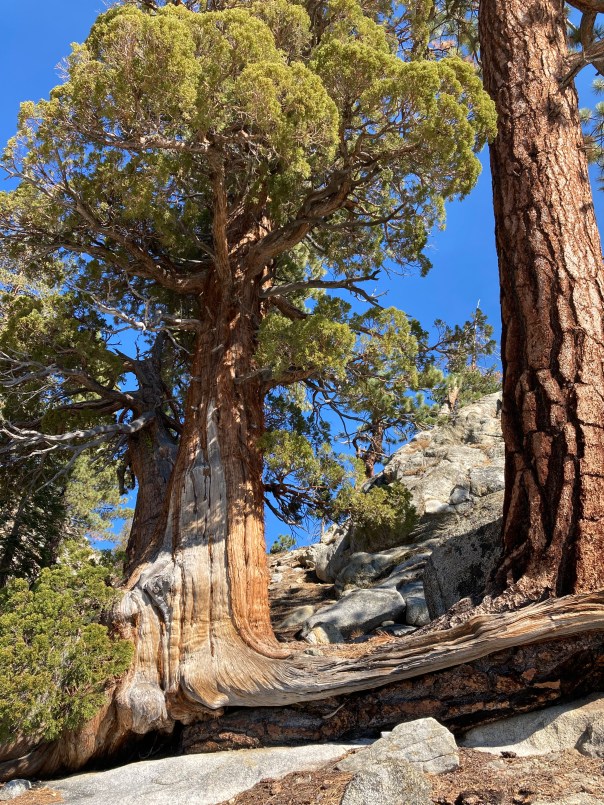
On the back side, the line between dome and not-dome is vague, as that granite face stretches away in an ever flattening  grade, down into the trees. There is still lots of rock there, but giant conifers grow out of cracks in it, and their duff lies thickly on top. Granite domes like this are called bornhardts; there are several theories about how they form.

For a long time I gazed at the wide views from my high perch, a flattish boulder-bench, and felt the cool breeze growing warmer as the sun rose to my left.

“O, Lord, how manifold are Thy works! In wisdom hast Thou made them all.”

From here you can see other domes in the distance, but of course you can’t get a good idea of what the dome you are standing on looks like. The best vantage point I’ve ever had is from the lake, as in this picture that was taken some years ago:

This area below I call the amphitheater. It’s a good place from which to watch the show!

If I had brought a snack, I might have stayed hours longer. It was all delicious and satisfying as a feast for the soul, but pure bliss was not going to prevent me getting shaky (elevation about 8500′) if I kept putting off nourishment such as was waiting for me back at the cabin; so I stood up and continued my explorations.

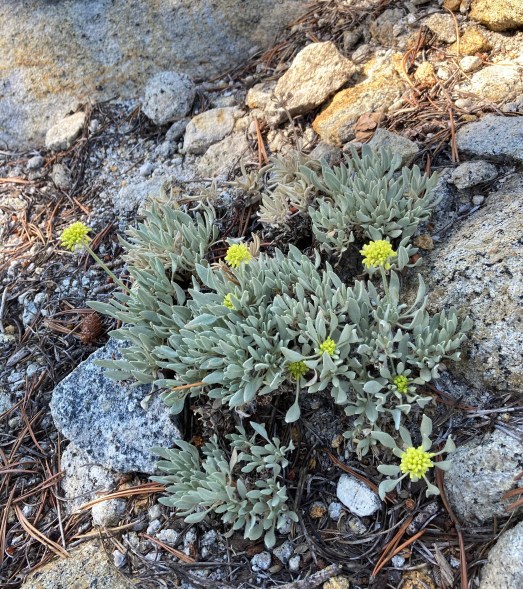
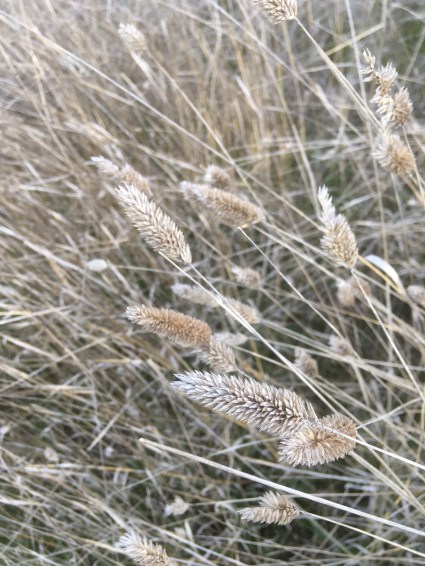
Frosted Buckwheat

This couplet below does not at all fit with the stones that I collected on the dome, as far as their smoothness, or the number of them. But the poet’s metaphor echoes somehow that of Annie Dillard at the top of this post, and they both understand what I left behind on that mountain dome, and what I brought home.

“may came home with a smooth round stone
as small as a world and as large as alone.”
-E.E. Cummings

Here is my last look at Gumdrop, when I had circled around to my starting place. From this angle it seems that it might not be impossible to climb that particular slope. I wonder…. Well, next time I have a companion, I’ll have to bring him or her to this place and give it a try! But for now, Good-bye Gumdrop! Good-bye mountains! Thank you for inviting me. I had a good time!

Down to the lake to be alone.

THE COUNTRY WIFE

She makes her way through the dark trees
Down to the lake to be alone.
Following their voices on the breeze,
She makes her way. Through the dark trees
The distant stars are all she sees.
They cannot light the way she’s gone.
She makes her way through the dark trees
Down to the lake to be alone.

The night reflected on the lake,
The fire of stars changed into water.
She cannot see the winds that break
The night reflected on the lake
But knows they motion for her sake.
These are the choices they have brought her:
The night reflected on the lake,
The fire of stars changed into water.

-Dana Gioia

I spent quite a while looking for a nice piece of art, or one of my photos, to accompany the story of this woman’s walk. The trying had the effect of making me love the poem even more; I began to think that only Gioia himself might be capable of creating a visual graphic that wouldn’t actually detract from what he’s already given us in words. There are voices and movement and one thing changing to another….

All the pictures I looked at were still pictures, of course. And none of them could carry half of the feeling of even one material element as expressed by these lines, such as the woods in the dark, or the stars, the water. When there is a stop in the middle of the fourth line, I see her pausing to push aside fir branches. The whole is an elegant interplay of the forces of beings.

Those beings are not only material. For example, the heart and mind of the woman any of us might imagine. It’s a wondrous thing to be able to go with her down to the lake, and yet, not invade her privacy. To have the vicarious experience of being her.  I follow the music, arrive at the lake, and find a solitude as full as the universe.

I grow younger again in January.

In spite of being only 95% recovered from my illness (a wild guess at a statistic), I started something new today. Pippin and the Professor gave me a Christmas present of a year’s membership in the local regional parks agency. It includes other benefits besides free parking, but my unwillingness to waste that part made me want to use it soon and often. I’d thought that I’d need to drum up a walking companion in order to get myself moving in that direction, but today when the afternoon suddenly opened up, I decided to go on my own to the most familiar of the parks. I’ve written about this one before, most memorably just after my husband’s death almost five years ago.

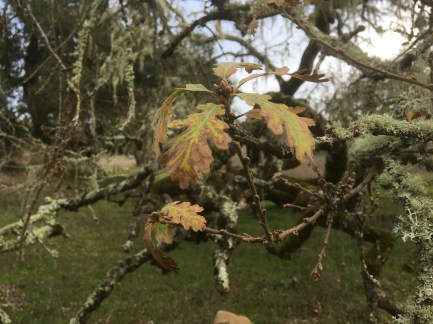
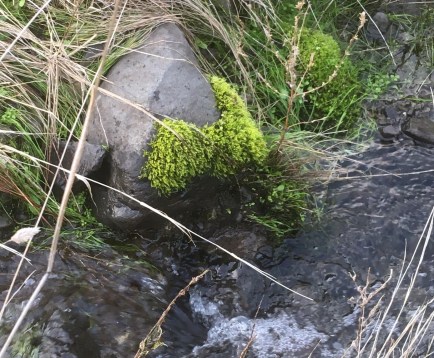
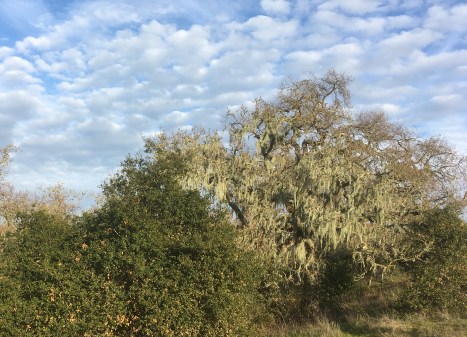
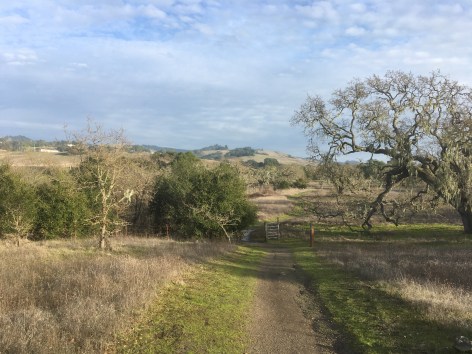
It’s winter, and I knew there would be a lot of grayness on this mostly gray day; I was (surprisingly) surprised at how much there was to see that wasn’t drab. Some of the regional parks I will visit have no parking fee at all, but this one is $7! So it was a good one to start with, to make me feel the monetary value of my gift — which is surely the least part.

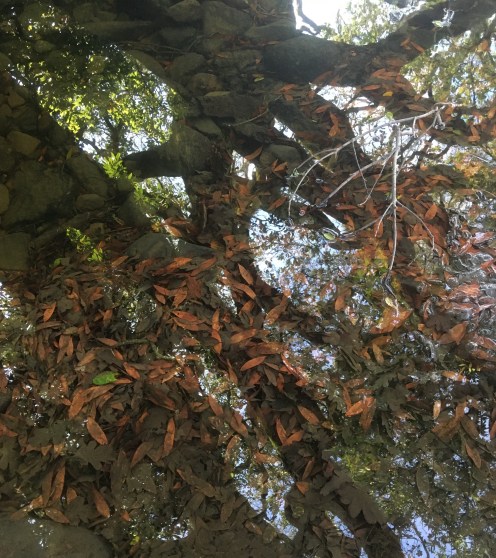
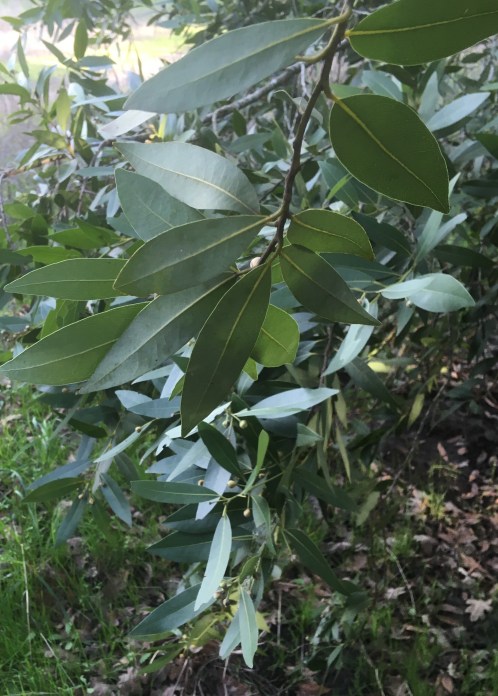
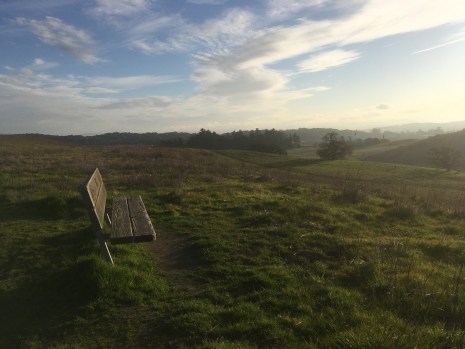
It’s not a huge park, but it is crisscrossed with several trails and I never have a map. In the past it seems we often end up back at the parking lot before we are feeling done, so I was trying to make the widest loop I could around the perimeter of the space. I think I did okay. Where a huge bay tree hangs over the creek, I took this picture in which I already can’t tell where the lines lie between the sky and the tree and the reflections.

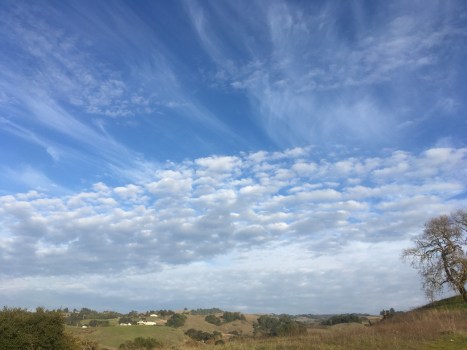
In the last several months “everything,” most lately the attack of who knows what viruses, has conspired to make me feel my mortality. Not that I thought I was near death, but in just one year’s time I seemed to have become several years older, weaker and flabbier. I know youth is relative to a point, but I thought my youth might have died. It felt very good to be walking briskly in the fresh air and to be right there under the sky when the sun came out from time to time. It was shining nearly horizontally in my face or my camera lens when it did. Frogs croaked, and towhees hopped about in the bushes.

Have I mentioned that I also put my back “out” just before my battle with the viruses? I couldn’t even do anything about that for weeks, but last Friday I did see a chiropractor and am now on my way to getting back my less flabby self. The weather is of the sort that makes me want to curl up indoors with a book and a blanket, but I have had my warning, and I am going to fight against my tendency to the sedentary lifestyle.

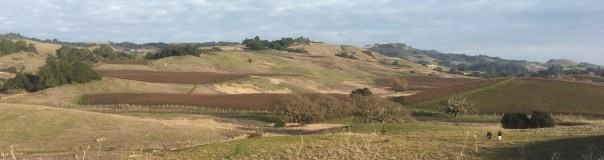
Not far from the descent to the parking lot, I was on a ridge from which I could see across the road below to the vineyards on the slopes beyond. And on my drive home — only ten minutes! — I noticed workers pruning the vines.

January is usually somewhat depressing for me, but this year I have been distracted from the bleak weather by other things that one might think more depressing. It didn’t work that way; I was continually reminded of God’s presence and had so many occasions of joy and contentment, it was obvious that they were pure gift. And this Christmas present from my children — it is a gentle prod to do the things they know I will love. I wonder if I can squeeze in one more park before the end of January?