Monthly Archives: June 2018

Moles fly, and sparrows sweep the sky.

IMG_3260Preface:  I drafted this post yesterday, not expecting to publish it this soon, but today, the occasion of a statewide election day, I was pained to see public pleas and even poems put forth drawing attention to the needs of “art” and “artists” for money and support. I am all for supporting artists whom I admire, but I am also realizing that in the minds of some professional artists, art has become just another “spiritual practice” to support and be supported by that new religion of modernity, politics. So I decided to share this poem, and my short response, on behalf of all you creative people out there, who may or may not know that you are. Art will never not be, and that is a gift.

PRAISE in SUMMER

Obscurely yet most surely called to praise,
As sometimes summer calls us all, I said
The hills are heavens full of branching ways
Where star-nosed moles fly overhead the dead;
I said the trees are mines in air, I said
See how the sparrow burrows in the sky!
And then I wondered why this mad instead
Perverts our praise to uncreation, why

Such savor’s in this wrenching things awry.
Does sense so stale that it must needs derange
The world to know it? To a praiseful eye
Should it not be enough of fresh and strange
That trees grow green, and moles can course in clay,
And sparrows sweep the ceiling of our day?

-Richard Wilbur

This poem was part of Wilbur’s first collection published when he was 26, just returned from World War II. I read it in Poem A Day Volume 3, where it is accompanied by comments from Wilbur himself:

“Aristototle once said, ‘The making of metaphor is the peculiar gift of the poet, the mark of poetic genius.’ This early poem of mine — a Spenserian sonnet, by the way — begins as an impatient attack on metaphor, but by the close has capitulated and become helplessly metaphorical. That’s as it should be, because the likening of all things, the implication that all things are connatural, is of poetry’s essence.”

I like that in the poem, he refers to “uncreation,” i.e., the One who has made “all things visible and invisible,” and from which Source they also come by their likeness one to another. God is the supreme metaphorical Poet from whom we all receive this gift of making metaphors, and most of us think and speak in metaphors all day long. When in the poem we read, “summer calls,” is that not likening summer to a being that can beckon with a hand or voice? To think of our senses as “stale” links them in our mind to flat beer or dry bread. It’s part of the gift of imagination which has the same Source, and another way that we are made in the image of God. Glory to the Father, and to the Son, and to the Holy Spirit!

Middlemarch – Ladislaw’s force of unreason.

One Saturday evening Will Ladislaw is thinking about the foolishness of his current situation, in which he has taken work in the town near to where our heroine Mrs. Casaubon lives, because of his feelings for that woman “for ever enthroned in his soul.” But he has been forbidden by Dorothea’s jealous husband to visit their home. So, “he could hardly ever see her.”

His thoughts are going irritably round and round on this subject when, “suddenly reflecting that the morrow would be Sunday, he determined to go to Lowick Church to see her.” It’s not his parish, and his presence would annoy Casaubon certainly, but he reasons,

“It is not true that I go to annoy him, and why should I not go to see Dorothea? Is he to have everything to himself and be always comfortable? Let him smart a little, as other people are obliged to do. I have always liked the quaintness of the church and congregation; besides, I know the Tuckers. I shall go into their pew.”

Having silenced Objection by force of unreason, Will walked to Lowick as if he had been on the way to Paradise, crossing Halsell Common and skirting the woods, where the sunlight fell broadly under the budding boughs, bringing out the beauties of moss and lichen, and fresh green growths piercing the brown. Everything seemed to know that it was Sunday, and to approve of his going to Lowick Church. Will easily felt happy when nothing crossed his humour, and by this time the thought of vexing Mr. Casaubon had become rather amusing to him, making his face break into its merry smile, pleasant to see as the breaking of sunshine on the water — though the occasion was not exemplary…. Will went along… chanting a little, as he made scenes of what would happen in church and coming out….The words were not exactly a hymn, but they certainly fitted his Sunday experience….

…. Sometimes, when he took off his hat, shaking his head backward, and showing his delicate throat as he sang, he looked like an incarnation of the spring whose spirit filled the air — a bright creature, abundant in uncertain promises.

This is one of a thousand passages in Middlemarch that so delightfully convey the personality and the feelings of one of the characters. I wish that I could transcribe a score of them just because I admire so much Eliot’s art. In this case Will is to himself in happy concord with even the weather and the season, and with the landscape that the author paints with a few perfect phrases. I think that Eliot is a little bit in love with Will Ladislaw, for how else could she make me fall in love with him?

The last phrase, though, comparing Will and springtime, is suddenly ominous, because, as we all know, the weather is unpredictable at this time of year. And the spirit of spring — I am as susceptible to its easy promises as anyone.

I did read this novel aloud with my husband 15 years ago, an acquaintance that was too shallow and distant for me to retain more than vague impressions. This time, on my own, I’m more engaged and enraptured, but still, I don’t want to take a year to read as thoroughly and meditatively as this book seems to warrant. So I’m glad Arti proposed two months, and I look forward to the remaining weeks and stories.

photo credit: Pippin

Grass and turmeric and some same old (sweet) things.

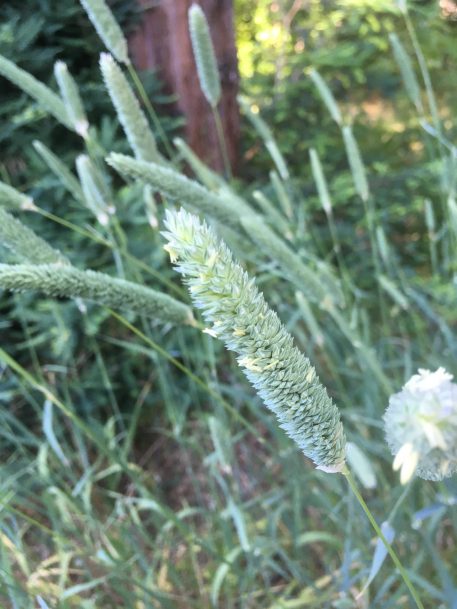
Today I’m wondering what this grassy “weed” is, along a stretch of path by the creek that didn’t get mown down – yet? It’s very familiar, and I guessed it was rye, but I can’t match it up with anything in Weeds of the West at this stage. Maybe when the seed heads develop, if it is allowed to remain.

The Queen Anne’s Lace that made such a lush display last year was removed on my side of the creek, but there are a couple of plants starting to bloom on this far side:

Thursday I worked in the kitchen and cooked up a storm the whole day long. I hardly did anything else. Every other Thursday my CSA box (farm box) gets delivered, so I had that to deal with. I made some more of the Egg Bhurji, a sort of Indian scramble, and got the flavors closer to my goal. This time I grated fresh turmeric into it because I had it on hand. I had bought the turmeric rhizomes to plant, but there were more of them than I needed for that.

I boiled the quail eggs. They were so darling at every stage, I even had to take pictures of them simmering in the pot. One place I read said to cook them for two minutes, another four minutes, so I think I had them in the pan for about three minutes, and the yolks are soft, but that’s very pretty, too! And they are very tasty. 14 calories and 1.2g protein each.

Last Sunday when I saw them as the love offering on that bench, it was amazing how instantaneous was the progression in my mind to the thought, “I could raise quail!” Ha! I did laugh at myself. It’s not beyond the realm of possibility, and it would be easier than chickens, but I want to get started on raising worms as my next homesteading project.

Now that the temperature has been in the 80’s the sweet peas are exploding; one day I took bouquets to two different neighbors, and the next day I filled two vases for my own house. Soon the stems will be too short to do much with, and I need to take them out anyway, to make room for the butternut squash that I will train up the trellis.

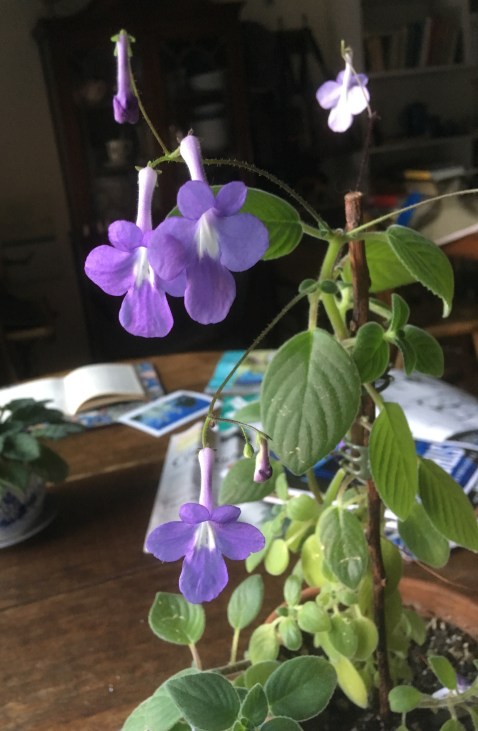
Some pretty blooms in the house are the Nodding Violet or Streptocarpella, a species of Streptocarpus, which a friend and I agreed sounds like a flower to feed a dinosaur with a sore throat. But they don’t make that many flowers that I want to offer them to the sick, so I think I will forget about the dinosaur and just remember Nodding Violet.

Mrs. Bread gave me my first plant, from which I accidentally broke a stem that I rooted into a second plant; I gave that second plant to friend Ann at church.  Then my violet was struck down by cold in the greenhouse one winter’s day, but by then Ann had started a second plant which she gave to me. And that is how we take care of each other and of our Nodding Violets, and how I am learning to just keep them safe in the house. They are nodding “Yes” to that:

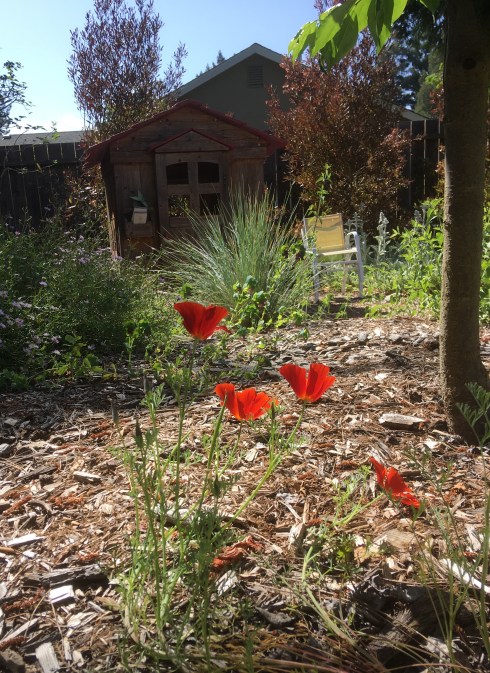
And in the back garden, the red California poppies are blooming under the (fruitless) plum trees. Mr. Greenjeans said that the warm weather we had a few months ago confused the plums and made them bloom early; then the frost hit and destroyed the buds. 😦 So he doesn’t have any plums, either. This is the third year for my plums and I ate one last year.

Considering how little attention I have given my strawberries, and the fact that they are old plants, it is a big surprise to me that they are so happy and productive this spring. This morning I picked eight fruits to bring into the house, which might set a record, but that could be because in the past I have eaten them all in the garden.

I hope your June is starting out as happy as mine. ❤

Slipping from the tedious plane.

I was telling Mr. Greenjeans about how An American Childhood by Annie Dillard encouraged me in my writing. He comes from the author’s hometown of Pittsburgh, Pennsylvania, which is the backdrop for her growing-up adventures told from her vividly revealing point of view. I took the book off the shelf to put aside for him, and turned the pages a while, seeing passages I’d marked long ago.

Hers is a unique point of view, of course, as each of us is an unrepeatable individual looking out on our world. Whether it is her perspective that is unusual as well, or only her ability to convey it in words, I don’t know. I do know that few children today have the liberty of youth that Dillard describes as regularly offering periods of time so deep and distraction-free that you can “lose yourself.” In a chapter on her love of books and reading, she tells how she felt:

The actual world is a kind of tedious plane where dwells, and goes to school, the body, the boring body which houses the eyes to read the books and houses the heart the books enflame. The very boring body seems to require an inordinately big, very boring world to keep it up, a world where you have to spend far too much time, have to do time like a prisoner, always looking for a chance to slip away, to escape back home to books, or to escape back home to any concentration–fanciful, mental, or physical–where you can lose your self at last. Although I was hungry all the time, I could not bear to hold still and eat; it was too dull a thing to do, and had no appeal either to courage or to imagination. The blinding sway of their inner lives makes children immoral. They find things good insofar as they are thrilling, insofar as they render them ever more feverish and breathless, ever more limp and senseless on the bed.

-Annie Dillard, in An American Childhood