It’s been a long time since my first posting of the poem below. I thought of it this morning when I was sorting my Painted Lady beans. October is the month to clean up all the leftovers of summer plants and visitors. It probably won’t surprise you to know that little boys left dishes in the playhouse sink!
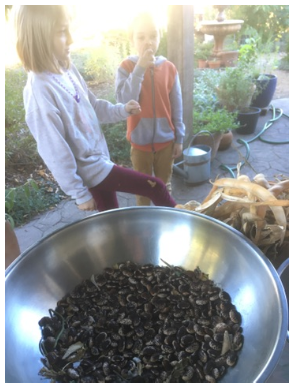
Last week four helpers came for a long session of work, and the youngest of them washed up those dishes; now I can put them where the winter wind won’t drop leaves and dust and rain on them, when it blows through the paneless windows.
They also finished up tasks relating to those runner beans, removing the last of the vines from the trellis, and shelling the beans into a big bowl.
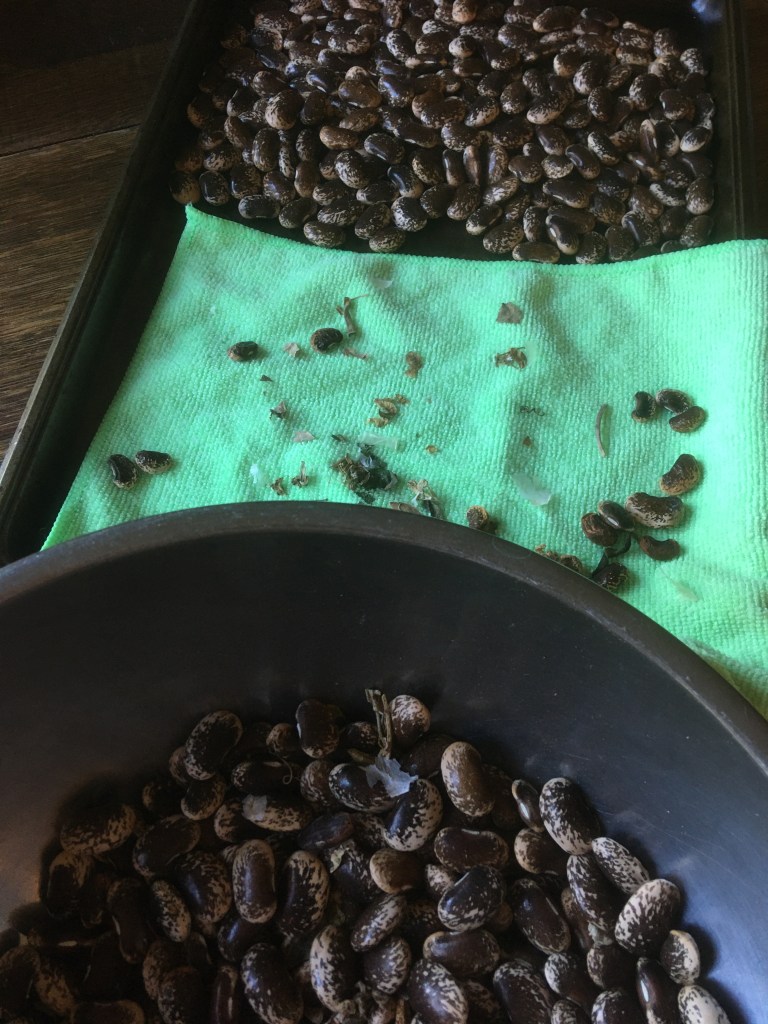
Then it was my turn, to take out the biggest pieces of stem and pod so that the beans could simply be washed when I’m ready to cook them. But no sifter or screen that I could find had the right size holes.
When I was dusting this morning I hit upon the idea of using a microfiber cloth to spread the beans on, thinking it might reach out and grab all of that litter. It worked beautifully. I spread a layer of dirty beans on the cloth, and then moved the beans off, leaving all the detritus behind. The shriveled or undeveloped beans were left with the inedibles.
A WOMAN CLEANING LENTILS
A lentil, a lentil, a lentil, a stone.
A lentil, a lentil, a lentil, a stone.
A green one, a black one, a green one, a black. A stone.
A lentil, a lentil, a stone, a lentil, a lentil, a word.
Suddenly a word. A lentil.
A lentil, a word, a word next to another word. A sentence.
A word, a word, a word, a nonsense speech.
Then an old song.
Then an old dream.
A life, another life, a hard life. A lentil. A life.
An easy life. A hard life, Why easy? Why hard?
Lives next to each other. A life. A word. A lentil.
A green one, a black one, a green one, a black one, pain.
A green song, a green lentil, a black one, a stone.
A lentil, a stone, a stone, a lentil.
— Zahrad
There is a book we’ve had for years in our parish bookstore, Our Thoughts Determine Our Lives. I might even have it in my house by now, but I haven’t read much of it. One might think its message is similar to “The Power of Positive Thinking,” but it’s not. It’s more like what the Apostle Paul said:
“We demolish arguments and every pretension that sets itself up against the knowledge of God, and we take captive every thought to make it obedient to Christ” (2 Corinthians 10:5).
That book is a collection of teachings from Elder Thaddeus of Vitovnica, such as:
“Our life depends on the kind of thoughts we nurture. If our thoughts are peaceful, calm, meek, and kind, then that is what our life is like. If our attention is turned to the circumstances in which we live, we are drawn into a whirlpool of thoughts and can have neither peace nor tranquility.”
“We need repentance. You see, repentance is not only going to a priest and confessing. We must free ourselves from the obsession of thoughts.”
“Freedom belongs to God. When a person is free from the tyranny of thoughts, that is freedom. When he lives in peace, that is freedom. He is always in prayer, he is always expecting help from the Lord—he listens to his conscience and does his best. We must pray with our whole being, work with our whole being, do everything with our whole being. We must also not be at war with anyone and never take any offense to heart.”
Quietly thinking, letting words come to one’s mind, sorting them out — it sounds like a wholesome and meditative activity. But how many pieces worthy only of the garbage might we find in the bowl of a lifetime — or merely a certain calendar year — stones and shriveled things, and who knows what words and whole tirades and laments that might pop into one’s mind?
When they do, it’s better to grab them, to be like a microfiber cloth. Keep only the beautiful, smooth and thankful legumes on which your soul can feast and grow strong. Every lentil can be like a knot on a prayer rope, bringing the sorter closer to her Lord, Who is her Life.
 One book in my collection of poetry is the anthology Poems that Make Grown Men Cry, edited by father-son team Anthony and Ben Holden. Clive James contributed this poem by Keith Douglas to the book, and in his introductory comments tells us that it dates from early in the poet’s career, before he went off to war and became famous for his war poetry. Keith Douglas was killed in action during the invasion of Normandy.