Glimpses of then and now.

I had just begun to eat my eggs and greens when I glanced out at the garden table and knew it was warm and cheery there, so I moved out to that sunny corner. There were two lovely bird sounds close by that I haven’t heard lately, and I wondered who was singing, and if I had identified them before…

Then a new sound, and hopping noises in the hopbush, and whom did I see but my old wren friend Bewick! I’m pretty sure I haven’t noticed him in a couple of years. The titmouse was back, too, this week, peeking from under the wisteria. The birds are telling me it’s fall.

I have yet to do most of those pre-winter chores outside; somehow it always seems more necessary to read poems, or watch and write about the garden instead of working in it. I did plant a pot of mums, and had Alejandro transfer a bunch of succulents out of pots and into my gravel area under the manzanita. After I told him which one was my favorite, I came back this morning to see that he had put a circle of small stones around it.

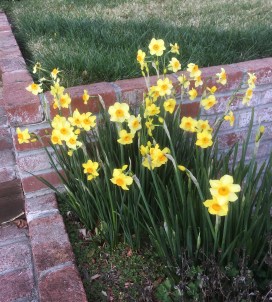
I spent an hour last night looking at pictures of my back yard just four years ago. It is pretty unbelievable what has “happened” since then, by which to say, what the rain and sun and tiny plants have done together, after humans arranged them to work in harmony. The next few photos are from fall of 2015:

The photo below is from February 2016, about two months after planting, through my rainy bedroom window. One of the dodoneas is already dying, and the replacement for the first, defective, fountain is already installed and running.

And this morning:

Oh, but all this new landscaping went in just a moment ago, compared to the events I will be remembering with friends this weekend: My K-8 elementary school is having a reunion, spanning ten years of graduating classes, and I am driving south to take part. Other than my siblings, I haven’t seen any of the people who will be there since high school or before. I don’t think we’ll be wanting to take pictures of our older selves in the “now” – we much prefer the “then” from our yearbooks, where we all look so cute! This one is me in First Grade.

Next, glimpses of my garden currently, and goddaughter Mary on her family’s trampoline, from last week when I got to spend a little time with them.

Work has ramped up on my remodel project. The latest delay has been over non-standard construction in the original house, which was revealed after removing sheetrock in advance of moving a closet wall. This photo shows the three main parties so far, including the contractor and the architect, who are calculating the necessary strength of extra beams they will install to bear the current load, in addition to the weight of the new rooms.

It made me happy to hear how conscientious they are about it. The architect said to me, as I listened in on their hour-long discussion yesterday, in between their tromping up and down the stairs from the garage to the great room above it, “You are learning about how not to build a house.” Everyone has been saying, “Once they get started, it shouldn’t take long.” I think we are at that point now, of having started. But until now, that point was theoretical.

I guess that’s about enough procrastination, and I must go pack a suitcase!
Those garden chores will have to wait till next week. 🙂

A song and a sermon of beans.

While some of us are still gathering in the harvest, I don’t think it’s too late to post about my garden beans. I have been working on a bean story since last summer, which I thought would be the end of my pole bean career, or at the least, the end of growing my favorite Blue Lakes in two-foot high vegetable boxes; I found myself swaying and tottering as I would stand in the boxes in order to pick them, trying not to stand on the basil plants, and it was unnerving.

So this year, I grew bush beans for the first time ever, but they were terribly disappointing. They had a very short peak of productivity, and instead of the fear of breaking my back falling out of the planting box, I knew the reality of slow backbreaking labor, bending over the jungle where the beans were even harder to find than when strung up on twine. I’m going back to pole beans, and will just have to figure something out to make picking safer.

More recently I harvested the Painted Lady perennial runner beans that I’ve told you about a few times. This year they produced so heavily from the five or six plants in the corners of my boxes, that I have enough to make a pot of soup, and I plan to create a recipe just for them.

In the time of harvest I found that Les Murray wrote a poem about beanstalks. In the title he mentions broad beans, which is one of the names I’ve heard for fava beans, which I also grew this year. However, his description of his beans does not match what I know of favas. It sounds more like regular green bean pole beans. So maybe in Australia they use different words. In any case, he highlights many aspects of this favorite garden vegetable in a joyful and celebratory way.

THE BROAD BEAN SERMON

Beanstalks, in any breeze, are a slack church parade
without belief, saying trespass against us in unison,
recruits in mint Air Force dacron, with unbuttoned leaves.

Upright with water like men, square in stem-section
they grow to great lengths, drink rain, keel over all ways,
kink down and grow up afresh, with proffered new greenstuff.

Above the cat-and-mouse floor of a thin bean forest
snails hang rapt in their food, ants hurry through several dimensions:
spiders tense and sag like little black flags in their cordage.

Going out to pick beans with the sun high as fence-tops, you find
plenty, and fetch them. An hour or a cloud later
you find shirtfulls more. At every hour of daylight

appear more that you missed: ripe, knobbly ones, fleshy-sided,
thin-straight, thin-crescent, frown-shaped, bird-shouldered, boat-keeled ones,
beans knuckled and single-bulged, minute green dolphins at suck,

beans upright like lecturing, outstretched like blessing fingers
in the incident light, and more still, oblique to your notice
that the noon glare or cloud-light or afternoon slants will uncover

till you ask yourself Could I have overlooked so many, or
do they form in an hour? unfolding into reality
like templates for subtly broad grins, like unique caught expressions,

like edible meanings, each sealed around with a string
and affixed to its moment, an unceasing colloquial assembly,
the portly, the stiff, and those lolling in pointed green slippers …

Wondering who’ll take the spare bagfulls, you grin with happiness
– it is your health – you vow to pick them all
even the last few, weeks off yet, misshapen as toes.

-Les Murray

Spanish Musica pole beans 2018

I take succour from pudding and poems.

Sunday there was a big bowl of dead-ripe bananas in the parish hall, for the taking. Maybe they had been left from our church’s monthly hosting of the overflow from the local rescue mission. The program started up again last week for the fall and winter.

I couldn’t resist bringing home a couple of bunches, which I put in the fridge while I hunted for a fast-friendly recipe to use them in. Since then I have very much appreciated the pudding I made, eaten as warm as possible as I try to shake the chill that has descended on me and my house.

Do I never weary of writing about my shivering? Evidently not. My flesh and bones are crying out, “Do something!” And I occasionally respond in new ways… but I suppose it is typically a variation on a story of sun and food.

On my outing to the library I was able to shed my wool sweater. I was picking up a collection of poems by Les Murray, whose name has popped up here and there for months now; I see that he died just this year. When I eventually checked, what do you know, I didn’t have to search farther than my neighborhood branch to find New Selected Poems. It was lunchtime when I got home, so I took a little bowl of Vietnamese Banana Tapioca Pudding and some other snacks out front to eat on the bench. And I sat longer, to be warm, and perused my book.

In the garden the sun is shining, and I can even get hot in my flannel shirt. But indoors this morning I had carried my breakfast on a tray up the stairs to one of the temporary storage rooms (a.k.a. bedrooms), the eastern one where I could sit with the sun on my back. I have been reluctant to turn on the furnace, because of all the empty spaces in the walls and ceiling of the room that is still not out of its demolition phase. I didn’t want to try “heating the great outdoors,” as my father used to put it.

In my library book a surprising number of poems got my attention by their accessibility and themes, and then made me happy by the evocative images and philosophical musings that are so satisfying. Which to share first? By now you will know why I chose this one to end today’s story:

SUCCOUR

Refugees, derelicts – but why classify
people in the wreck of their terms?
These wear mixed and accidental clothing
and are seated at long tables in rows.

It’s like a school, and the lesson
has moved now from papers to round
volumes of steaming food
which they seem to treat like knowledge,

re-learning it slowly, copying it
into themselves with hesitant spoons.

~Les Murray

It’s a mistake to rush through this cake.

My friend Timothy told me yesterday that the only people he knows who can truly multi-task are mothers of young children. It’s true, when you are a mother, you often are solving their problems, teaching them, or nurturing their souls more generally even while sweeping the floor or cooking, etc.

But if like me you are often alone and can fully focus on one thing at a time, that is best. One of my favorite quotes on this subject has long been from St. Seraphim of Sarov: “Whatever you do, do it gently and unhurriedly, because virtue is not a pear to be eaten in one bite.” And this morning I read on Lisa’s blog this good word from Fr. Jacques Philippe:

“To live today well we also should remember that God only asks for one thing at a time, never two. It doesn’t matter whether the job we have in hand is sweeping the kitchen floor or giving a speech to forty thousand people. We must put our hearts into it, simply and calmly, and not try to solve more than one problem at a time. Even when what we’re doing is genuinely trifling, it’s a mistake to rush through it as though we felt we were wasting our time. If something, no matter how ordinary, needs to be done and is part of our lives, it’s worth doing for its own sake, and worth putting our hearts into.”

When I read that, I had just finished eating a piece of the most delectable cake — while reading at the computer. Everyone knows that is a bad thing for an overeater to do! But the other unfortunate thing is, I missed the full experience of this cake, which I don’t exactly want to put my heart into, but which I do want to receive “gently and unhurriedly,” in a way that promotes the greatest thankfulness and encourages virtue.

I’d been wanting to try this cake to make use of my fig harvest; I think of it as an autumn cake because it is now that the figs really come in. The recipe is from Martha Stewart, but I combined the figs with dried apricots instead of fresh plums, because I had just bought the wonderfully rich Blenheim apricots from Trader Joe’s, and did not have plums on hand. The apricots were both more flavorful and colorful than plums would have been. Also I cut down on the sugar.

I don’t think I’ve ever had a more buttery cake, but the flavor of butter was even lovelier — is that possible? — by being in combination with the almonds and fruit. As it turns out, the fruit and nuts and eggs are all products of California farms or gardens, and perhaps the butter as well? So mine is a California Cake, but yours might be otherwise.

You start with a cookie-like crust that gets pre-baked, an eggy almond-flour paste spread on top, then the fruit over all, before it goes in the oven again for a long time. I added a little water to the fruit to make up for the apricots being dried. I definitely had to give the whole process my full attention.

AUTUMN FIG CAKE

Trying to warm the butter a bit.

2 sticks unsalted butter, cool room temperature, cut into pieces, plus more for pan
1 pound fresh figs, halved or quartered
6 oz dried apricots, preferably Blenheim variety, sliced
1/4 cup water
1 1/4 cups unbleached all-purpose flour, divided
Almost 1 cup sugar, divided
1 teaspoon salt, divided
1/4 teaspoon baking powder
1 cup finely ground almond flour
2 large eggs, room temperature
1/4 teaspoon pure almond extract

Preheat oven to 350 degrees. Butter a 9-inch square cake pan; line with 2 wide pieces of parchment, leaving a 2-inch overhang on all sides. Butter parchment. Toss fruit with 1/3 cup sugar, and 1/4 teaspoon salt. If you are using dried fruit add the 1/4 cup water; set aside and stir occasionally.

In a food processor, pulse 1 cup all-purpose flour, 1/4 cup sugar, and 1/4 teaspoon salt to combine. Add half of butter and pulse until fine crumbs form. Transfer to prepared cake pan and use floured fingers to press dough evenly into bottom of pan. (If too soft to easily press in, refrigerate 10 minutes.)

Bake until crust is light golden in color, about 20 minutes; transfer to a wire rack and let cool 15 minutes.

In food processor, pulse remaining half of butter, 1/2 cup sugar, and 1/2 teaspoon salt with baking powder until combined. Add almond flour, remaining 1/4 cup all-purpose flour, eggs, and almond extract; process until smooth.

Spread batter evenly over crust. Gently stir fruit to reincorporate sugar mixture and arrange on top of batter (cut-side up). Bake until fruit is bubbling and filling is firm, about 1 hour and 5 minutes (Mine took 10 minutes longer). Let cool in pan 15 minutes, then use parchment overhang to lift cake out of pan and transfer to a wire rack. Let cool 1 hour and serve. Cake can be stored in an airtight container up to 2 days.

Wouldn’t the base of this cake be good with just about any fruit topping? I think it would.

Whatever you make of it, when you do partake,
I hope you can do it with attentive thanksgiving. 🙂