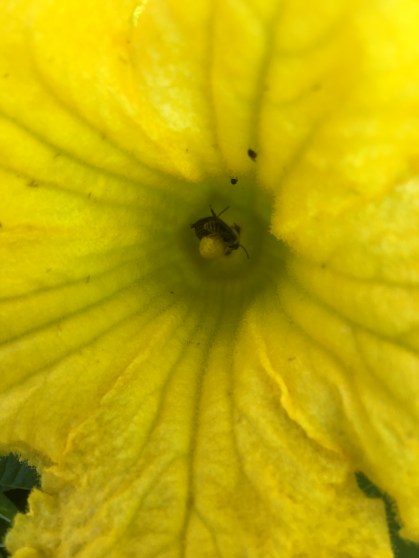
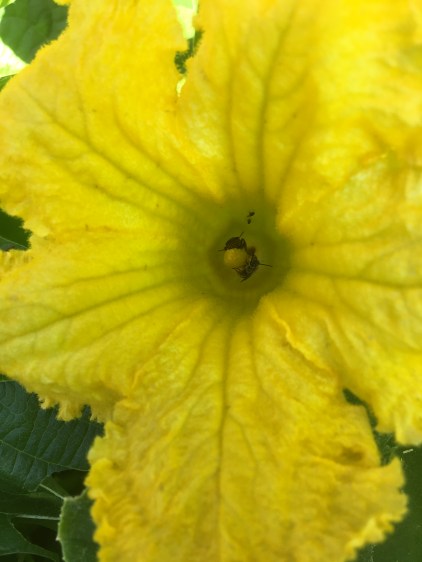
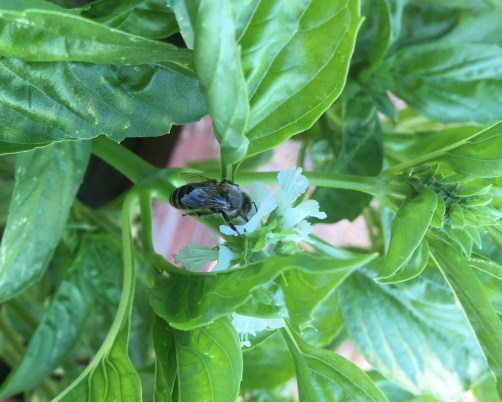
It felt very coastal this morning with high fog and chill breeze. Along the front walk where I have allowed a volunteer sunflower to grow in the middle of the germander, one flower was close enough for me to notice the cluster of bees.

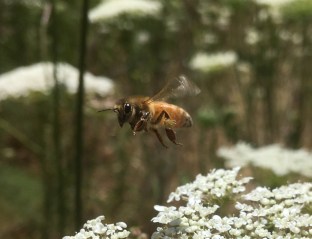
How did they happen to all bed down for the night on that one flower? Were they even alive? A half-hour later on my way to the car to drive to church I stopped by again; one or two had left, and the others had shifted position, but were quite motionless. About noon, not one remained. [Update: the next morning they were back, and after watching them off and on for an hour, I think they are not bees, but hoverflies. I’ve mistaken them for bees before.] [UPDATE No. 2: I was right the first time. They are bees. They fold their wings over each other, but flies leave theirs splayed out. I think I’ve learned this more than once, on a site such as Beekeeping Like a Girl. And other differences…]

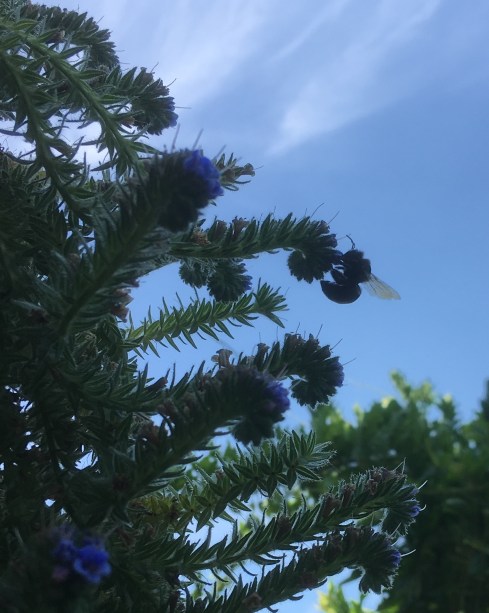
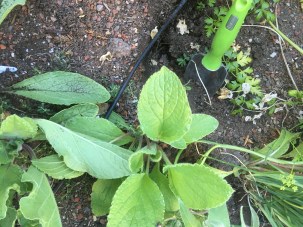 Today was the day we celebrated St. Joanna, and it was also the meeting of our parish women’s book group — in my garden! The weather was as perfect as could be for that. Our group of six included several gardeners who didn’t sit down until we’d discussed borage and the borage flowers hanging into the pathway. The bees draw your attention to them! I quickly dug up a few of the many little borage volunteers for a couple of women to take home later.
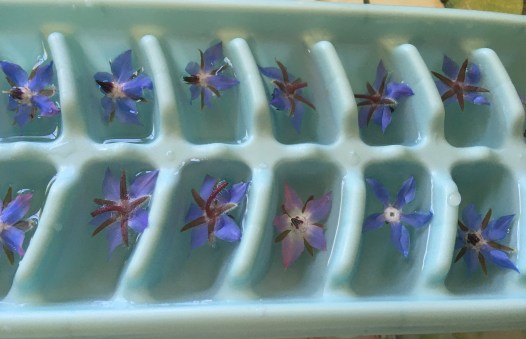
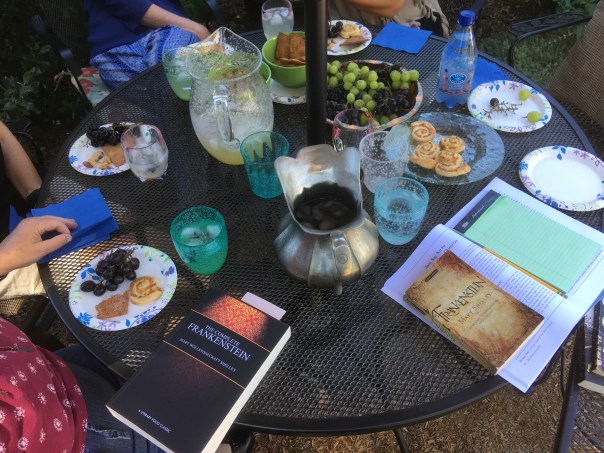
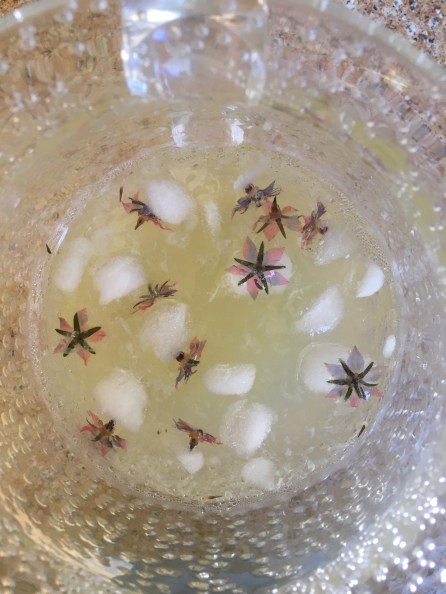
It just so happened I had made two trays of borage ice cubes and it was time for me to add them to the lemonade so we could start talking about Frankenstein.
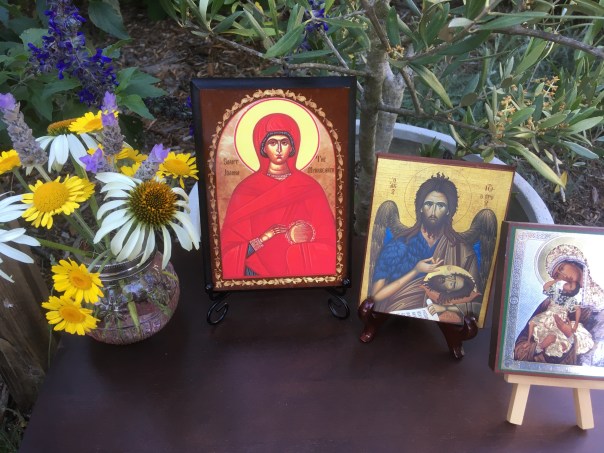
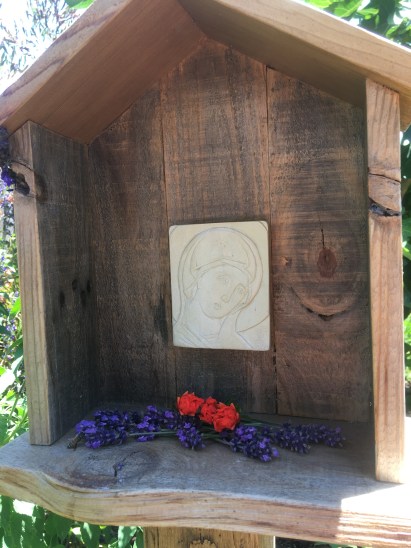
The table where we sat is near my garden icon stand with the stone icon of Christ’s mother; for the day’s commemoration I nestled a TV tray under the olive tree to hold a few more icons. You can read here why I included St. John the Baptist among them.
Early in our talk about Frankenstein I showed the group this adaptation of the novel that had been given to me, and it got passed around the table so that everyone could take a look at the illustrations.

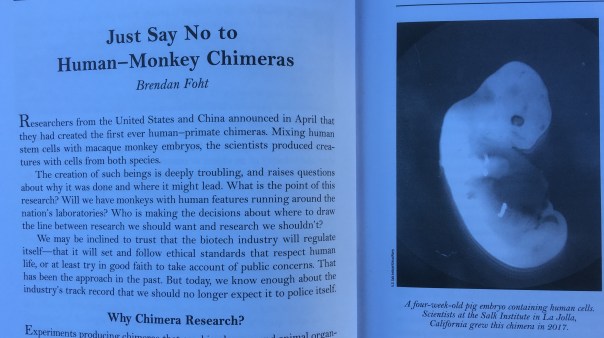
We had a lively discussion about elements of the story, and also concerning ethical questions about the uses of science that are still pertinent in our day. I read only a few lines to the group from this article in the current issue of The New Atlantis about recent questionable experiments.
Various of the readers in our group knew more than I about the historical and philosophical context in which Frankenstein was written, which made it a pleasure to be with them and muse about much more than what had impressed me personally. I think we all were glad to have read the book, especially those who before had only known the movies, but no one exactly loved it.
It didn’t have a satisfying ending, in that, as our moderator said, she had hoped for redemption and there was none. We all agreed it was too long and repetitive. Several women said they definitely wanted to read something “lighter” next time. What constitutes a light novel? Here are the (not necessarily light) possibilities we had brought with us. As we went around the table making our suggestions, it seemed to me that the enthusiasm mounted with each one.
- A Long Walk with Mary by Brandi Schreiber
- My Cousin Rachel by Daphne De Maurier
- The Giver by Lois Lowry
- Shades of Milk and Honey
- The Guernsey Literary and Potato Peel Pie Society
- The Scent of Water by Elizabeth Goudge
 My Cousin Rachel and The Giver were deemed too heavy. Milk and Honey didn’t engender any discussion, and I was personally torn between Potato Peel Society and Scent. Several had already read Potato Peel so they were leaning toward Scent; I was the only one who had read it, and I told them what I loved about Goudge’s books generally. A Long Walk with Mary seemed like a good one to read during our Orthodox Dormition Fast.
So, we voted in a very informal way, and decided that in six weeks we will meet again and discuss two books: The Scent of Water and A Long Walk with Mary.
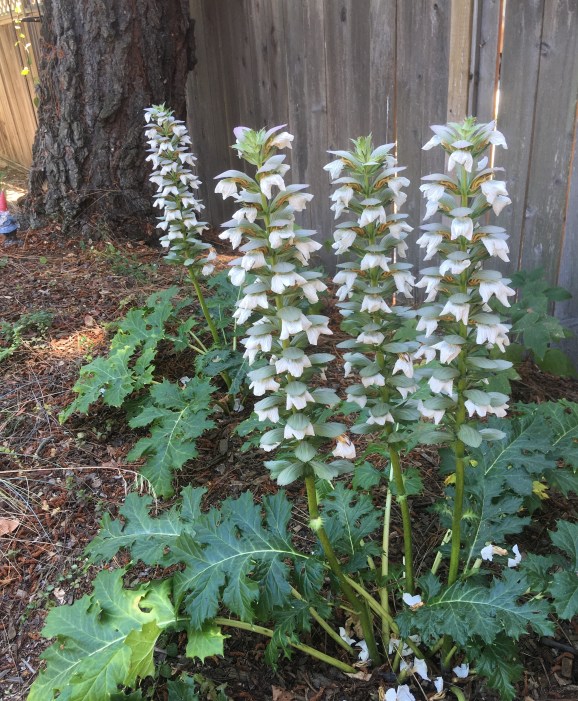
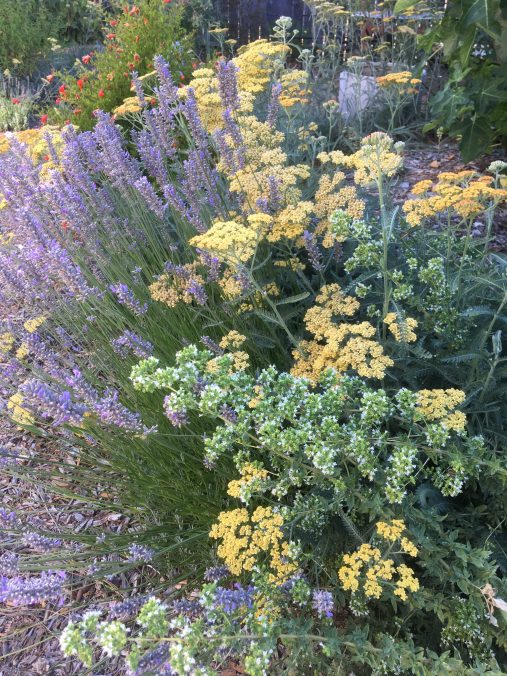
Before everyone went home, we toured the other side of my garden, and I told them about acanthus and why I used to not like it, but now I do. The acanthus is more beautiful than ever, its spires taller, and in their prime right now. My 24 lavender bushes are at the height of bloom, too. We got to hear from our sheep farmer lady how she made lavender simple syrup to use in cool summer drinks.
How sweet it was to have these friends to be with me for my name day. After they were gone, there was still lemonade left in the pitcher, and floating among the melting ice cubes, the lemon-bleached borage blossoms.

 ,”
,”
 When I got home from church this afternoon I baked a cheese tart from Trader Joe’s and ate it outdoors, and as the sun did not go behind a cloud, I read the Heritage Farm Companion and did some Spanish lessons. The Companion is a little magazine for members of the
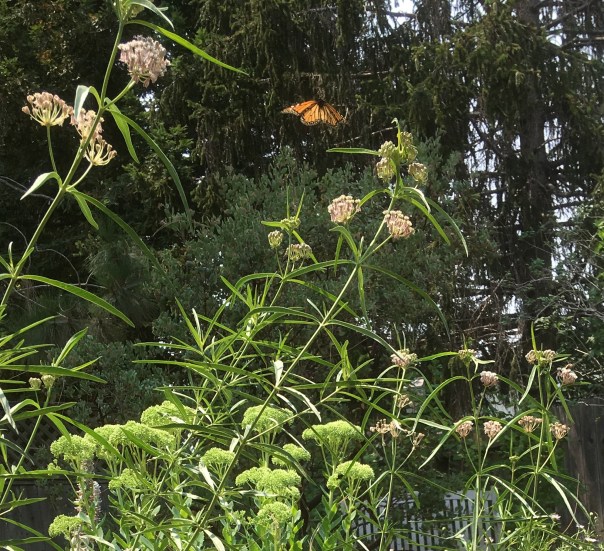
  that situation as benign, whereas the aphids are a plague. Maybe there is a connection?
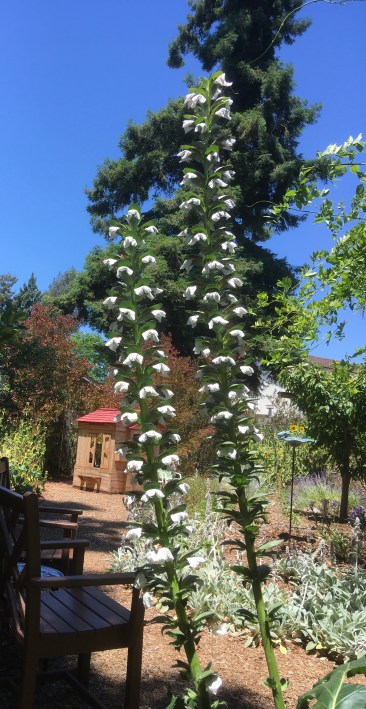
 Several times in the last week I’ve been able to sit in the warm garden, usually in the early afternoon. The morning is often overcast and around 55°; dinner times a cool marine breeze often drives us indoors. Today after I finished my tart I glanced behind me and saw that the toadflax is finally in full bloom. It looks pretty weedy most of the year, and even now 🙂 but the flowers are so cheery… I’d say it never looks better than today.
 their favorite flower around here. Come to think of it, there are blooming lamb’s ears right next to the aphid-infested milkweed… ? …but the hoverflies are mostly in the front yard… ? I need to think about this some more.

 A year or so ago I decided to study Spanish. In much of California it’s kind of crazy not to know Spanish, but I chose French in high school, and several other languages since then. I’ve had close friends who were Spanish majors, and four of my children studied Spanish for two or more years. When I started doing 5-minute lessons on my phone using the Duolingo app I discovered that I already knew quite a lot. It’s been more like play than work, because there are no humans to see my work, no shame in goofing up. I get points for doing the lessons no matter how many times I get something wrong. For six months I managed to do at least one five-minute lesson per day.
 When I was at Kate’s for three weeks I didn’t have any gardening or housework or church work to do, and I was able to do so many Spanish lessons one day that my brain grew weary. It occurred to me that there would be no harm in checking out the French course, to brush up on my French; in my youth I studied it first and the longest, so it’s probably stuck deep in the recesses of my mind… While mom and babies were napping, I did quite a few French lessons, and they were even more fun than Spanish. On Duolingo the first lessons of a language are short so you whip right through them — especially if they are ones you did when you were 13!
 So the next day what did I do? Turkish! I’ve had very little Turkish instruction, but I did spend six months total in that country, living with Turks, and it has been pure delight to do Turkish lessons. You may ask, what about my work, now that I am home again? It is mostly not stuff that anyone else cares if I do or not. And I’m still in a kind of limbo about my remodeling project, which makes it hard for me to know just what thing is the Next Thing. So I behave as though the maid is going to show up soon, and I am a woman of leisure with nothing more important to do than to read about seeds and learn a useless language.

 cosmos, being in becoming, is a mystery (mysterion) for the human mind, a genesis produced by the Word of God. As such, the world is a revelation of God (Rom. 1:19-20). Thus, when its intelligent inhabitants see it as cosmos, they come to learn about the Divine wisdom and the Divine energies. The cosmos is a coherent whole, a created synthesis, because all its elements are united and interrelated in time and space.” (From






 Gladsome Lights