This is a post about bees. If you find them icky or boring and don’t care which bee is a robber, I understand! I put a pretty flower at the bottom for you to look at before you leave.
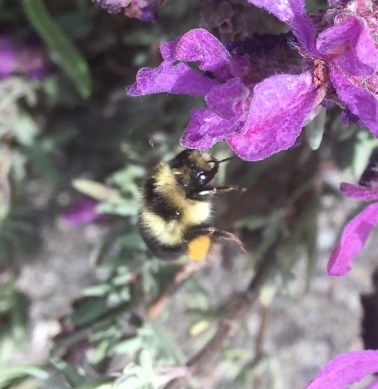
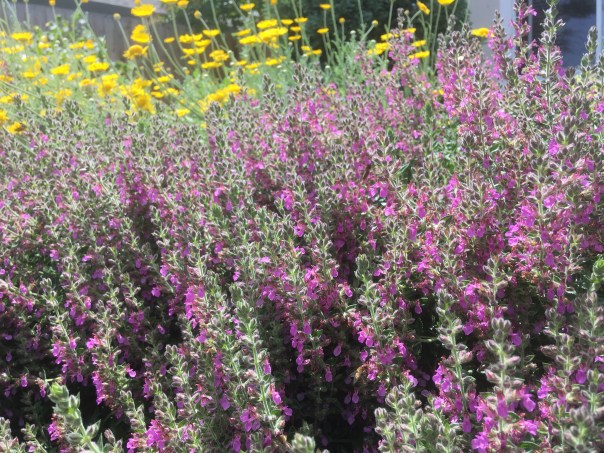
One morning this week I went back and forth along the front walk, for fifteen minutes or so, stooping over the germander hedges to watch a bumblebee. It caught my eye because of its yellow markings that were not what I’m used to seeing, and also because of its nectar-gathering style.
Was it because of its size and weight, that it couldn’t manage the flowers near the tops of the germander stems? It seemed to get lost in the understory of that purple forest, but would eventually resurface, tempting me to try again and again with my camera to fix his image (I can’t help switching male pronouns so I will just give in to my inclinations and be unscientific, because of course I have no idea of “his” sex.) so as to be able to see his markings better.
Here are the best pictures I got. Bees are buzzy and usually vibrating!
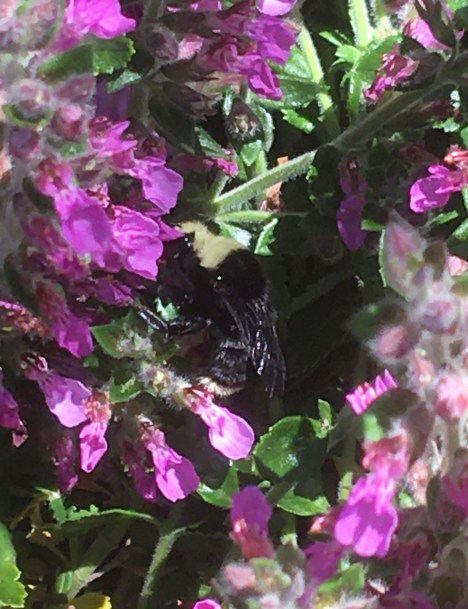
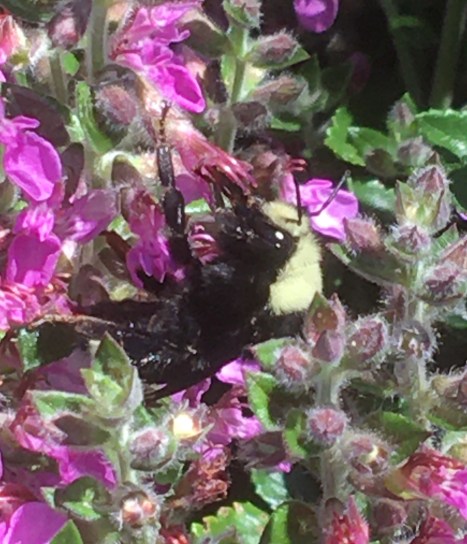

My Yellow-Faced Bumblebee is funny-looking! In that middle picture sprawled on his back like a suckling child, his yellow face is more like a yellow toupee. Here is a clearer, more classic image of the bee:

It is from the page Bumblebees of California, which is where I realized that what I thought for years was the primary bumblebee enjoying my pollinator garden is not a bumblebee at all.
It wasn’t until that same evening that I was set straight. As the sun was about to go down, I was snipping spent penstemon blooms in the back garden when I saw one of these “bumblebees” visiting the non-spent ones. He was not trying to go in at the door, so to speak, but was busy at the top. Did he have a short cut to the nectar? Was he making a short cut?

Back inside, when it began to dawn on me that he was not a bumblebee, I searched for “black bees that look like bumblebees,” and soon realized that he is a carpenter bee. And on the first site I found they described what I had seen a few minutes before: “On flowers such as salvias, penstemons, and other long, tubular flowers the carpenter bee, due to its large size, is unable to enter the flower opening. Instead they become nectar robbers. Using their mouthparts they cut a slit at the base of corolla and steal away with the nectar without having pollinated the flower.”
I learned that there are 500 species of carpenter bees! Most of them are all black and hard to tell one from another. The easiest way to tell them apart from bumblebees is by their abdomens: The bumblebees’ abdomens are covered with dense hair, while the carpenters’ are shiny. This last fact I was well aware of, because it has been the biggest hindrance to me getting a picture of these bees that usually show up as shiny black blobs. But now that I have identified two bees in one day, and have blurry pictures to refer to when I forget, I will relax and move on.
But — early this morning I went out looking for Yellow Face. I didn’t see him, but I did see the carpenter bees, and what were they doing? Stealing nectar from the tubular white salvia flowers!

I wasn’t shocked, but pleased. And I don’t see why this should be called “stealing.” Is there a law of nature that says a bee has a right to nectar only if he pollinates the flower at the same time? Have the tubular flowers filed a complaint about the theft?
Last year I was trying to identify a strange-looking wasp, and I browsed entomology sites to no avail. Entomologists can’t even keep the thousands of species straight, and we common people who deal with insects our whole lives have strong and conflicting beliefs about their names and identities. I realized back then that wasps were a low priority for me; I’m sorry to say that I even hate some of them. But I feel otherwise about bees. Here is a photo from the U.S. Forest Service showing the smallest bee with the largest bee:
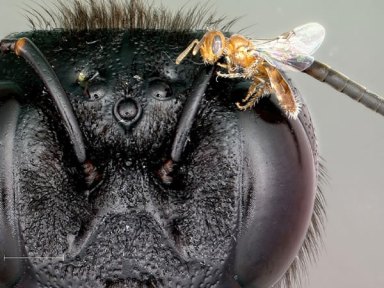
It is the Perdita minima on the head of a female carpenter bee. Wasps and bees, along with ants, are among the members of the Order Hymenoptera, but wasps are not bees any more than ants are bees. The first very readable paragraphs on this site I found helpful in refreshing my own memory on these creatures: Bees, Wasps, and Ants.
The tribe to which the 250 species of bumblebees belong is called Bombini. Isn’t that cute?
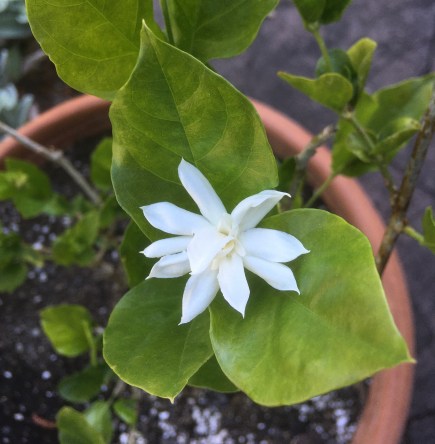
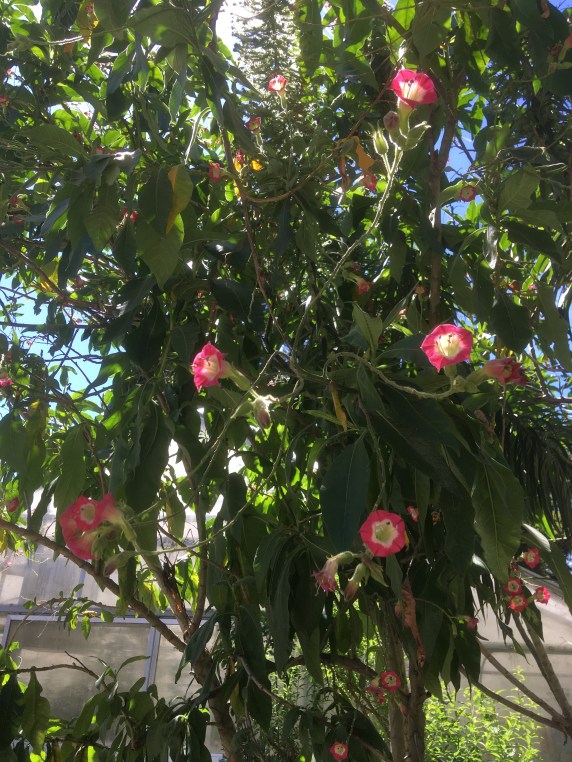
Okay, enough entomology for today. Here is that flower I promised you. It is my Belle of India jasmine that Soldier and Joy gave me for Christmas one year. It’s taken me a while to figure out how to make it happy, but now it is healthy and blooming and so sweet! I wonder if any Bombini will come by for a taste?
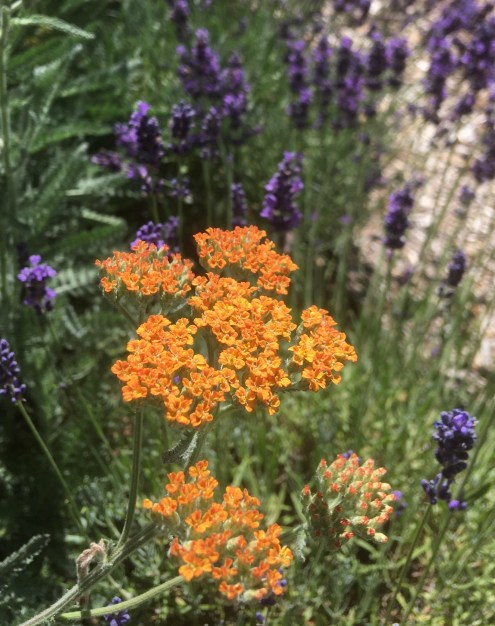
 Way back in October, I think, was the last time a certain one of my favorite plant nurseries was open — until Saturday, when I drove over for the reopening. The retail aspect is a small part of a larger sustainable agriculture/ecological/educational project, and is only open on weekends in the warmer months. Over the years I’ve bought lots of annual vegetables there, but lately they focus on perennial edibles and and medicinal plants.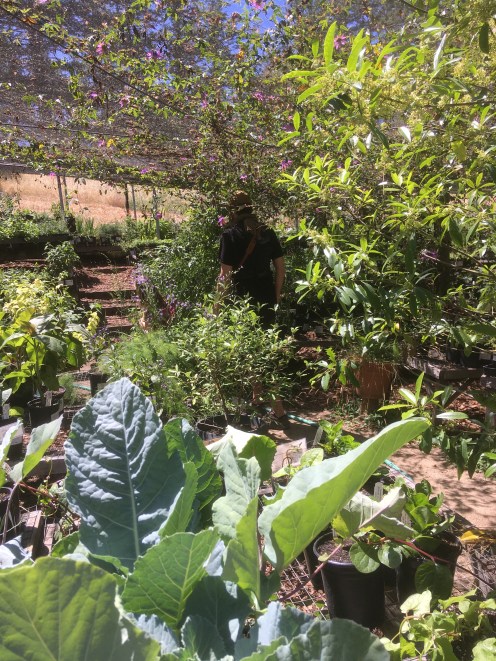







 What sets this autumn apart from any other is my distaste for leaves turning color. Out of the corner of my eye I’ve seen it happening, and my heart protests, “Oh, please don’t!” I look the other way. Time has been swallowed up in remodeling, or waiting for remodeling, and the steady progress of months and seasons was not in my face so colorfully until now, telling me that without a doubt the end of the calendar year is drawing near as well.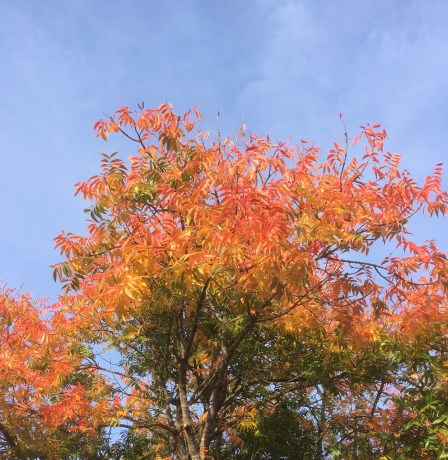
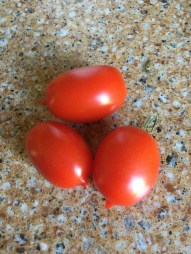 peat the horrors of the fires of the last two years. Too bad we can’t put all that behind us — but “it” is trying to be part of our future as well, a reality of which the power company keeps reminding us, and shutting off the power as a precaution.


 When I got home from church this afternoon I baked a cheese tart from Trader Joe’s and ate it outdoors, and as the sun did not go behind a cloud, I read the Heritage Farm Companion and did some Spanish lessons. The Companion is a little magazine for members of the
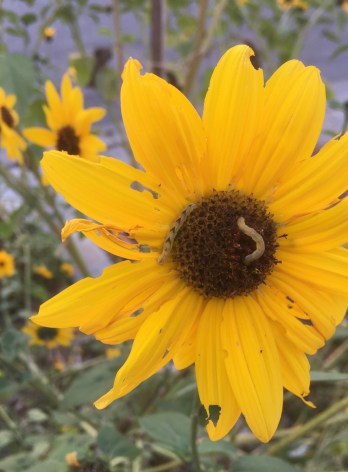
  that situation as benign, whereas the aphids are a plague. Maybe there is a connection?
 Several times in the last week I’ve been able to sit in the warm garden, usually in the early afternoon. The morning is often overcast and around 55°; dinner times a cool marine breeze often drives us indoors. Today after I finished my tart I glanced behind me and saw that the toadflax is finally in full bloom. It looks pretty weedy most of the year, and even now 🙂 but the flowers are so cheery… I’d say it never looks better than today.
 their favorite flower around here. Come to think of it, there are blooming lamb’s ears right next to the aphid-infested milkweed… ? …but the hoverflies are mostly in the front yard… ? I need to think about this some more.

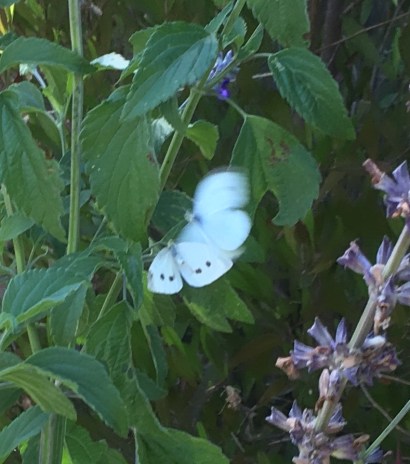
 A year or so ago I decided to study Spanish. In much of California it’s kind of crazy not to know Spanish, but I chose French in high school, and several other languages since then. I’ve had close friends who were Spanish majors, and four of my children studied Spanish for two or more years. When I started doing 5-minute lessons on my phone using the Duolingo app I discovered that I already knew quite a lot. It’s been more like play than work, because there are no humans to see my work, no shame in goofing up. I get points for doing the lessons no matter how many times I get something wrong. For six months I managed to do at least one five-minute lesson per day.
 When I was at Kate’s for three weeks I didn’t have any gardening or housework or church work to do, and I was able to do so many Spanish lessons one day that my brain grew weary. It occurred to me that there would be no harm in checking out the French course, to brush up on my French; in my youth I studied it first and the longest, so it’s probably stuck deep in the recesses of my mind… While mom and babies were napping, I did quite a few French lessons, and they were even more fun than Spanish. On Duolingo the first lessons of a language are short so you whip right through them — especially if they are ones you did when you were 13!
 So the next day what did I do? Turkish! I’ve had very little Turkish instruction, but I did spend six months total in that country, living with Turks, and it has been pure delight to do Turkish lessons. You may ask, what about my work, now that I am home again? It is mostly not stuff that anyone else cares if I do or not. And I’m still in a kind of limbo about my remodeling project, which makes it hard for me to know just what thing is the Next Thing. So I behave as though the maid is going to show up soon, and I am a woman of leisure with nothing more important to do than to read about seeds and learn a useless language.
 Gladsome Lights