Category Archives: quotes

Christ Who is offered, and to Christ the offering.

On Holy Thursday one of the events the Orthodox Church commemorates is the institution of the Sacrament of the Holy Eucharist at Christ’s last meal with His disciples; on this occasion I thought to share a post from Abbot Tryphon on the topic of this mystical sacrifice:

The Orthodox Church believes the Eucharist to be a sacrifice, in which Christ himself performs the act of offering, and is both priest and victim. This sacrifice is offered to God the Trinity, and not just to the Father, but also to the Holy Spirit and to Christ Himself. It is Christ Who is offered, and to Christ the offering.

Our Orthodox theology also teaches that the Eucharist is a propitiatory sacrifice, offered on behalf of both the living and the dead, and is not a mere figure or symbol but a true sacrifice. It is not the bread that is sacrificed, but the very Body of Christ. And, the Lamb of God was sacrificed only once, for all time. This sacrifice at the Eucharist consists, not in the real and bloody immolation of the Lamb, but in the transformation of the bread into the sacrificed Lamb.

All the events of Christ’s sacrifice, the Incarnation, the Last Supper, the Crucifixion, the Resurrection, and the Ascension are not repeated in the Eucharist, but they are made present. The Eucharist is both symbolic and mystical, and is understood to be the genuine Body and Blood of Christ, precisely because the bread and wine are the mysteries and symbols of God’s true and genuine presence and His manifestation to us in Christ. It is a mystery precisely because the Eucharist defies analysis and explanation in purely rational and logical terms. For the Eucharist, as Christ himself, is a mystery of the Kingdom of Heaven which, as Jesus has told us, is “not of this world.” The Eucharist, because it belongs to God’s Kingdom, is truly free from the earth-born “logic” of fallen humanity.

Saint John of Damascus tells us, “If you enquire how this happens, it is enough for you to learn that it is through the Holy Spirit … we know nothing more than this, that the Word of God is true, active, and omnipotent, but in its manner of operation unsearchable”.

With love in Christ,
Abbot Tryphon

From Abbot Tryphon’s blog

We enter the today of Holy Week.

In the past I have written a little about the atmosphere of Holy Week in the Orthodox Church. I have only been breathing it by means of a few, perhaps shallow, breaths, over the years. I feel that way because of the distractions that I haven’t been able to avoid, or the weaknesses of my flesh and will, which prevent me from staying close to the Lord through this last week before Pascha. I suppose I am like His disciples that way.

Icon for Holy Tuesday, of The Parable of the Wise and Foolish Virgins

With all that, I have been affected, and every year finds me looking forward to the riches that we live in, this week that does indeed carry the scent of holiness. The days with their minutes and hours are not in themselves vessels for the treasures, but it is in the services of the Church and their rich liturgical hymnography and prayers that we receive the gift.

Even after years of knowing better, I still occasionally notice the thought trying to push itself forward: “Why would I want to go to another church service? Won’t I be bored, since it is basically the same as the last one, and it is so long?” I have to laugh, because of the ways that the idea is so silly. Do you ever get tired of your spouse or your child saying, “I love you?” It takes a while in church to settle oneself enough to really hear God speaking, and then, He says “I love you” with so many hymns and songs and words of Scripture, not to mention bread and water, wine and oil, candlelight and incense….

I suppose you could say that the message is always the same, but no two services are ever exactly the same. The message, essentially being the Giver of Life Himself, is never tiresome; in this life we barely begin to experience His Life.

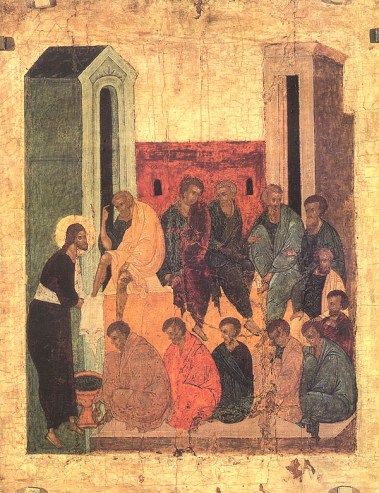
Holy Wednesday – Washing the Disciples’ Feet

I am writing this a few days before, so as to keep my calendar as free as I can. I wanted to pass on this meditation that I saved from when I read it last year – I hope it is a grace-filled breath of fresh air to you.

HOLY WEEK: A MYSTIC TORRENT

As we enter Holy Week, the festal atmosphere of Lazarus Saturday and Palm Sunday yields to the solemnity, sobriety and sadness of Holy Week as the Lord moves toward His voluntary and life-giving Passion.  The Son of God came into the world “to bear witness to the truth” and “to give His life as a ransom for many.” It is our privilege and responsibility to accompany Christ to Golgotha to the extent that our lives make that possible, especially by our participation in the services that guide us to Golgotha and beyond—to the empty tomb. 

As Father Sergius Bulgakov wrote, “The beauty, the richness and the power of these services take possession of the soul and sweep it along as upon a mystic torrent.” Therefore, during Holy Week we are challenged to “lay aside all earthly cares” and focus on our Lord Jesus Christ, whether we are at a particular service or not. This is a week filled with school, church and other necessary responsibilities.  There is no room or time for worldly entertainment -— not when the Lamb of God will be slain for the sins of the world.

Holy Friday

At the services of Holy Week, we enter into the “today” of the events being reactualized so that the event and all of its salvific power is made present to the gathered community. Thus, we are not simply commemorating a past event for its dramatic impact, or presenting something of an Orthodox “passion play.”  Rather, we re-present the event of the Crucifixion so that we participate in it within the liturgical time of the Church’s worship. 

As Bishop Hilarion Alfeyev writes, “Each one of us receives Christ as our personal Savior, and so we each make our own all the events of Christ’s life through personal experience, to whatever extent we can. The feast day is a realization here and now of an event that occurred once in time but is always happening outside time.” And he adds, speaking of the great saints and their faith in the Resurrection of Christ, “They lived… by their experience of eternity and knew that Easter was not a single day of the year, but an eternal reality in which they participated daily.”

-Fr. Steven Kostoff

It is because He wept.

LAZARUS SATURDAY

“It stinketh,” say the Jews trying to prevent Jesus from approaching the corpse, and this awful warning applies to the whole world, to all life. God is Life and the Giver of Life. He called man into the Divine reality of Life and behold “it stinketh”…The world was created to reflect and proclaim the glory of God and “it stinketh.”

At the grave of Lazarus God encounters Death, the reality of anti-life, of destruction and despair. He meets His Enemy, who has taken away from Him His World and become its prince. And we who follow Jesus, as He approaches the grave, enter with Him into that hour of His, which He announced so often as the climax and the fulfillment of his whole work. The Cross, its necessity and universal meaning are announced in the shortest verse of the Gospel: “and Jesus wept” …We understand now that it is because He wept, i.e., loved His friend Lazarus, that Jesus had the power of calling him back to life.

The power of Resurrection is not a Divine “power in itself,” but power of love, or rather love as power. God is Love and Love is Life, Love creates Life…It is Love that weeps at the grave and it is Love that restores life. This is the meaning of the Divine tears of Jesus. In them love is at work again—recreating, redeeming, restoring the darkened life of man: “Lazarus, come forth!…” And this is why Lazarus Saturday is the beginning of both: the Cross, as the Supreme sacrifice of love, the Resurrection, as the ultimate triumph of love.

-Fr. Alexander Schmemann

Icon from Sinai, 12th century

I float on a sea with bangles.

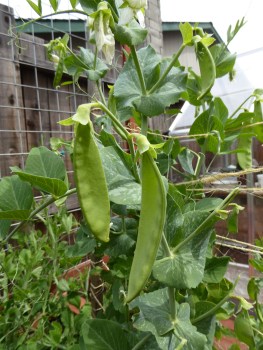
snow peas

Poetry is sane because it floats easily in an infinite sea; reason seeks to cross the infinite sea, and so make it finite. The result is mental exhaustion. To accept everything is an exercise, to understand everything a strain. (This and all quotes in green below are from G.K. Chesterton.)

I had another title for this blog post, something about pollinators, but when I saw the preponderance of green in the images, it made me think of Tuesday’s poem, which could be talking about my own garden that is wild with leaves and flowers popping out at a mad rate. All the glory does make it hard for me to hold a thought, and there are many I should not let go of — starting with all the outdoor tasks that won’t wait: feeding and weeding and trimming and tying….

But going back to the poem, I’ve been thinking about how it describes the way the most common natural occurrences — after all, “the world comes back” in spring year after year — can confuse and even shock us if we really pay attention. In my yard it seems that between the time I walk from the front garden to the back and return again, a new weed has sprouted or an iris has emerged.

Why have I arrived on the path by the salvia? I don’t even take time to ponder, but I immediately start pulling weeds. Then I return to the fountain and see a honeybee on a flower, and must go into the house for my camera and “waste” a few minutes attempting to record one of the thousands of thrilling things happening here, right outside my door.

There is a road from the eye to heart that does not go through the intellect.

This road leads to the heart from other sensory “gates” as well. My garden seems primarily visual, but also the rich scents of osmanthus and daphne and lavender have their own direct routes to my heart, as do the bird songs. I don’t have to think about them or know their meaning. In the poem about the “Deciduous Spring,” sounds of words are used to mimic the visual symphony or cacophony that all this burgeoning creates.

The poet only asks to get his head into the heavens.
It is the logician who seeks to get the heavens into his head. And it is his head that splits.

This week I will be adding more plants to the mix, and several of them will be of the sort that the hummingbirds and bees and other insects like. Last fall I planted five types of seeds that did not sprout: poppies, milkweed, prairie echinacea… So — I found a native plant nursery where I was able to buy two species of milkweed plants, orange Moroccan poppies, and penstemon. Visions of Monarch butterflies fill my head.

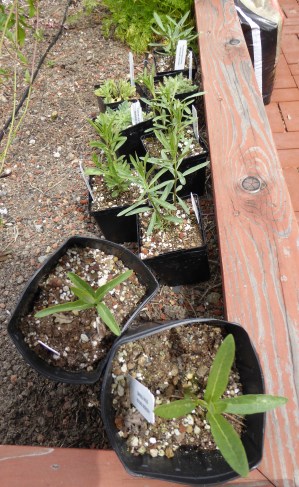
In the picture below of the waiting plants, the milkweed is mostly in the foreground, two types that are native to the western U.S.: Asclepias fascicularis and Asclepias speciosa

The perplexity of life arises from there being too many interesting things in it
for us to be interested properly in any of them.

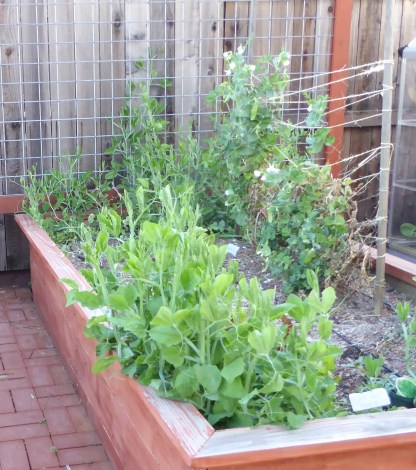
Three varieties of peas, mostly flowers soon to bloom.

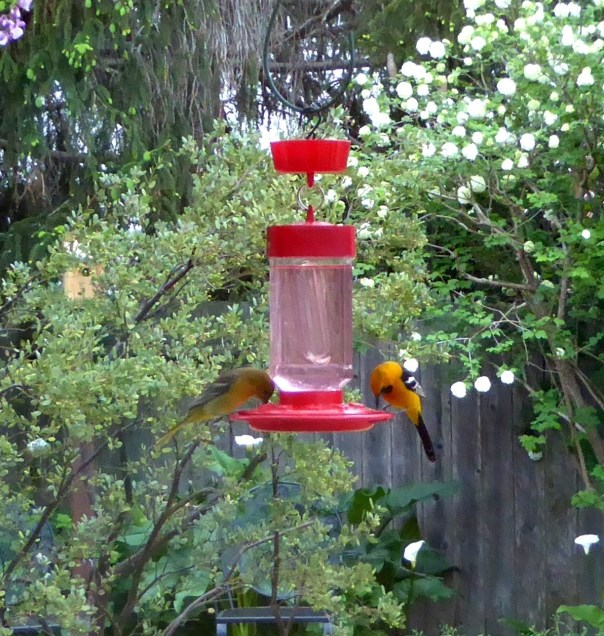
To mention a pair of not-green things: The orioles are back! Not in the group that I am trying to attract with certain flowering plants, their preference is sugar water.

They are very shy, so I’m not going to try to take new pictures of them. This one is from my great photographic effort last spring.

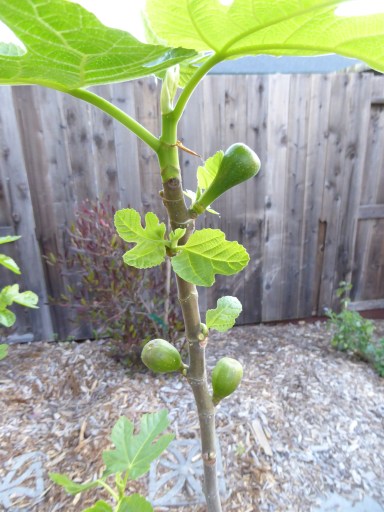
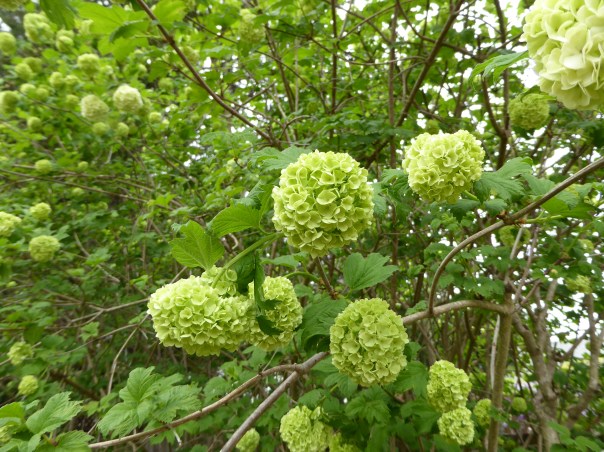
The snowballs on the viburnum are little green things so far. Green fruits are on the fig tree. I ran into a Painted Lady butterfly over there, and bumblebees, but their interest was the lithodora blossoms.

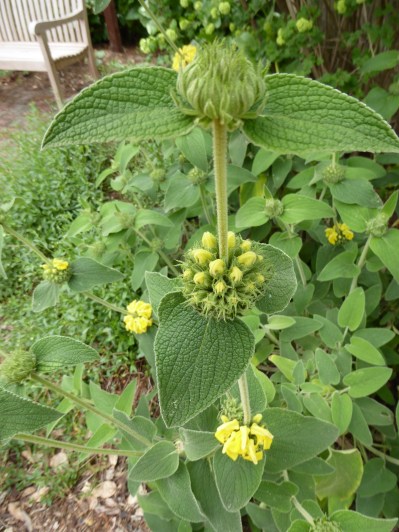
Jerusalem sage

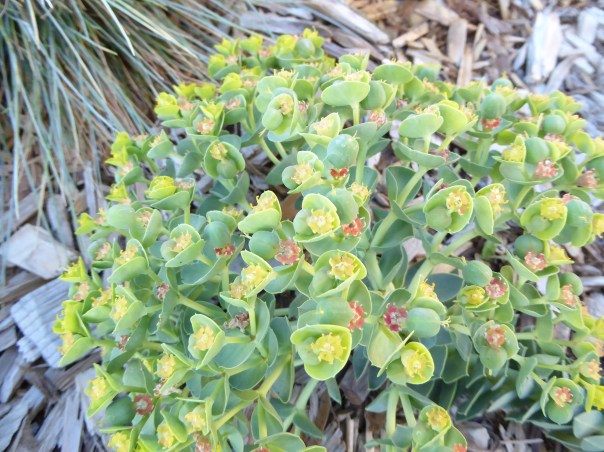
Even the tiny flowers of the Euphorbia myrsinites are swallowed up in their green leaves.
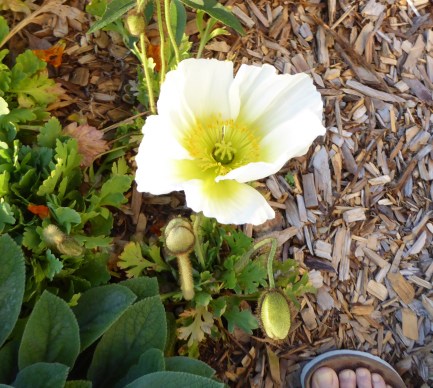
Nearly every day I fall in love again and try to capture another poppy with my camera.
This time my toes got in the picture. At least they are not green.

The whole order of things is as outrageous as any miracle
which could presume to violate it.

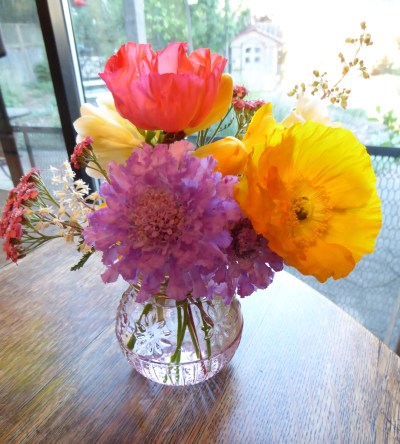
And below, I used a clever jar-vase that Mrs. Bread gave me for my birthday, and made a colorful bouquet that will give your eyes respite from green. It is like a little canning jar with a ring that screws on the top, but into the ring is set a florist’s frog, making it perfect for arranging odd little blooms with their often short stems that one finds in a garden like mine.

That’s my show-and-tell for today! How does your garden grow?

snowball bush